You sit down to write the report you have been putting off. A message blinks in Slack, you reply to it, then check your inbox while you are there, and by the time you return to the document the thread of the argument has gone. You reread the last paragraph twice before the words mean anything again. That small fog has a name, and it is more expensive than it looks.
Context switching is the mental cost of shifting your attention between tasks, tools or topics. Each switch forces your brain to set down one set of rules and pick up another, and that reload runs slower and costs more than almost anyone expects.
What is context switching?
Every task you do carries its own mental context: the goal, the vocabulary, the open files, the half-formed next step. When you move from writing a proposal to answering a client email, your brain has to swap all of that out and load a fresh set. The swap is invisible, so we tend to treat it as free. It is not.
The trouble is that knowledge work rewards the appearance of responsiveness. Reply fast, sit in every channel, keep every ball in the air. Underneath, each of those pivots taxes the same limited pool of attention, and the bill arrives as slower work, more mistakes and a strange end-of-day tiredness that has little to do with how much you actually finished.
There is a useful distinction to draw here. Some tasks are close cousins, like answering two emails in a row, and switching between them is cheap. Others sit far apart, like moving from deep analysis straight into a live sales call, and the jump is expensive. The wider the gap between contexts, the heavier the reload. A day that mixes many unlike tasks is far more draining than a day of similar ones, even when the raw hours are identical.
Psychologists separate two related costs. There is switch cost, the lag while your brain reconfigures for the new task. And there is attention residue, which is more insidious, and which we will come to shortly.
How much does a single interruption cost?
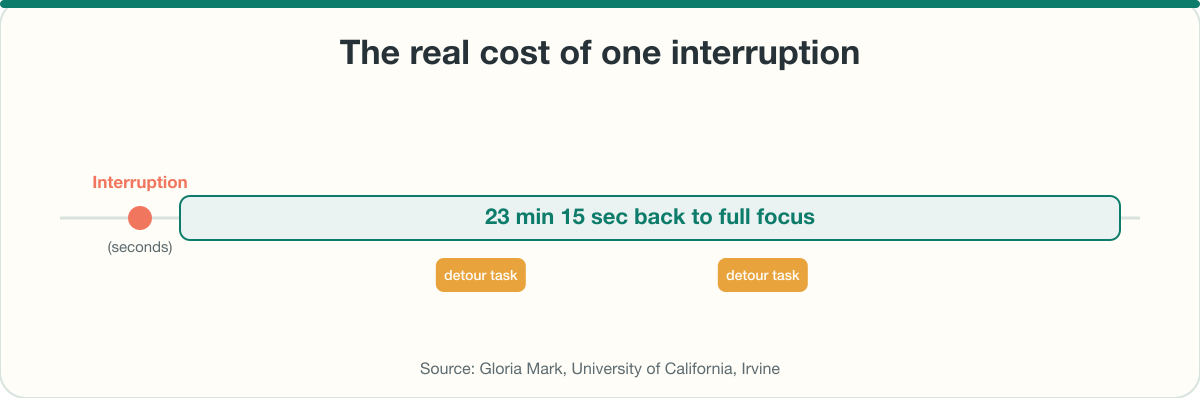 The most cited figure here comes from Gloria Mark, a professor at the University of California, Irvine, who has spent years observing how people actually work by shadowing them and logging every switch. Her research found that after an interruption it takes an average of 23 minutes and 15 seconds to return to the original task at the same level of focus.
Read that again. Not 23 seconds. Twenty-three minutes, to get back to where you were.
It gets worse. Mark's work also found that people do not return to the interrupted task straight away. On average they complete two other tasks in between before circling back to the original one. So a single "quick question" does not cost you the length of the question. It scatters your attention across a small detour of other work before you find your way home.
Stack a dozen of those into a normal day and the maths turns grim. The interruptions themselves might total half an hour. The recovery tax behind them can quietly eat the rest.
And not every interruption arrives from outside. A fair share are self-inflicted: the reflex to check email, the urge to glance at a phone the moment a task turns hard. Mark's observations captured both kinds, the external and the internal, and the recovery cost lands the same either way. Your brain does not care whether the ping came from a colleague or from your own restlessness.
What is attention residue?
The term attention residue was coined by Sophie Leroy, a researcher who published the idea in 2009. Her insight is deceptively simple: when you switch from one task to another, a part of your attention stays stuck on the first task, especially if you left it unfinished. You are physically working on task B, but a slice of your mind is still chewing on task A.
Residue is why the 23-minute figure feels so real in the body. You are not sitting idle for that time. You are working, but at reduced capacity, because your attention is split between what you are doing now and what you just left. Leroy's work suggests that finishing a task, or at least reaching a clear stopping point, leaves less residue than abandoning it mid-thought. That is a practical clue we will use later.
Why does modern knowledge work maximise switching?
If you set out to design a workplace that maximised context switching, you would struggle to improve on the average office setup. Consider the standing arrangements.
- Group chat that expects a reply in minutes, not hours.
- An inbox that refills faster than you can empty it.
- A calendar carved into 30-minute meetings with no gaps to think between them.
- Notifications from a dozen apps, each one a small hand on your shoulder.
- Open-plan floors where every conversation nearby is a potential interruption.
Sitting behind all of this is the multitasking myth: the belief that a capable professional handles several streams at once. The evidence points the other way. What feels like multitasking is really rapid switching, and every one of those switches carries the costs above. You are not doing three things at once. You are doing one thing badly, three times in a row.
The scale of the problem has grown. In her 2023 book Attention Span, Gloria Mark reported that average sustained attention on a screen has fallen to around 47 seconds, down from measurements of two to three minutes in the mid-2000s. Less than a minute of focus before the next switch. That is not a personal failing. It is the predictable result of tools built to interrupt.
| Switch trigger | What it feels like | The hidden tax |
|---|---|---|
| Slack or Teams ping | A two-second reply | Up to 23 minutes to refocus (Mark, UC Irvine) |
| Inbox check "while I'm here" | Staying on top of things | Attention residue on both tasks (Leroy, 2009) |
| Back-to-back meetings | A full, productive day | No deep block long enough to think |
| Constant notifications | Being responsive | Sustained attention down to ~47 seconds (Mark, 2023) |
How do you reduce context switching?
 You cannot delete interruptions, but you can shrink how many you invite and how much each one costs. A handful of habits do most of the work.
Monotasking. The plainest fix is to do one thing at a time and finish it, or reach a clean stopping point, before moving on. This is not a productivity gimmick; it directly targets attention residue. Our guide to monotasking walks through how to rebuild the habit when your brain has been trained to flit.
Work-Life Balance Jobs with Genuinely Reduced Hours
Save one to come back to it — it's free.



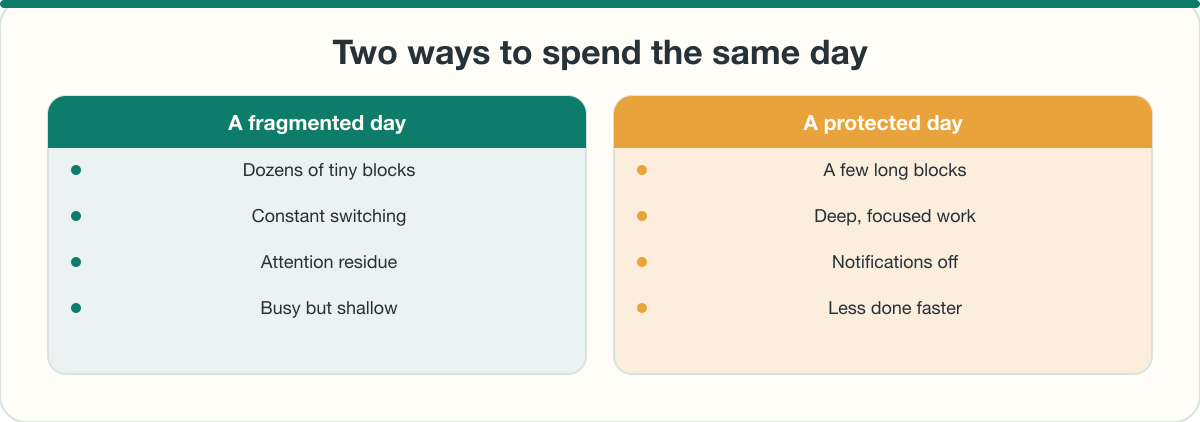
Time-blocking and deep-work blocks. Protect one or two blocks a day, 90 minutes or so, where you close the chat, silence the phone and work on a single hard thing. Guard them like meetings, because that is what they are: appointments with the work that actually matters.
Batching. Group similar tasks so your brain stays in one context. Answer email in two or three deliberate sessions rather than continuously. Do your admin in a block. Keep calls near each other so the rest of the day stays open.
Async over real-time. Not everything needs an answer this minute. A culture that defaults to written, asynchronous updates lets people reply when they surface from focus, rather than yanking them out of it. This is the same principle behind a results-only work environment, where output matters more than instant availability.
Notification hygiene. Turn off everything that is not a genuine emergency. Badges, banners, buzzes: default them to silent and check on your own schedule. The interruption you never receive costs you nothing.
Fewer meetings. Every meeting is a scheduled context switch for everyone in it, and video calls carry their own particular drain. If your days feel shredded by calls, our piece on Zoom fatigue explains why they tire you out and which ones to cut.
Is this your problem or your employer's?
Personal habits help, but context switching is mostly a systems problem. If the culture rewards instant replies, punishes slow ones and packs the calendar wall to wall, no amount of individual willpower survives contact with the working week.
The organisations that take this seriously change the defaults. They set core focus hours where meetings are off limits. They treat "reply within minutes" as the exception, not the norm. They measure people on what they produce, not how quickly they twitch to a notification. The result is fewer switches for everyone, and work that is both better and less exhausting.
This is where reduced-hours work quietly earns its keep. A four-day week removes a fifth of the working time, so a team cannot afford to fritter attention on performative busyness. It forces the honest question: what actually needs doing, and what is just switching for its own sake? Parkinson's Law, the idea that work expands to fill the time available, cuts both ways. Give the work less time and, protected from constant interruption, it often shrinks to fit. Companies that adopt shorter weeks tend to attack meetings and notifications first, precisely because protecting attention is the only way the maths works.
Focus, it turns out, is not a personality trait you either have or lack. It is a resource you can defend, and reduced-hours work is one of the few arrangements that makes defending it non-negotiable.
Frequently asked questions
Is context switching the same as multitasking? Close, but not identical. Multitasking is the attempt to do several things at once; context switching is the mental cost you pay each time you flip between them. Because true multitasking is mostly rapid switching in disguise, the two travel together. Every "multitask" is a stack of switches, each with its own tax.
Does the 23-minute figure mean I lose 23 minutes every time? Not exactly. Gloria Mark's research found it takes an average of 23 minutes and 15 seconds to return to the original task at full focus, and that people usually do two other tasks before returning. You are working in that window, just at reduced capacity because your attention is split. The loss is in quality and speed, not a literal blank 23 minutes.
Are some people just better at switching? People vary, but the research is blunt about the ceiling. The costs of switching and attention residue show up across the board. Feeling comfortable juggling tasks is not the same as performing well at them, and the confidence often outruns the results.
What is the single most effective change I can make? Protect one uninterrupted deep-work block a day and defend it like an appointment. Close the chat, silence notifications and work on one thing until you hit a clear stopping point. It attacks switch cost and attention residue at the same time, and it is entirely within your control.
Ready to find work that respects your attention instead of shredding it? Browse reduced-hours and four-day-week roles from companies that measure output, not busyness.
Protect your focus, and find a job that protects it too.




Get 4-day week jobs in your inbox
Create a free account to receive curated opportunities weekly.
Sign up for freeFree forever. No spam, unsubscribe anytime.