
Not everyone wants their whole working life to run through a single employer. Some people would rather assemble it themselves, from several kinds of work they actually enjoy. That is the idea behind a portfolio career, and it is more achievable now than it has ever been.
A portfolio career means building your income from several strands at once, such as part-time roles, freelance or consulting work, a fractional role, teaching or a small side business, rather than relying on one full-time job. The mix is the point.
What is a portfolio career?
The term comes from the management thinker Charles Handy, who described "portfolio work" and the "portfolio worker" in his 1989 book The Age of Unreason. Handy pictured a future in which fewer people would spend their lives inside one organisation, and more would sell their skills to several clients and causes at once, arranging their work like a portfolio of investments.
Decades later that future is ordinary. A portfolio careerist might spend two days a week as a part-time marketing manager, one day consulting for a startup, and the rest writing, teaching a course or running a small product on the side. Another might combine a fractional leadership role with freelance projects and a seat on an advisory board. The specific mix varies enormously. What they share is the structure: several income strands held at the same time, on purpose.
The crucial word is "on purpose". A portfolio career is a deliberate design, not an accident of taking whatever work turns up. You decide how the strands fit together, how much each should earn and how much of your week each deserves, then adjust the balance as your life and interests change.
Handy's insight was that steady, single-employer careers were becoming less common, and that treating your own skills as a set of assets to be deployed in different places would become a normal way to work rather than an unusual one. He turned out to be right.
What a portfolio career is not
It helps to clear up what the term does not mean, because it gets stretched.
A portfolio career is not simply a side hustle. A side hustle is usually one extra thing bolted onto a full-time job for a bit of additional income. A portfolio career replaces the single full-time job with a balanced set of strands, each a real part of how you earn.
It is not necessarily gig work either. Gig work tends to mean low-paid, on-demand tasks with little control. A portfolio career is more often built on skilled, well-paid work where you choose the clients and set the terms. Some strands might be casual, but the model is about control, not precarity.
And it is not the same as quietly working two full-time jobs at once. That is a different, more stressful arrangement with its own pros and cons. A portfolio career is designed so the strands add up to a sensible total, usually with more freedom than a single full-time job, not less.
Why do people build a portfolio career?
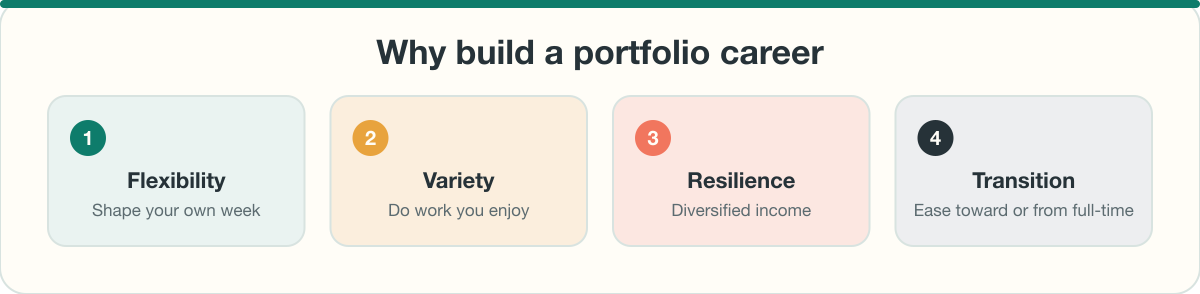 The reasons people give tend to fall into a few clear groups.
Flexibility and autonomy come up most. When you hold several strands, you shape your own week and decide which work to accept, which to decline and when to take time off. You answer to clients rather than to one boss who owns all of your hours.
Variety is a close second. Doing several different kinds of work keeps the days interesting and stretches you in ways a single narrow role rarely does. Skills from one strand feed another, and boredom is far less likely.
Resilience matters too. Diversifying your income across several clients can feel steadier than depending on one employer who could restructure or make you redundant. If one strand falls away, the others keep you going while you replace it.
Portfolio careers also work well as a transition. People use them to ease toward retirement by scaling down gradually, to test a new field alongside familiar work, or to step back from full-time hours while children are young without leaving working life altogether. The model bends to fit the season you are in.
What are the honest downsides?
A portfolio career is not a free lunch, and it is worth being straight about the harder parts.
Income can be irregular. Strands start, stop and overlap, so months rarely look identical, and the early stage before your mix is stable can feel wobbly. You need a financial buffer and a habit of not over-spending in the good months.
You lose a single employer's safety net. There is no paid holiday, sick pay, pension contribution or health cover arriving automatically. You arrange and fund all of it yourself, which means pricing it into what you charge.
The admin is real. Invoicing, contracts, tax and record-keeping all land on you, across several clients rather than one. Self-discipline becomes a core skill, because nobody sets your schedule or chases your deadlines but you.
And the boundaries can blur. With several clients and no fixed office hours, work can leak into every evening if you let it. Managing that is a genuine skill, and getting it wrong turns a flexible life into a permanently busy one.
How does a portfolio career compare with a full-time job?
Neither model is better in the abstract. They suit different people and different phases of life. This table lays out the honest trade-offs.
| Feature | Portfolio career | Single full-time job |
|---|---|---|
| Income sources | Several strands | One employer |
| Schedule control | High, you set it | Low to moderate |
| Income stability | Variable, self-managed | Steady and predictable |
| Benefits | Self-arranged | Employer-provided |
| Variety of work | High | Usually narrow |
| Admin burden | On you | Handled by employer |
| Resilience if one source ends | Other strands remain | Full income at risk |
| Best for | Autonomy and variety | Security and simplicity |
Read the table honestly and the choice becomes clearer. If you value predictability and want someone else to handle the admin, a full-time job is hard to beat. If you value control and variety enough to manage the extra responsibility, the portfolio model gives you something a single job cannot.
Work-Life Balance Jobs with Genuinely Reduced Hours
Save one to come back to it — it's free.



How do you build a portfolio career?
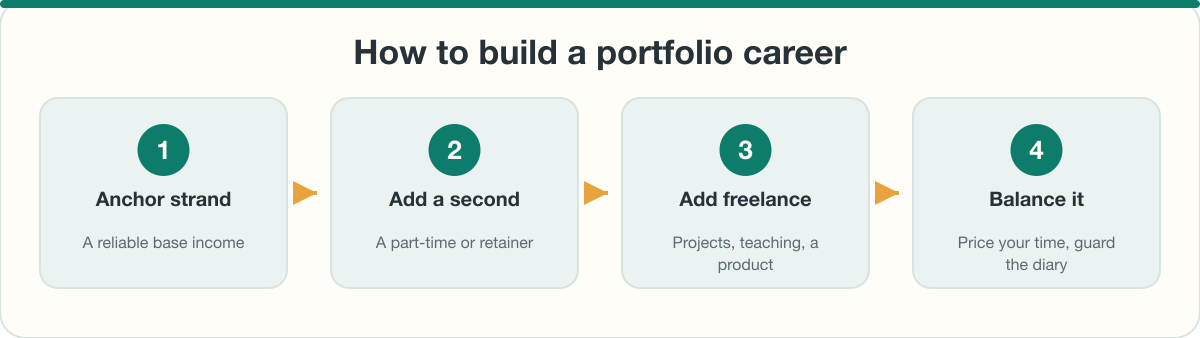 You do not build a portfolio career overnight, and you should not try. The people who do it well tend to add strands gradually.
Start with an anchor. One reliable strand, often a part-time role or a steady client, that covers a meaningful share of your income gives you a stable base to build on. It takes the pressure off while you develop the rest. Part-time and reduced-hours roles make excellent anchors, and there are more of them than most people realise, so it is worth browsing flexible part-time work as a starting point.
Add strands one at a time. Once the anchor is steady, layer on a second strand, perhaps freelance projects or a fractional role, then a third once that beds in. Adding slowly lets you learn what you enjoy and what actually pays, without betting everything at once. Running two complementary part-time roles is a common early shape, and there are real benefits to holding two part-time jobs done deliberately.
Price your time properly. Each strand has to cover the holiday, pension and downtime an employer used to fund, so your rates need to reflect that, not just match an old salary divided by working days. Undercharging is the most common early mistake.
Manage the schedule and the boundaries. Block your week so each strand gets its fair share, keep some time genuinely free, and be willing to say no when a new opportunity would tip you into overload. The whole advantage of the model is control, and you only keep it by defending your calendar.
Keep a buffer and keep marketing. A few months of savings smooths the lumpy months, and staying visible in your fields keeps new strands coming when old ones end.
Who does a portfolio career suit?
A portfolio career suits people with a marketable skill and enough experience that clients will pay for it directly. It rewards self-starters who can manage their own time, sell their work and cope with a bit of uncertainty in exchange for a lot of freedom.
It fits people at particular life stages especially well: parents who want to work around family, experienced professionals easing toward retirement, and anyone recovering from burnout who wants working life on gentler terms. It also suits the naturally curious, the people who would rather do three different things than one thing for forty years.
It is a harder fit if you strongly prefer security, dislike admin and selling, or want a clear boss and a fixed routine. There is no shame in that. A single good job with room to breathe suits plenty of people better, and the point is to choose deliberately rather than drift.
Frequently asked questions
Is a portfolio career the same as freelancing? Not quite. Freelancing is usually one type of work, selling your services to clients, and it can be a strand within a portfolio career. A portfolio career is broader, mixing freelance work with part-time roles, fractional positions, teaching or a side business, so the whole is more varied than freelancing alone.
How many income strands should a portfolio career have? There is no fixed number. Many people run between two and four strands, enough for variety and resilience without becoming impossible to manage. The right count is whatever fills your week to the level you want while leaving you in control of your time.
Can you earn as much in a portfolio career as in a full-time job? You can, and some people earn more, because skilled strands priced properly add up. Income is less predictable, though, and the early stage while you build your mix is often leaner. A financial buffer helps you ride out the uneven months.
How do I start a portfolio career while employed? Most people begin by adding one strand alongside their job, such as a small freelance or consulting client, then reduce their employed hours as that strand grows. Moving to a part-time or flexible role first can give you the time and the stable anchor to build the rest around.
A portfolio career is one of the clearest routes to a reduced-hours working life on your own terms, built from work you choose rather than a single job that owns your week. If that appeals, browse flexible and reduced-hours roles on 4dayweek.io to find an anchor strand to start from.
Want to design work around your life? Explore flexible, part-time and reduced-hours jobs and build a career on your terms.




Get 4-day week jobs in your inbox
Create a free account to receive curated opportunities weekly.
Sign up for freeFree forever. No spam, unsubscribe anytime.