
Changing careers successfully takes more than a polished resume. It takes a plan — a clear, actionable roadmap that starts with honest self-reflection and ends with you in a role that genuinely fits your life. The process rests on three things: deep self-assessment, strategic skill mapping, and a focused job search. Done well, your next move isn't just another job. It's a real step toward long-term fulfilment and a healthier balance between work and the rest of your life.
A Blueprint for a Successful Career Change
The idea of a single "career for life" is largely a relic. Today, professionals expect more than a paycheck — they want work that fits their values and integrates with their lives. That shift shows up in the data: in Gallup's Q4 2025 workforce polling, 51% of US employees said they were either actively job-hunting or watching for opportunities. People aren't just hopping between gigs; many are making intentional pivots toward roles that match their lifestyle goals.
Why a Structured Approach Matters
Starting a job search without a roadmap is like building a house without a blueprint. You'll waste time and energy, and probably end up somewhere you don't want to be. A structured approach turns chaos into clarity.
Here's the core strategy at a glance — we'll dig into each phase below.
| Phase | Key action | Primary goal |
|---|---|---|
| Foundation | Deep self-reflection to define your values, non-negotiables, and motivators | Get clarity on what you genuinely want from your next career |
| Strategy & mapping | Map your transferable skills and identify the gaps | Build a bridge between where you are and where you want to be |
| Execution | Run a targeted search focused on aligned roles and companies | Land a role that fits your new criteria — especially on work-life balance |
This isn't about rigid rules. It's about moving with intention, so every step is a deliberate move toward a career that fits.
A thoughtful career change is a deliberate investment in your future well-being. The goal isn't just a new job — it's a more fulfilling professional life that supports your personal goals.
A big part of the process is learning to reframe your experience: telling a new story that connects past wins to future ambitions. That skill is essential when you update your application materials — our guide on how to prepare your resume for remote work covers tactics that apply directly to anyone making a career change. And if you're not sure what type of role to target, the 10 best jobs for career changers is a useful starting point.
Discovering Your Strengths and Mapping Your Skills

Before you can chart a course somewhere new, you have to know your exact starting point. A real career change begins with an honest self-assessment — not a glance at your resume, but a full inventory of what you bring.
Think about your current and past roles. Which parts of the day genuinely energised you? Which tasks did you dread? The answers point to your non-negotiables — the core values that have to be met for work to feel right.
Pinpoint Your Core Values and Motivators
Your values are your career compass. They shape what kind of environment will actually suit you. Do you crave autonomy and creative latitude, or does a tight-knit, collaborative team suit you better? Does social impact matter more than a top-of-market salary?
A quick exercise to make this concrete:
- List your top five work-related values — stability, creativity, leadership, work-life balance, continuous learning, and so on.
- Rank them by importance. Be honest about what you genuinely can't compromise on.
- Hold your current role up against the list. The gaps are powerful clues about what to look for next.
This is a strategic filter, not a feel-good exercise. Knowing what truly motivates you stops you chasing shiny job titles that leave you just as unfulfilled as before.
Uncover Your Transferable Skills
One of the biggest mistakes career changers make is underestimating the skills they already have. Your professional value isn't tied to a job title — it's rooted in your abilities. Those transferable skills are assets you've built over years, and they can give you a real edge in a new field.
Take a high-school teacher who wants to become a corporate trainer. The two jobs look worlds apart — until you look at the underlying skills:
- Curriculum development. Designing lesson plans is fundamentally the same skill as building training modules for new hires.
- Public speaking. Holding a room of teenagers builds exceptional presentation and communication skills.
- Stakeholder management. Regularly briefing parents and administrators is direct experience in managing expectations and reporting progress.
- Conflict resolution. Mediating student disputes is a masterclass in de-escalation and creative problem-solving.
This is the key to a successful change: learn to reframe your experience, translating what you did into the language of the industry you want to join. It shows hiring managers that while your context was different, your capabilities are directly relevant. A strong career change resume is the tool that brings this reframing to life.
Use Data to Map Your Skill Gaps
Once you have a solid list of transferable skills, compare it against the real requirements of your target career. A data-driven approach beats guessing.
Analyse five to ten job descriptions for roles that excite you. Use a simple spreadsheet to track the skills and qualifications that show up most often.
| Skill category | Keywords from job descriptions | Your experience |
|---|---|---|
| Project management | Agile, Scrum, JIRA, timeline management, budget oversight | Led a 3-person team to launch an annual fundraising campaign |
| Data analysis | SQL, Tableau, data visualisation, reporting | Tracked and analysed donor data using Excel pivot tables |
| Communication | Content creation, public speaking, stakeholder presentations | Wrote weekly newsletters; presented results at board meetings |
This gives you a clear, objective roadmap. You can see instantly where you're strong (communication) and where you need to build (SQL, Tableau). A vague goal becomes an actionable plan.
Many technical roles also lean heavily on soft skills, which are highly transferable. Our guide on the essential soft skills of an engineer shows just how well your existing abilities might apply.
The goal isn't to find a career where you start from zero. It's to find one where your existing strengths give you a head start — and the skills you still need are both achievable and genuinely interesting to learn.
Building New Skills and a Standout Portfolio

With a clear map of your skill gaps, it's time to act. This isn't about going back to school for four years — it's about smart, targeted learning to get you job-ready as efficiently as possible.
Treat it as an investment, and aim for the highest return. That means choosing courses and certifications employers in your target field actually recognise. The best programmes are project-based, giving you raw material for your portfolio.
Choose Your Learning Path
Most online learning falls into a few buckets. The right one depends on your budget, timeline, and how you learn best.
- Online courses (Coursera, Udemy, and similar). Strong for picking up a specific technical skill — a programming language, a software tool. Affordable and flexible, but they demand self-discipline.
- Certifications. An official credential from an industry leader like Google or AWS adds instant credibility. Recruiters recognise and respect these.
- Bootcamps. For a full career overhaul, an intensive bootcamp is hard to beat — a bigger investment, but you get a structured curriculum, career support, and a peer network.
Match your choice to the gaps you identified. If you just need SQL, a focused online course is fine. If you're jumping from marketing into UX design, an immersive bootcamp will likely get you there faster.
Your Portfolio Is Your Proof
A resume tells people what you've done. A portfolio shows them what you can do. For a career changer, it isn't optional — it's your most powerful answer to the "no direct experience" objection.
Your portfolio answers the hiring manager's biggest question: "Can you actually deliver?" It turns you from someone who wants to be in a new field into someone already contributing to it.
The trick is to build projects that look and feel like the real work you'll be doing. Go beyond course assignments. Find a problem that genuinely interests you and solve it with your new skills — that shows passion, initiative, and the ability to think for yourself.
A strong portfolio matters more than ever, because the easy wins of job-hopping have cooled. The pay premium for switching jobs has all but vanished: by mid-2025, the Atlanta Fed's wage data showed job switchers earning raises roughly in line with — and at times below — those who stayed put, the first sustained reversal since around 2010. In a market where employers are cautious, demonstrable proof that you can do the work is worth far more than a confident claim.
From Theory to Tangible Projects
Building a portfolio without a relevant job title is entirely doable — you just need to be creative and proactive. Find a problem; solve it with the skills you want to showcase.
A couple of real-world examples:
Retail manager to data analyst. Find a publicly available sales dataset for a well-known retail brand. Use Python or R to clean it, identify trends across regions, and build clear visualisations in Tableau. What it shows: you can handle messy data, pull out insights, and communicate them — you're already thinking like an analyst. Starting from scratch? Our guide on how to become a self-taught data scientist lays out a full roadmap.
Marketing coordinator to UX writer. Pick an app you use daily and run a "microcopy audit." Find spots where button text, error messages, or onboarding tips are confusing, and rewrite them to be clearer, tighter, and on-brand. What it shows: a sharp eye for user experience and an instinct for clear communication.
Projects like these do more than fill a page. They prove commitment — that you're not waiting for permission, you're already creating your own experience.
Tell Your Story and Network With Purpose
You've built the portfolio and sharpened your skills. Now it's time to turn that effort into documents that open doors. Your resume and cover letter aren't dry historical records — they're marketing tools, built to tell a compelling story about where you're headed.
For a career changer, that story is everything. A standard chronological resume can work against you, because it foregrounds a path that looks disconnected from the roles you want now. To get noticed, reframe the narrative — connect what you've done to what you're aiming for.
Crafting Your Career-Change Narrative
Your job is to build a bridge between your old career and your new one. Instead of listing job duties from a decade ago, frame your accomplishments through the lens of your target role — emphasising transferable skills and putting your portfolio projects front and centre.
Hiring managers spend only seconds scanning each resume. Make it immediately obvious why someone with your background is a strong — and maybe more interesting — fit for the team.
A powerful summary at the top does a lot of work. Treat it as a thirty-second pitch:
"Former project manager with 8+ years leading cross-functional teams to deliver complex projects on time. Recently completed a UX design bootcamp and built a portfolio of user-centred projects. Eager to apply proven leadership and strategic planning to creating intuitive digital experiences."
That doesn't hide the career change — it frames it as a deliberate evolution. A story of growth and intent is far more compelling than a list of old jobs.
Tools Can Speed Up Tailoring
Work-Life Balance Jobs with Genuinely Reduced Hours
Save one to come back to it — it's free.

Manually tailoring your resume for every application is draining. Modern tools can help: AI-assisted resume builders scan a job description and suggest ways to rephrase your experience so it matches the role's keywords and requirements. That's genuinely useful for getting past automated screening systems and in front of a real person. Use them as a drafting aid — the underlying story still has to be yours, and accurate.
Networking With Authenticity
A strong resume gets you in the door. Your network often finds the door for you. The "hidden job market" stat is frequently exaggerated, but the underlying point holds: in MyPerfectResume's 2025 survey, 54% of workers said they landed a job through a personal or professional connection. For career changers, those connections are gold — they can route you around the crowded standard application process.
Networking shouldn't feel transactional, though. The real goal is building genuine relationships and gathering information, not cornering people for a job. Informational interviews are one of the best ways to do it.
- Informational interviews. Casual conversations with people already in your target field. You're not asking for a job — you're asking for their story. Most people enjoy talking about their work and are glad to advise someone who's genuinely curious.
- Build a support system. Find other career changers. Join online communities, local meetups, or industry Slack channels. Peers who get it offer both emotional support and practical leads.
When you do connect with someone, come prepared. Have specific questions ready about their role, the company culture, and the skills they value most. That preparation is a big part of what sets you apart from other candidates.
A story-driven resume plus a network of supportive contacts is a strong combination. The resume gets you in the door; the network helps you find which doors to knock on.
Landing the Job: The Search, the Pitch, the Interview
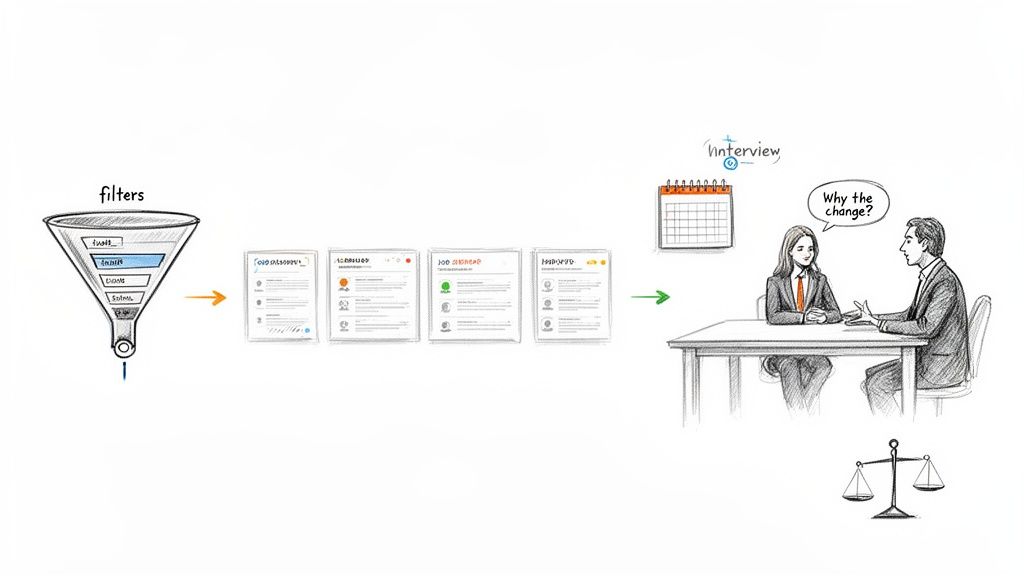
You've done the hard work — a solid portfolio and a clear story. Now it's time to turn preparation into interviews, and ideally an offer that fits your life.
The modern job search isn't a numbers game; it's about precision. Your goal is to find companies that value exactly what you bring — including your desire for a healthier balance between work and life. Better pay is a common motivator, but the most fulfilling career changes are usually driven by a deeper need for a sustainable lifestyle.
Finding Roles That Fit Your New Life
A targeted search saves enormous time and energy. Instead of spraying your resume across the internet, focus on the platforms and filters that match what you're after.
If a four-day week is a dealbreaker, a specialised job board isn't just convenient — it's essential. On a board built around reduced-hours work, you can filter 4-day-week jobs by the exact schedule you want, not just by job title, and connect directly with employers who already operate that way.
- Filter precisely. Look for the specific schedule that suits you — four 8-hour days, a 9-day fortnight, half-day Fridays.
- Do your homework. Dig into culture. Do they just talk about work-life balance, or do they live it? Browse companies with reduced-hours policies and look for proof.
- Set up alerts. Create alerts for your target roles so you're among the first to apply when the right fit appears.
Every application then goes to a company that's already on the same page — which meaningfully improves your odds of landing somewhere you'll want to stay. Once you have an offer, our guide on how to accept a job offer for a four-day workweek walks you through what to confirm before you sign.
Answering the "Why the Change?" Question
As a career changer, you're almost guaranteed to hear it: "So, why the career change?" Your answer can be the deciding factor. A fumbled response makes you look uncertain; a confident one makes the pivot look like a strategic advantage.
The key is to frame the transition as a move toward something better, not an escape from a job you hated. Keep it short, positive, and connected — past experience to future goals.
Treat your career change as a deliberate journey of growth. Show that you analysed your skills, found a direction you're passionate about, and took real steps to get there. That demonstrates self-awareness, drive, and strategic thinking — three things hiring managers look for.
A simple framework for the answer:
- Start with your past. Briefly name your old career and a key skill you genuinely enjoyed.
- Share the turning point. What sparked your interest in the new field — a side project, a collaboration, a realisation?
- Show your work. Name the concrete steps: the course you finished, the portfolio you built, the skills you developed.
- Bring it home. Connect it back to their company and this role. Explain why this is the right place to blend your old and new skills.
A structured response turns a potential red flag into a story of ambition and purpose — and shows that an unconventional background is an asset, not a weakness.
Common Career-Change Questions
Pivoting your professional life raises real questions. Here are the ones that come up most.
How Long Does It Really Take?
There's no magic number — it depends on the gap between where you are and where you're going. A small jump, like moving from marketing analytics into product marketing, might take three to six months of focused work: same ballpark, different position. A full overhaul — hospitality manager to software engineer — could realistically take one to two years. You're not just learning a new job; you're learning a new way of thinking.
It helps to break the timeline into phases:
- Discovery and research (1–2 months). Self-reflection and deep research into what you genuinely want to do.
- Skilling up and portfolio building (3–12 months). The heavy lifting. Duration depends on how much you need to learn.
- The job hunt (2–4 months). Applying, networking, and interviewing in earnest.
A niche job board can speed the last phase up — searching by schedule connects you straight to companies that already value flexibility, which cuts through a lot of noise.
Is Taking a Pay Cut a Terrible Idea?
Not always — sometimes it's the smartest move available. A short-term pay cut can be a strategic investment in long-term happiness and earning potential. Look at the total compensation package, not just the base salary.
A role with a slightly lower salary but a four-day workweek can offset the difference through lower childcare and commuting costs — and the harder-to-price cost of burnout. The goal isn't simply to earn more; it's to build a sustainable, fulfilling life.
Before you sign anything, calculate your new effective hourly rate. A 32-hour week at a slightly lower salary can mean you're actually earning more per hour worked — and you get a full day of your week back. Our guide on how to calculate your hourly rate from a salary makes this straightforward.
Can I Change Careers With No "Relevant" Experience?
Yes — if you're smart about it. "Relevant experience" is more than a job title. Become a master at identifying your transferable skills: communication, leadership, and problem-solving are valuable everywhere.
This is where a strong portfolio becomes essential. Fill it with personal projects, freelance work, or volunteer work that proves you can do the job — tangible evidence beats a claim every time.
Networking matters here too. A referral from a real person can carry your resume past automated filters that might otherwise discard it for missing a keyword. "Bridge" roles — positions that sit between your old field and your target one — are another way to get a foot in the door.
The throughline of every successful career change is the same: prove your capability through action rather than asserting it. Design the next chapter around the life you actually want — and let the work itself, not just your job title, make the case for you.




Get 4-day week jobs in your inbox
Create a free account to receive curated opportunities weekly.
Sign up for freeFree forever. No spam, unsubscribe anytime.