
Working out your hourly rate from an annual salary looks simple on the surface: divide your yearly salary by the total hours you work in a year. For a standard full-time role, that divisor is 2,080 hours — 40 hours a week multiplied by 52 weeks. HR and payroll teams use 2,080 as the default divisor because it keeps budgeting and pay calculations clean.
But the basic arithmetic is only a starting point. Knowing how to convert salary to an hourly rate properly helps you budget, compare job offers honestly, and decide whether a contract gig is actually worth your time. The figure only tells the truth when you use the right number of hours — and that is where non-traditional schedules change everything.

Why the standard formula is only a baseline
The 2,080-hour rule assumes a 40-hour week. Plenty of jobs no longer work that way, and the divisor you choose can swing your effective hourly rate by 20% or more.
Take the four-day week. If you are paid the same salary for a 32-hour schedule, you are working far fewer hours over the year — so your effective hourly rate is meaningfully higher for identical pay.
Here is a common scenario. Say you earn a $60,000 annual salary:
- Traditional 40-hour week: $60,000 ÷ 2,080 hours = $28.85 per hour
- Four-day, 32-hour week: $60,000 ÷ 1,664 hours (32 × 52) = $36.06 per hour
Same salary, but the shorter week lifts your effective rate by roughly 25%. That difference matters when you are comparing roles on a job board and trying to compare like with like.
This isn't just a maths exercise. A higher effective hourly rate from a shorter week is real leverage when negotiating a salary offer — and a genuine win for your time outside work.
If you are heading into a pay conversation, it pays to prepare. Our salary negotiation email template is a practical place to start.
Calculating for non-traditional schedules
The 40-hour week is no longer the only model. As more companies adopt compressed and reduced-hours schedules, you need to translate salary into an hourly rate that reflects how you actually work. The 2,080-hour figure simply does not fit everyone. The 2,080-hour figure simply does not fit everyone.
A compressed work week or a true four-day schedule changes the divisor — and a smaller divisor lifts your effective hourly pay even when the annual salary is unchanged.
A worked four-day-week example
Say you have been offered a job with an $80,000 annual salary:
- Traditional 40-hour week: $80,000 ÷ 2,080 hours = $38.46 per hour
- Four-day, 32-hour week: $80,000 ÷ 1,664 hours = $48.08 per hour
That is a roughly 25% jump in hourly rate for the exact same salary. It is the clearest reason to look past the annual headline number and understand the hours behind it — especially when you are targeting high-paying jobs with flexible hours that promise a better work-life balance.
The real value of a four-day week is not only the extra day off. It is the higher worth placed on each hour you do work.
Adjusting for different pay frequencies
How often you get paid trips a lot of people up. Whether you are paid weekly, bi-weekly, or semi-monthly, the final hourly figure does not change — but you have to annualise your pay correctly first.
A quick guide to annualising:
- Weekly pay: multiply gross pay by 52
- Bi-weekly pay (every two weeks): multiply gross pay by 26
- Semi-monthly pay (twice a month): multiply gross pay by 24
So a bi-weekly paycheck of $3,077 annualises to roughly $80,000 (3,077 × 26). From there, divide by your total annual hours — 2,080 for a 40-hour week, 1,664 for a 32-hour week — to land on your true hourly rate. The two-step process keeps you working from the right base number.
What your hourly rate does not include
Once you have run the numbers, remember what the figure actually is: your gross pay. It is the number before taxes, insurance, and other deductions — not what lands in your bank account.
Think of it like the sticker price on a car. It looks good on paper, but it ignores the costs that come up later. Your gross hourly wage is one piece of a larger financial picture.
Benefits: the part that never shows up in the rate
A large share of your real compensation never arrives as cash — it comes as benefits. According to the U.S. Bureau of Labor Statistics, benefits made up about 30% of total employer compensation costs for private-industry workers, with wages and salaries accounting for the other roughly 70%. Compare two offers on hourly rate alone and you could be ignoring nearly a third of the package.
The big ones to weigh:
- Health insurance: employer contributions to medical, dental, and vision plans are a substantial financial benefit.
- Retirement plans: an employer 401(k) match is effectively free money that compounds over decades.
- Paid time off: every vacation day, sick day, and holiday is part of your earnings even when you are off the clock.
- Other perks: life insurance, disability cover, professional-development budgets, and wellness stipends all add real value.
This chart shows how much your schedule alone shifts your hourly value — before any benefits enter the picture.
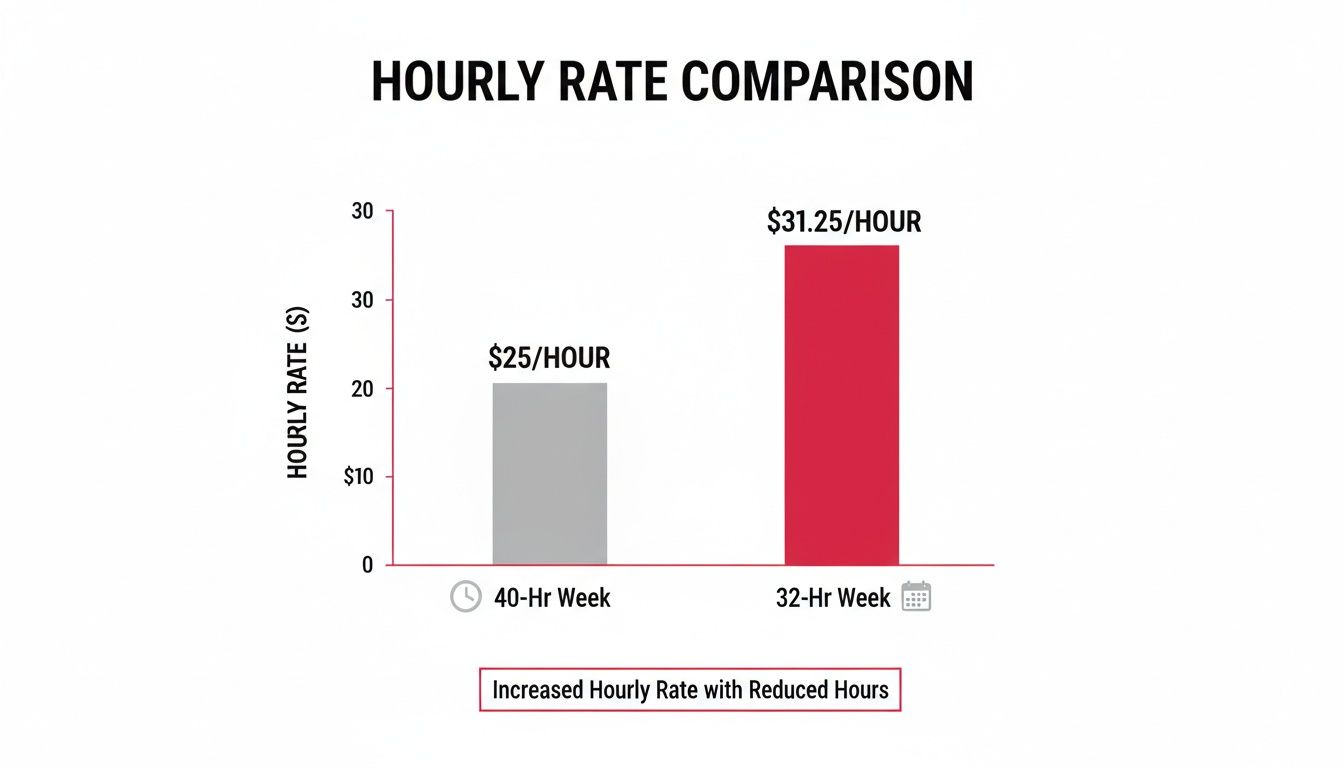
Moving from a 40-hour week to a 32-hour one at the same salary gives your hourly rate a clear lift.
Taxes and deductions
Your gross pay also takes a hit from mandatory deductions before it reaches you — the classic gap between gross pay (what you earn) and net pay (what you take home).
Taxes are the biggest deduction: federal, state, and sometimes local income tax, plus Social Security and Medicare (FICA). The exact amount depends on your income, location, and filing status. Overtime pay is generally taxed alongside your regular income.
It is easy to fixate on a big annual salary. But a slightly lower-paying job with strong, low-cost health insurance can leave more money in your pocket than a higher-paying one with thin benefits.
To dig into how benefits connect to your hours, see our guide on how many hours you need to work to get health insurance. The bottom line: judge the whole package, not the rate.
How location changes the picture
Work-Life Balance Jobs with Genuinely Reduced Hours
Save one to come back to it — it's free.

Where you work plays a major role in what your salary — and your hourly rate — looks like. With remote work now mainstream, that matters more than ever. The same job title can carry very different pay depending on country, currency, and local cost of living.
This is not just a currency-conversion exercise. Local productivity, mandatory social-security contributions, and the real cost of living all feed into what employers can and will pay. It is why a software engineer in San Francisco has a different salary expectation from one in Lisbon, even with an identical skillset.
International pay scales
The gaps are wide even inside a single economic bloc. According to Eurostat, average hourly labour costs across the EU were €33.5 in 2024 — but that average hides an enormous spread. At the top sit countries like Luxembourg (€55.2) and Denmark (€50.1); at the other end, Bulgaria (€10.6) and Romania (€12.5).
For anyone weighing remote roles across borders, that range is the whole story. The same job, costed at the EU average versus the Luxembourg rate, can differ by more than half — a stark reminder of how much geography moves the needle.
Putting it together
Knowing these scales helps you set realistic expectations. Before applying for a role abroad, research the typical salary range for your position in that specific country or region — do not simply convert your current salary and call it done.
That knowledge gives you the leverage to negotiate a fair package, one that reflects both what you bring and the economic reality of where your employer is based. For a deeper dive, see our comparison of software engineering salaries in Europe versus the United States.
Common mistakes to avoid
It is easy to slip up converting salary to an hourly rate, and a small error can paint a misleading picture of what you earn.
The most common mix-up is confusing gross pay with net pay. The maths here gives you the gross hourly rate — the figure before taxes, insurance, and deductions. Your take-home will always be lower.
Another easy miss is unpaid leave. If you take a stretch of unpaid time off during the year, your total hours worked fall, which actually raises your effective hourly rate for the time you were working.
Freelancer versus salaried-employee maths
This one matters. You cannot use the same maths for a freelance rate as for a salaried employee's hourly wage — the two numbers tell different stories.
A contractor's hourly rate has to cover far more than their time:
- Self-employment taxes: they pay both the employee and employer portions of Social Security and Medicare.
- Benefits: health insurance, retirement savings, and paid time off all come straight out of their own pocket.
- Business expenses: software subscriptions, equipment, and the other running costs of a one-person business.
- Unpaid time: admin, finding clients, sick days, and holidays — none of it billable.
A salaried employee's hourly rate is simply their wage. A freelancer's rate is their wage plus the overhead of running a business — which is why a contractor with your skills might need to charge well over double your equivalent rate just to come out even.
For software engineers, precision here is especially valuable during pay talks. Sharpen your approach with our guide on how to negotiate a software engineer's salary.
Frequently asked questions
Will I get taxed more on overtime pay?
No — overtime is not hit with a special, higher tax rate. What happens is that your overtime earnings are added to your regular wages for that pay period, which can temporarily push some of your income into a higher tax bracket. But U.S. tax brackets are marginal: only the dollars that fall into the higher bracket are taxed at the higher rate, not your whole paycheck. You always take home more for working more — you simply keep a slightly smaller share of those extra dollars once you cross a threshold.
How does my rate compare to what a freelancer charges?
It is close to comparing apples and oranges. A freelancer charges a higher rate because that single number has to cover self-employment taxes, benefits, unpaid admin and marketing time, and business expenses — none of which a salaried employee pays directly. So if your effective rate is $35/hour, a freelancer with your skills might need to charge $70/hour or more just to break even.
What is the difference between "exempt" and "non-exempt"?
These terms, defined by the Fair Labor Standards Act (FLSA), determine who is entitled to overtime pay. Non-exempt employees are legally entitled to overtime — typically 1.5 times their regular hourly rate for hours worked over 40 in a week. Exempt employees are not; these are usually salaried workers in roles classed as executive, administrative, or professional, whose salary is meant to cover all their work regardless of hours.
Getting your hourly rate right is the first step toward better financial planning and smarter career moves. Run the calculation with the correct number of hours, factor in benefits and taxes, and you will know what your time is genuinely worth — whether you are budgeting, comparing offers, or making the case for a four-day week.




Get 4-day week jobs in your inbox
Create a free account to receive curated opportunities weekly.
Sign up for freeFree forever. No spam, unsubscribe anytime.