
When you are writing a resume for a career change, the mission is simple: reframe your past experience through the lens of the role you want next. Forget the chronological list of duties. A career-change resume has to tell a story — one that spotlights the transferable skills and measurable achievements that matter to your future field, not your former one.
Rethinking Your Resume for a Career Pivot

Here is the honest truth: when you are changing careers, your old resume is your biggest liability. A standard reverse-chronological format works fine when you are climbing a predictable ladder, but it falls flat during a pivot. It draws attention to job titles that no longer fit and buries the skills that could actually land you the interview.
The mindset shift is everything. You are no longer documenting your work history — you are building a strategic marketing document designed to sell your potential. That means dropping the passive list of responsibilities and building a narrative that connects your background directly to what the employer needs.
Here is how the two approaches differ.
Traditional Resume vs Career-Change Resume
| Element | Traditional Resume Approach | Career-Change Resume Strategy |
|---|---|---|
| Opening Summary | A generic objective statement or a summary of past roles. | A forward-looking pitch that declares the new career goal and highlights key transferable skills. |
| Experience Section | A chronological list of jobs focused on duties and responsibilities. | Prioritises achievements and results, quantifying impact with metrics relevant to the new field. |
| Skills Emphasis | Skills listed in a separate, often-overlooked section. | Transferable skills woven through the summary and experience sections as the core narrative. |
| Overall Goal | To show a clear, linear progression within one industry. | To bridge the gap between past experience and future aspirations, proving potential and adaptability. |
You are not just updating your resume — you are rebuilding it with a new purpose.
The Foundation of Your New Resume
Do not fall into the trap of thinking you are starting from scratch. Your experience is valuable; it just needs a new frame. Success rests on three core pillars that turn your resume from a historical document into a forward-looking proposal.
- A powerful summary. This is your elevator pitch. It needs to state your new career direction immediately and make a concise case for why you are a strong candidate despite a non-traditional background.
- A skills-first approach. Transferable skills are the bridge between your past and your future. You have to identify them, translate them, and showcase abilities like project management, data analysis, or client relations in a way that resonates with the new role.
- Achievement-oriented framing. Stop listing what you did. Start showing what you achieved. Every bullet point should signal impact and results, backed by hard numbers wherever possible.
The goal is to make it easy for a hiring manager to picture you in the new role. By leading with skills and results, you control the narrative — and stop them from dismissing you based on past job titles alone.
This approach matters more than it used to. Career mobility is now the norm: the U.S. Bureau of Labor Statistics reports median job tenure has fallen to 3.9 years, the lowest level since 2002, and just 3.5 years in the private sector. The "job for life" is a relic. By focusing on these principles, you build a resume that confidently translates your unique background into a clear vision for your future — and you start to understand what sets you apart from other candidates.
Uncover Your Hidden Talents: The Power of Transferable Skills
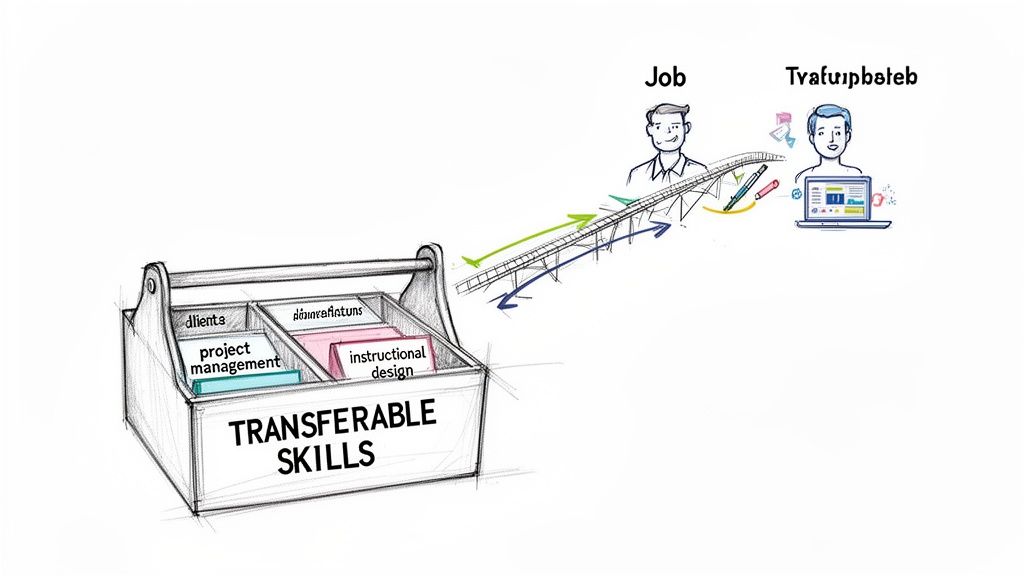
This is where the work pays off. Your transferable skills are the engine driving your career change — the universal currency that converts past experience into future value for a new employer.
The goal is not to list old job titles. It is to pinpoint the skills you have already mastered and frame them so a hiring manager in a completely different field thinks, "we need that."
A teacher who builds lesson plans and runs a classroom of 30 is a master of instructional design, project management, and stakeholder communication — exactly what a corporate training department or a growing tech company is looking for. You just have to stop talking like a teacher and start speaking their language.
Identifying Your Hidden Assets
Start with a serious audit of your work history. Set aside day-to-day tasks for a moment and dig into the abilities you used to get the job done.
Do not just write "teamwork." That is lazy. What did teamwork actually look like? Did you lead a cross-departmental project? Mediate a conflict? Onboard every new hire?
Work through your past roles with a few questions:
- Project management. What projects did you own start to finish? Did you manage timelines, coordinate people, or watch a budget?
- Data analysis. When did you use data — any data — to make a decision? Analysing sales reports, tracking website clicks, even reviewing student test scores to adjust a lesson plan all count.
- Client and stakeholder relations. Who were your "clients"? They might have been customers, but also patients, students, or department heads. How did you build those relationships and manage expectations?
- Budget and resource oversight. Did you ever manage a budget, however small? Were you in charge of ordering supplies or allocating resources without waste?
This exercise builds a "skills inventory" — the raw material for your new resume.
Translating Your Skills for the New Role
Once you have the list, the next challenge is translation. You need to rephrase your experience in the vocabulary of your target industry. This matters for getting past Applicant Tracking Systems (ATS) and for grabbing a recruiter's attention.
A retail manager's experience with "inventory oversight" becomes supply chain logistics for an operations role. A nurse skilled in "patient triage and education" has experience that translates cleanly into client needs assessment and onboarding for a customer success job.
Your past job title does not define what you are capable of. The language you use to describe your skills does. Adopt the vocabulary of your new field and the transition starts to read like a natural next step.
This matters even more if you are targeting forward-thinking sectors — for example, companies offering four-day workweeks. To soften the pay cut that can come with a major career change, you have to prove your value with broadly sought-after skills. Problem-solving is a good place to start: in a UK survey of employers conducted for the City of London Corporation, more than 90% rated problem-solving a high or very-high priority when recruiting, alongside communication and the ability to work with others.
Putting Your Skills into Action
Here is a key point: a standalone "Skills" section is not enough. You have to weave these skills into your professional summary and — most importantly — your work-experience bullet points. That shows you did not just have the skill; you used it to get real results.
Imagine someone moving from hospitality management into a tech project-manager role.
Instead of this:
- Managed hotel operations.
Write something with punch, like this:
- Directed cross-functional teams across front desk, housekeeping, and F&B to execute a $50,000 renovation, completing the project two weeks ahead of schedule and 10% under budget.
- Rolled out a new guest-feedback system, using data analysis to pinpoint service gaps and drive a 15% increase in positive online reviews within six months.
The second version signals project management, budget oversight, and data analysis — the keywords that make a tech recruiter pay attention.
The same idea applies to soft skills, which are valuable in collaborative fields. Understanding the soft skills of an engineer, for instance, can help you frame your own communication and problem-solving abilities so they resonate — even if you have never written a line of code.
Crafting a Compelling Professional Summary
Think of your professional summary as the trailer for your career. You have a few seconds to hook a hiring manager and convince them the rest of the document is worth their time. A generic "Objective" statement will not do it — you need a forward-looking pitch that connects your past directly to their future.
This is non-negotiable for a career-change resume. Your summary is your first, sometimes only, chance to bridge your old job title and your new ambition. It sets the stage, lets you control the narrative, and stops a recruiter from making a snap judgment about what they think your work history means.
The Anatomy of a Powerful Summary
Forget fluffy, vague introductions. A career-change summary needs a tight structure built for one thing: impact. It is not about what you want; it is about the value you bring.
Keep it to a three-to-four-line paragraph that does three things:
- Declare your new direction. Lead with a clear headline stating your new career goal.
- Highlight quantified achievements. Follow with two or three sentences showing transferable wins, backed by real numbers.
- Align with the job description. Close with core competencies that mirror the language in the posting.
This formula answers the recruiter's biggest question — "why should I consider someone with this background for this role?" — before they have to ask it.
From Vague to Valuable
Watch the transformation. Imagine a former retail manager going for a Junior Project Coordinator role.
Before — the vague summary:
Experienced retail manager with over 10 years of experience in store operations, team leadership, and customer service. Seeking to apply my skills in a new and challenging environment.
This is a dead end. It is backward-looking, full of clichés, and tells the recruiter nothing about the candidate's potential as a project coordinator.
After — the strategic summary:
Project Coordinator
Proactive, results-oriented professional transitioning from retail leadership, bringing a 10-year track record of executing complex initiatives and managing cross-functional teams. Led a $75,000 store remodel, completing it 15% under budget and lifting foot traffic by 20%. Proven expertise in budget oversight, vendor management, and process improvement, driving projects from concept to completion.
Core Competencies: Project Lifecycle Management, Agile Methodologies, Stakeholder Communication, Risk Assessment, Resource Allocation.
That is a different document. It leads with the target job title, uses punchy action verbs, quantifies achievements, and weaves in keywords relevant to project management. It reframes "managing a store" as "executing complex initiatives" and "working with suppliers" as "vendor management."
A strong career-change summary does not just list skills — it provides concrete proof. By connecting accomplishments to the new role's requirements, you make the transition feel intentional and logical.
This kind of reframing matters because career changes are increasingly common, often driven by a search for better pay and more flexible schedules. Treat your summary as the place where you make that move look deliberate rather than desperate.
Translating Experience Into High-Impact Achievements
Recruiters do not hire you for the tasks you were assigned. They hire you for the results you delivered.
When you are changing careers, that distinction is everything. Your goal is to stop listing job duties and start showcasing a portfolio of high-impact achievements that prove your value in any context.
Treat every bullet point in your experience section as a mini-story of success. Instead of stating what you did, frame it to highlight a problem you solved, the action you took, and the positive result that followed. That single shift turns your resume from a passive record into an active sales document.
Adopt the Problem-Action-Result Framework
A reliable way to structure achievements is the Problem-Action-Result (PAR) framework. You will not literally write "Problem," "Action," and "Result" on your resume, but thinking this way forces you to connect work to a meaningful outcome.
- Problem. What was the challenge, issue, or opportunity? This gives context.
- Action. What specific steps did you take? Use strong, dynamic verbs here.
- Result. What was the positive, measurable outcome? This is the most important part — quantify it whenever you can.
This is closely related to other storytelling techniques. If you want to dig deeper into structuring career stories, our guide to the STAR method for resumes offers a useful complementary perspective.
From Passive Duties to Powerful Bullet Points
Here it is in action — a few common job duties transformed into PAR-driven achievements.
Before and After Achievement Bullets
| Original Duty (Before) | Impactful Achievement (After) |
|---|---|
| Responsible for managing the company's social media accounts. | Grew social media engagement by 45% in six months by launching a data-driven content strategy to address low audience interaction. |
| Coordinated team meetings and events. | Orchestrated 20+ cross-functional workshops for 50+ team members, improving project alignment and reducing communication errors by 30%. |
| Handled customer service inquiries. | Resolved an average of 50 customer tickets daily, maintaining a 95% satisfaction rating and reducing issue escalation by 20%. |
The "After" examples are packed with value. They show strategic thinking, data-driven decision-making, and a direct link to business growth — all highly transferable.
Work-Life Balance Jobs with Genuinely Reduced Hours
Save one to come back to it — it's free.


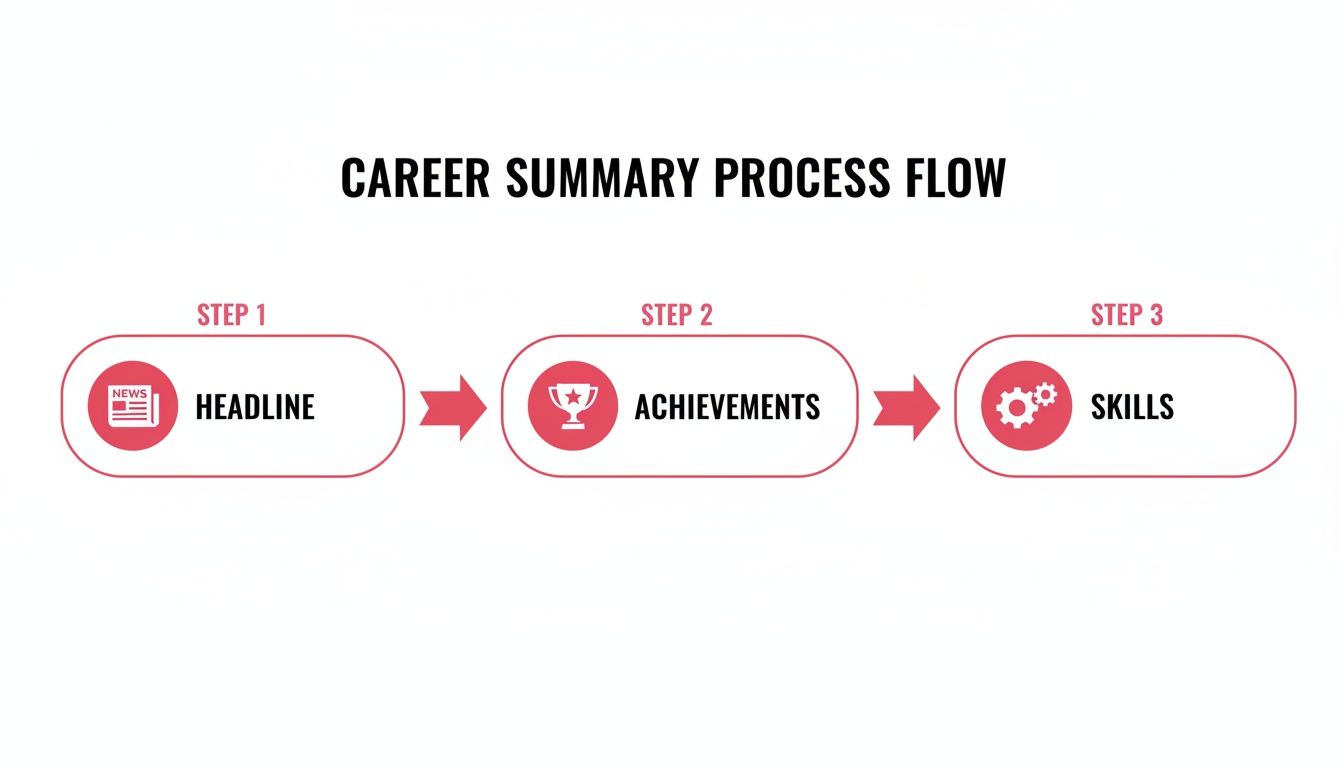
A successful summary is not just a list — it is a strategic narrative that moves from a clear goal to proven results.
How to Quantify Results Without Hard Numbers
What if you do not have specific percentages or dollar amounts? "Quantify" does not always mean numbers. You can still demonstrate impact through scale, scope, and frequency.
- Scale. How many people did your work affect? ("Trained a team of 15 new hires...")
- Scope. How large or significant was the project? ("Managed a project with a $50,000 budget...")
- Frequency. How often did you perform a key task? ("Coordinated 5+ large-scale events per quarter...")
Even qualitative improvements can be framed well: "Overhauled a clunky workflow, cutting team frustration and improving cross-departmental communication" still shows clear value.
Frame All Relevant Experience
"Experience" is not limited to your nine-to-five. For career changers, volunteer work, freelance gigs, and significant personal projects can be goldmines of relevant achievements.
Frame them with the same PAR-driven approach. If you managed the budget for a local charity fundraiser, that is legitimate financial-oversight experience. If you built a personal website that attracted thousands of visitors, that is digital marketing and SEO experience.
The point is to show initiative and a genuine commitment to your new field. Including these projects demonstrates that your career change is a deliberate, well-considered move — not a random leap.
This matters because career changers often take a financial hit. According to careers organisation Careershifters, the average career changer faces a pay penalty of around £3,731 a year — roughly 14% lower hourly pay when moving into a new sector. A resume full of quantified impact — "managed budgets, saving 15% annually" — is your best tool to narrow that gap and prove your immediate worth.
Structuring Your Resume for Recruiters and Robots
A perfectly written resume is useless if no one reads it. Before your application reaches a hiring manager, it usually has to clear a gatekeeper: the Applicant Tracking System (ATS) — software that scans, sorts, and ranks resumes by keywords and formatting before a human ever sees them.
Your job is to create a single document that satisfies both the digital screener and the actual person making the hiring decision.
That is a balancing act, and every choice — layout, font, structure — has to be intentional. For career changers the stakes are higher: the right structure spotlights your transferable skills, while the wrong one can get your resume skipped by software that does not understand nuance.
The Hybrid Format: A Career Changer's Best Friend
When you research how to write a resume for a career change, you will hear about three formats: chronological, functional, and hybrid (sometimes called a combination resume).
A purely chronological resume is a poor choice for a pivot, because it puts your least relevant history front and centre. A purely functional resume — skills only, no clear timeline — is a red flag to recruiters; it reads as if you are hiding something, like employment gaps or a spotty record.
That is why the hybrid format is the clear winner. It gives you the best of both:
- It opens with a strong Professional Summary and a prominent Skills section, immediately showing the recruiter you have what they need.
- Then it follows with a streamlined Professional Experience section in reverse-chronological order, satisfying the recruiter's need to see a clear timeline.
This structure lets you control the narrative — you ensure the reader sees your qualifications for the new role before they glance at your old job titles.
Designing for Readability (and Robots)
Once you have chosen the hybrid format, the design details matter. People and software both prefer resumes that are clean, clear, and easy to scan. Clutter is an instant turn-off — and the evidence is striking. In Ladders' widely cited eye-tracking study, recruiters spent an average of just 7.4 seconds on an initial resume screen. The same study found that resumes performed best with simple layouts, clear section headings, and bold job titles supported by bulleted accomplishments — and performed worst with cluttered layouts, multiple columns, and little white space.
Font and formatting rules to live by:
- Stick to the classics. Use simple, ATS-friendly fonts like Calibri, Arial, Helvetica, or Garamond. No decorative scripts.
- Keep it clean. Use 10–12 points for body text and 14–16 points for headings.
- Give it room to breathe. Set margins between 0.5 and 1 inch. White space prevents your resume from looking like an intimidating wall of text.
One critical tip: avoid tables, columns, headers, footers, and graphics in the resume itself. These elements can confuse an ATS, causing it to scramble or skip your information. (The tables in this article are fine — they are teaching aids, not a resume.) Keep the resume simple.
Speaking the Language of the Job Description
To get past the ATS, use the right keywords. Comb through the job description, pull out the key skills, technologies, and qualifications the employer names, and work those exact terms into your summary, skills section, and experience bullets.
For professionals aiming at flexible or four-day-week roles, this means reframing past experience in the vocabulary of the new industry. Match the words the employer actually uses — that is what the screening software is matching against.
One last practical tip: save and submit your resume as a PDF unless the application specifically asks for a Word document. A PDF locks in your formatting, so what you see is what the recruiter sees.
If you want extra help, you can explore some of the best AI resume builders, which are designed to optimise resumes for these systems automatically.
Career-Change Resume Questions, Answered
Switching careers raises a different set of resume questions than a routine job hunt. A few tricky situations come up again and again.
What Do I Do About a Big Employment Gap?
An employment gap only becomes a red flag if you treat it like one. The worst move is trying to hide it — a giant unexplained blank invites a hiring manager to assume the worst.
Own it and frame it positively. You do not need a long story, just a brief, confident explanation. Add a short "Career Note" section to your resume or weave it into your cover letter.
Frame the time off in a way that shows intent:
- Sabbatical for professional development. Ideal if you spent the time taking courses, earning certifications, or teaching yourself a new skill.
- Travel and cultural immersion. Signals adaptability, curiosity, and a broader worldview.
- Family care responsibilities. A completely valid reason that speaks to maturity and responsibility.
If you worked on any projects, volunteered, or took relevant courses during that time, highlight them. Show the gap was a period of intentional growth, then pivot the conversation back to why you fit the new role.
Should I Use a Functional or Hybrid Resume?
It is tempting to use a purely functional resume — skills up top, work history buried — on the logic of "I'll just show them what I can do." Unfortunately, most recruiters see a functional resume and get suspicious: "what are they trying to hide?"
The clear winner is the hybrid (or combination) format. Lead with a strong Professional Summary and a prominent "Key Skills" section, immediately showing the hiring manager you have the transferable skills they want. Then follow with a clean, reverse-chronological "Professional Experience" section. You control the narrative while still giving recruiters the timeline they expect.
What if I Have Zero Paid Experience in My New Field?
This is the classic career-change catch-22. The fix is to stop thinking of "experience" as only full-time, paid work. What matters to a hiring manager is evidence of initiative, genuine interest, and skills applied in the real world.
Do not hesitate to create sections like "Relevant Projects," "Volunteer Work," or "Freelance Experience." This is your chance to prove you can do the job even if no one was paying you for it yet.
Breaking into marketing? Talk about how you grew the social media accounts for a local non-profit. Pivoting to project management? Detail the community event you organised from scratch. Quantify those achievements just as you would a paid role — "grew the non-profit's Instagram following by 300% in six months" is an impressive result, full stop. Learning how to list contract work on a resume gives you a useful template for framing project-based wins.
Is a Cover Letter Really That Important for a Career Change?
Yes — for a career changer it is essential, not optional. Your resume shows the what (your skills and experience); your cover letter explains the why.
Use it to connect the dots for the hiring manager: why you are making this pivot, why this industry, and why your unconventional background actually makes you the right candidate. A strong cover letter is often the single thing that convinces a recruiter to take a chance on you.
A career change is not a backward step. With a resume built around transferable skills, quantified achievements, and a clear forward-looking story, your background stops being something to explain away — and becomes the evidence that you can do the job.




Get 4-day week jobs in your inbox
Create a free account to receive curated opportunities weekly.
Sign up for freeFree forever. No spam, unsubscribe anytime.