
Offsites can be one of the highest-ROI things a small startup does: you get everyone in the same room, you make the hard tradeoffs you’ve been avoiding, and you leave with a plan that actually sticks.
They can also quietly wreck your team’s energy for weeks.
The usual failure mode isn’t the offsite itself. It’s the combo: travel fatigue + an overstuffed agenda + “back to normal” the next day with a mountain of catch-up. If you care about sustainable performance and work-life balance (especially if your team is experimenting with a four-day workweek or any kind of compressed schedule), your offsite design has to protect people’s time and recovery as much as it protects the company’s goals.
This is a founder-friendly playbook for running a company offsite (or team retreat) that produces real outputs—without creating burnout.
What a burnout-safe offsite optimises for
A burnout-safe offsite protects three things:
- Energy: people leave clearer and lighter, not depleted.
- Time: the offsite doesn’t create hidden overtime before/after.
- Autonomy: no “mandatory fun” where opting out has social consequences.
If your company’s culture is built around healthier, more intentional work (the kind of thing you’ll see in many work-life balance-focused teams), your offsite should feel like an extension of that culture—not an exception to it.
Step 1: Decide if you actually need an offsite (the “worth it” test)
Offsites are worth it when you need one of these outcomes:
- Strategy clarity: priorities are muddy or you’re seeing internal conflict between goals.
- Decision-making cleanup: decisions get revisited, ownership is fuzzy, or “we’ll circle back” has become a lifestyle.
- Cross-functional friction fix: handoffs are breaking (Product ↔ Sales, Sales ↔ CS, Eng ↔ everyone).
- Team formation: new hires, new managers, rapid growth, a re-org, or a big shift in direction.
- Trust repair: silos, resentment, “DM culture,” or unspoken tension.
If the goal is basically “bonding,” you probably don’t need a multi-day retreat. A one-day local working session plus a great dinner can deliver most of the value without the travel hangover.
The one-sentence test (do this before you book anything)
Finish this sentence:
“This offsite is successful if we leave with ______.”
Good answers are concrete outputs: a written plan, a decision log, a set of norms, a prioritised roadmap, a list of owners. If you can’t name the outputs, you’re not planning an offsite—you’re planning an expensive vibe.
(If you want a sanity check from people who’ve seen a thousand offsites go wrong, HBR’s piece on off-sites that actually work is a solid read.)
Step 2: Pick 2–4 outputs (and ruthlessly protect them)
Small startup offsites fail when they try to do everything. Instead, choose 2–4 outputs and design everything around them.
Examples of strong outputs:
- A one-page strategy narrative for the next quarter
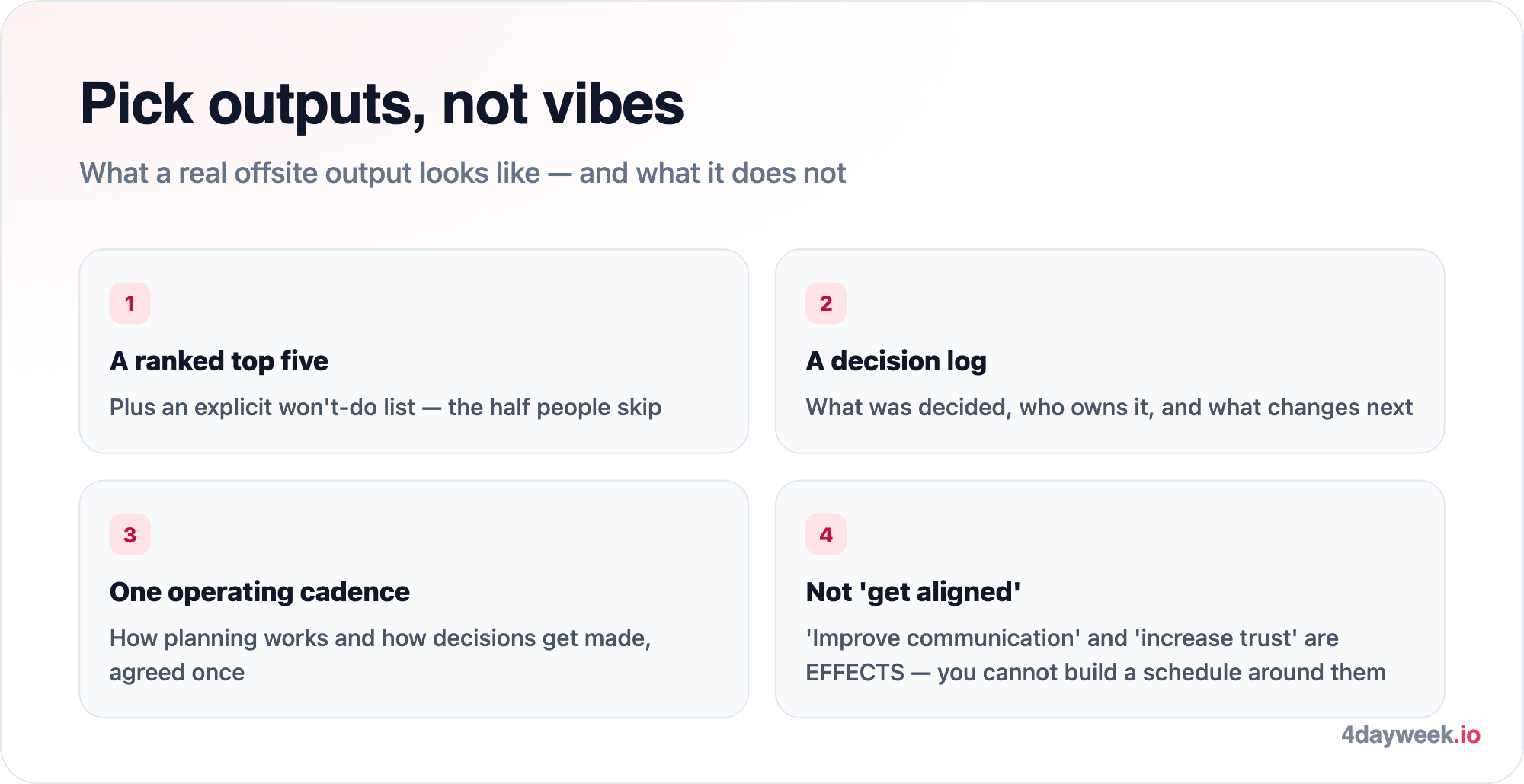
- A ranked top 5 priorities plus a clear “won’t do” list
- A decision log: what’s decided, who owns it, what changes next
- A single operating cadence (how planning works, how decisions get made)
- Team norms that reduce meetings and protect deep work
Examples of weak outputs:
- “Improve communication”
- “Get aligned”
- “Increase trust”
Those can be effects of a good offsite, but they aren’t outputs you can build a schedule around.
Step 3: Choose an offsite format that doesn’t punish your team
Most burnout comes from format, not content. Choose the lightest format that can still produce your outputs.
-
Format A: One-day local offsite (lowest burnout, high output)
Best for teams that can meet in one city without flying (or with minimal travel). No hotel sleep, no travel hangover, simpler re-entry.A one-day offsite is also easier to justify when you’re building a culture that values time and recovery—something that becomes non-negotiable once you’ve felt the benefits (and tradeoffs) of shorter schedules, like those described in the pros and cons of a four-day week.
-
Format B: Two-day offsite with travel buffers (best all-rounder)
Best for distributed teams where some people need to fly. Day 1 starts late and Day 2 ends early so travel doesn’t become the main event. -
Format C: 3-day retreat (only if you truly need it)
Best for major resets, heavy strategy work, or trust repair. The risk is social pressure + long days. The fix is shorter days, real breaks, and optional evenings. -
Format D: Hybrid offsite (async prework + one intense in-person day)
Best for small startups with tight calendars or budgets. You move context out of the room and keep in-person time for decisions.This is especially useful if you’re already dealing with the operational complexity of remote work—things like scheduling, handoffs, and async habits that show up in everyday life (and in pain points like the ones in remote staff scheduling challenges).
Step 4: Build a startup offsite agenda that respects human limits
A good offsite agenda is fewer sessions, deeper outputs. The goal isn’t to cram a quarter into 36 hours. The goal is to create clarity.
The 60/30/10 rule
- 60% decision-making & alignment work
- 30% relationship-building (structured + optional)
- 10% updates/admin
A lot of burnout-heavy offsites flip this: too many presentations, too much “team building,” not enough real decisions.
Agenda guardrails (the boring stuff that saves you)
- No session longer than 75–90 minutes without a real break.
- One big decision block per day (not three).
- Use solo writing before discussion (quiet people get heard, loud people don’t anchor the room).
- End on time while people still have energy.
If you want a practical facilitator’s lens without hiring a facilitator, Atlassian’s guide on how to facilitate successful offsite meetings is genuinely useful.
Copy/paste offsite agendas (1-day, 2-day, hybrid)
Agenda 1: One-day local company offsite (high output, low burnout)
- 10:30–11:00 Arrival + coffee + outcomes (define success)
- 11:00–12:15 Strategy/priorities workshop (what matters now)
- 12:15–13:15 Lunch (no agenda)
- 13:15–14:30 Decision block (tradeoffs + “won’t do” list)
- 14:30–14:50 Break
- 14:50–16:00 Operating system (planning cadence, comms norms, decision rights)
- 16:00–16:15 Break
- 16:15–17:00 Action plan + owners + dates (write it live)
- Evening Optional dinner (explicitly optional)
Agenda 2: Two-day offsite with travel buffers (best general template)
Day 1 (start late, end on time)
- 11:30–12:00 Welcome + outcomes + working norms
- 12:00–13:00 “Where we are” (tight, data-led, no long decks)
- 13:00–14:00 Lunch
- 14:00–15:15 Strategy/priorities workshop
- 15:15–15:40 Break
- 15:40–16:45 Decision block (commitments + constraints)
- 16:45–17:00 Close + capture decisions
- Evening Optional social
Day 2 (finish early)
- 09:30–10:00 Recap + reset
- 10:00–11:15 Fix one friction point (pick the #1 coordination pain)
- 11:15–11:35 Break
- 11:35–12:35 Team norms (async, meetings, response times, focus time)
- 12:35–13:15 Lunch
- 13:15–14:15 Action plan + owners + dates + follow-up cadence
- 14:15–14:30 Close
- Travel
Agenda 3: Hybrid offsite (async prework + one in-person day)
Async prework (30–45 minutes total):
- Short survey: top 3 problems, top 3 opportunities, biggest risk if nothing changes
- One-page leadership context doc (no slide deck)
- Each person submits one “hard decision we’re avoiding”
In-person day:
- 00:00–00:30 Success outputs + working norms
- 00:30–02:00 Options workshop (silent writing → small groups → cluster themes)
- 02:00–03:30 Decision block
- 03:30–04:30 Operating system norms
- 04:30–05:30 Action plan + owners + dates + check-in calendar
Step 5: Facilitate like a founder (not a conference host)
You don’t need a professional facilitator. You need structure that stops dominance, drift, and circular debate.
-
Start big topics with silent writing.
Give everyone 5–8 minutes to write before anyone talks. You’ll get better ideas, less groupthink, and fewer “we just spent 45 minutes reacting to the loudest person.” -
Separate “Explore” from “Decide.”
Label agenda blocks as either Explore (generate options + criteria) or Decide (pick, commit, assign owners). Most offsite frustration comes from pretending you’re deciding while still exploring. -
Keep a live decision log.
Open a shared doc titled Decision Log with: Decision, Owner, Date, What changes now, Review date. If it’s not written down, it didn’t happen. -
End decision blocks with “disagree and commit.”
Do a quick round: “Any strong objections?” then “Can everyone commit to this for X weeks?” This prevents Monday-morning re-litigation.
GitLab’s handbook has a refreshingly operational approach to documenting these rituals—worth skimming their offsite structure and documentation if you want ideas.
Step 6: Make social time optional (and still genuinely good)
Burnout isn’t just about workload. It’s also about social pressure—especially in small startups where culture is tight and everyone knows everyone.
Make social time time-bound and opt-out normalised:
- Dinner in small groups (people choose)
- Optional morning walk or coffee
- Optional activity that isn’t alcohol-centered
- Explicit “quiet space” availability
Work-Life Balance Jobs with Genuinely Reduced Hours
Save one to come back to it — it's free.



A simple leadership rule helps: don’t reward late-night stamina with influence. If the “inner circle” is formed at midnight at the bar, your offsite is creating incentives that punish boundaries.
Step 7: Reduce travel + expense friction (the fastest burnout reducer)
You can run a perfect agenda and still burn people out if logistics are chaotic.
Travel guardrails that protect energy
- Avoid red-eyes unless someone opts in
- Build a buffer before the first session
- If travel is long, arriving the day before is usually worth it
- Keep hotel/venue close (commutes are energy leaks)
Remove “expense report debt”
Offsites create invisible admin: booking, receipts, policy questions, approvals, reimbursements. When people get home and face a pile of expense admin, the offsite keeps “charging interest” on their time.
If you’re evaluating ways to reduce booking + receipt + reimbursement friction, it’s reasonable to sanity-check what real users say—reading customer feedback about Navan fits naturally into that diligence process.
Step 8: Prevent the post-offsite catch-up cliff
A lot of offsites feel great… until Monday.
The catch-up cliff is where resentment grows: inbox floods, meetings pile up, and the offsite becomes the reason people worked late all week. If you care about sustainable pace, re-entry is part of the plan—especially for teams designing work around time boundaries and productivity (the kind of shift you’ll see reflected in four-day-week research and statistics).
-
Protect the next day.
No recurring meetings, lighter workload expectations, optional catch-up blocks. -
Ship the action plan within 48 hours.
Include what was decided, the owner for each decision, the first step, the deadline, and where progress is tracked. -
Pre-book follow-ups before people leave.
A 30-minute check-in one week later (unblock and adjust) and a 60-minute review one month later (review outcomes) prevents drift.
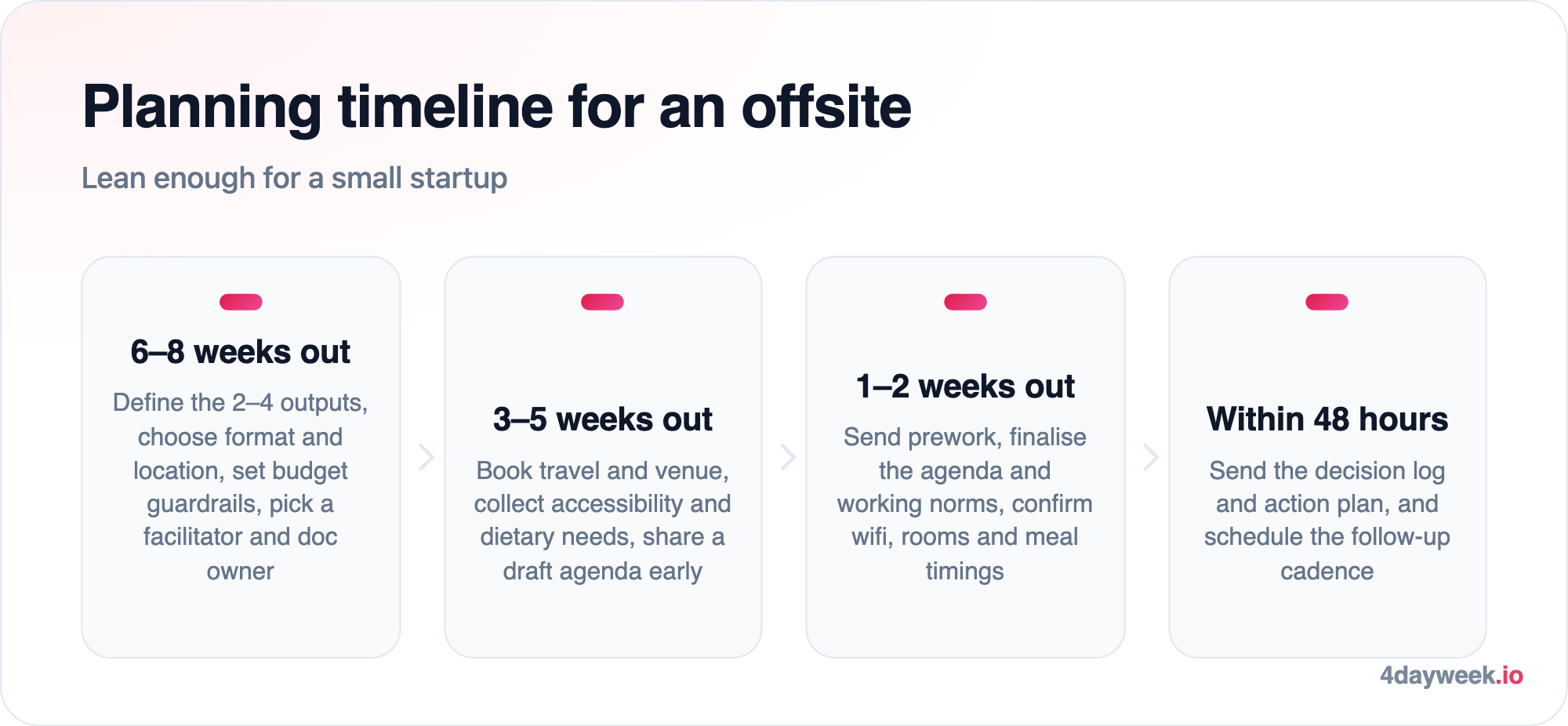
Planning timeline (lean enough for a small startup)
-
6–8 weeks out
- Define outputs (2–4)
- Choose format + location
- Set budget guardrails
- Pick a facilitator and a doc owner
-
3–5 weeks out
- Book travel + venue
- Collect accessibility and dietary needs
- Share a draft agenda early (people plan better when they know what’s coming)
-
1–2 weeks out
- Send prework
- Finalise agenda and working norms
- Confirm logistics (wifi, room setup, meal timings, emergency info)
-
Within 48 hours after
- Send decision log + action plan
- Schedule follow-up cadence
Templates you can copy/paste
Template 1: One-page offsite brief
Copy this into a doc and fill it out:
- Goal (one sentence):
- Outputs (2–4):
- Attendees:
- Format: (one-day / two-day / hybrid / retreat)
- Constraints: (budget, travel limits, dates)
- Decision rights: who decides what
- Working norms: timeboxing, breaks, opt-out social
- Success metrics: what will be true after
Template 2: Decision log (simple, but actually used)
Use this format and keep it in one shared place:
- Decision:
- Owner:
- Date decided:
- What changes now:
- Review date:
- Notes / open questions (optional):
Template 3: Team norms starter set (choose 6–10)
- Meetings default to 25/50 minutes
- Async-first updates; meetings are for decisions
- Response time expectations are explicit
- Focus blocks are protected
- Decision log is the source of truth
- “Disagree and commit” after decisions
Teams that are serious about protecting time often discover they can do more in fewer hours—exactly the kind of shift discussed in arguments for the 30-hour work week when norms, process, and expectations are aligned.
FAQ: Team offsite planning
How often should a startup run a company offsite?
Most early-stage teams land around 1–2 per year, plus smaller working sessions as needed. If your priorities shift monthly, you’ll need more frequent alignment—but that doesn’t always mean more travel.
What’s the best length for a team retreat?
If you can meet locally, one day is often enough. If people are flying, two days with travel buffers is usually the best balance. Three-day retreats are for rare moments: major resets, leadership transitions, or deep trust repair.
How do we avoid an offsite that’s just presentations?
Move context into prework. In-person time is precious—use it for decisions, workshops, and alignment. HBR’s guide to running offsites that aren’t a waste of time is a helpful reminder of the fundamentals.
How do we make offsites inclusive (introverts, caregivers, neurodivergent teammates)?
Shorter days, clear start/end times, optional social plans, and multiple ways to contribute (silent writing, anonymous input, small groups before full-group discussion). “Opt-out is normal” needs to be a real policy, not a vibe.
What’s one simple rule that prevents burnout?
End on time and protect re-entry. Most burnout isn’t created during the offsite—it’s created by what people have to do to recover from it.
(If you want a clean definition you can share internally, the World Health Organization’s description of burnout as an occupational phenomenon is useful context: https://www.who.int/news/item/28-05-2019-burn-out-an-occupational-phenomenon-international-classification-of-diseases)
Conclusion
A good offsite doesn’t feel like a productivity stunt. It feels like a reset: fewer open loops, clearer ownership, and better ways of working that make the next month easier—not harder.
If you keep the format humane, the agenda focused, and the re-entry protected, you can get the benefits of in-person alignment without paying for it in exhaustion. The real win is when the offsite doesn’t just produce a plan—it produces a team that can execute that plan at a sustainable pace.




Get 4-day week jobs in your inbox
Create a free account to receive curated opportunities weekly.
Sign up for freeFree forever. No spam, unsubscribe anytime.