
Taking a mental health day isn't a luxury or a sign you can't handle the pressure. It's a practical part of building professional resilience and sustaining a career over the long term. Think of it less as an escape and more as a strategic break to refuel — preventing burnout before it takes hold.
This guide covers the whole arc: recognising when you genuinely need a day, requesting it professionally, planning your absence so it's stress-free, spending the day in a way that actually restores you, and easing back in without undoing the benefit.
Why Mental Health Days Matter

Today's work culture often rewards constant availability. We're pinged on Slack at all hours, buried in back-to-back meetings, and expected to be "on" all the time. That pace is unsustainable, and it leaves your mental reserves dangerously low.
This isn't a fringe concern. In Ipsos's World Mental Health Day survey, 39% of respondents said they had taken time off work in the previous 12 months because of stress, and 78% said they consider mental health as important as physical health. Taking a mental health day, in other words, is something a large share of the workforce already does — and the broad agreement that mental and physical health carry equal weight is exactly the cultural shift that makes it normal.
The economic cost of ignoring the problem is just as stark. The World Health Organization estimates that depression and anxiety cost the global economy around US$1 trillion a year in lost productivity, with an estimated 12 billion working days lost annually. Proactive recovery isn't indulgence — it's how you stay in the game.
Signs You Need a Break
The warning signs are usually subtle at first, but they accumulate. You might notice:
- Losing focus on routine tasks that used to be easy.
- Feeling unusually irritable or short with colleagues.
- A constant sense of being overwhelmed, even by small things.
- Sunday-night dread hitting harder than usual.
These aren't just "bad days." They're your mind's warning signals telling you it's time to rest. Ignoring them is a fast track to full burnout.
The Modern Pressure Points
The contemporary workplace is packed with stressors that quietly drain your reserves:
- Round-the-clock connectivity from email and team-chat apps.
- Tight deadlines that leave no room for personal needs.
- Constantly shifting projects and scope creep.
- Pressure to hit high-performance targets with little recovery time.
When you start recognising these pressure points, taking a mental health day stops feeling like an indulgence and starts looking like a sensible career decision — one part of a broader effort to reduce stress in the workplace.
A mental health day is proactive care, not a sign of weakness.
Step 1: Recognise When You Genuinely Need a Break
Before you can think about asking for time off, you have to be honest with yourself. Learning to spot the early warning signs of burnout is what lets you prevent a full-blown crisis rather than react to one.
We're not talking about a single bad day. These are patterns — subtle shifts that signal your mental and emotional reserves are running low.
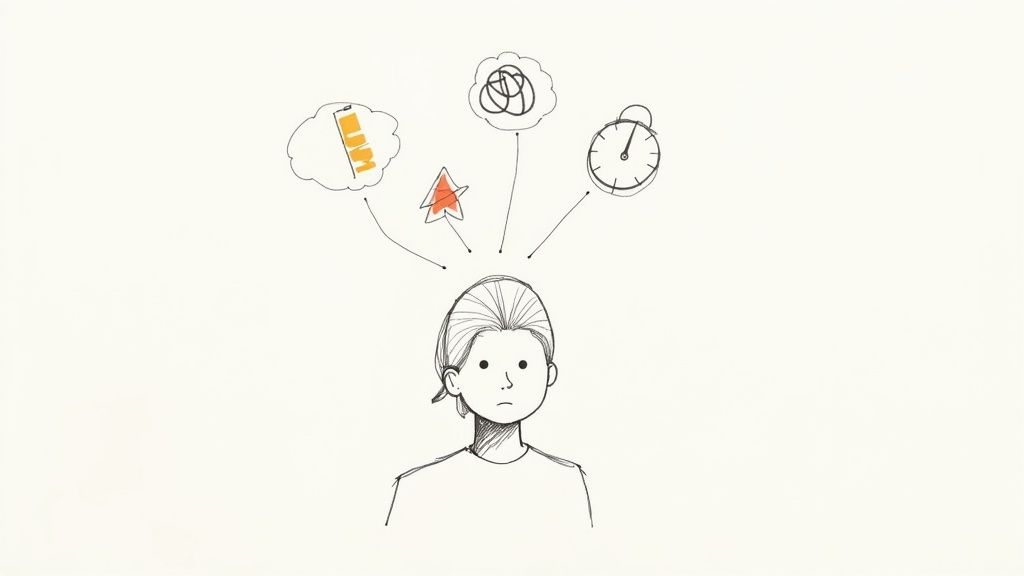
Often the first clues show up in your work habits. You're suddenly procrastinating on tasks you used to breeze through, or you feel a deep sense of detachment from the purpose of your work. That's not laziness — it's your mind signalling that it's overloaded.
Emotional and Behavioural Red Flags
Look beyond your to-do list and check in with your emotional state. Are minor setbacks sending you into a spiral of frustration? Do you find yourself snapping at colleagues or family for no real reason? Those swings are significant clues.
Another classic sign is when the Sunday scaries morph into genuine Sunday dread. A little apprehension about Monday is normal; intense anxiety or low mood every single Sunday is a clear signal that work is taking a serious toll — and that your weekends are no longer enough to recharge you.
Physical Symptoms of Mental Strain
Burnout doesn't just affect your head — it shows up in your body. Chronic stress can trigger very real physical symptoms you shouldn't ignore:
- Persistent fatigue: feeling bone-tired no matter how much you sleep.
- Frequent headaches: a noticeable rise in tension headaches or migraines.
- Changes in appetite or sleep: restless nights, waking up exhausted, or shifts in eating habits.
- Muscle tension: a constant knot in your neck, shoulders, or back.
The mind-body connection is powerful, which is why so many forward-thinking companies now treat mental health support as a way to head off these problems before they start.
The table below organises the common signals into clear categories — a personal burnout detector to help you decide when a mental health day is the right call.
| Indicator Category | Specific Signs to Watch For |
|---|---|
| Behavioural | Procrastinating on simple tasks, withdrawing from team activities, leaning harder on caffeine or alcohol. |
| Emotional | Heightened irritability, cynicism about your job, a sense of dread or anxiety about work, feeling emotionally numb. |
| Physical | Chronic fatigue, frequent headaches or stomach issues, difficulty sleeping, noticeable muscle tension or pain. |
| Cognitive | Trouble concentrating, difficulty making decisions, forgetting important details, feeling mentally foggy. |
If you're ticking off boxes across multiple categories, that's a strong indicator your mind and body are asking for a break. Listening to those signals is one of the smartest moves you can make.
Step 2: Request Your Mental Health Day Professionally
Knowing you need a break is the easy part. Asking for it can feel like a different challenge entirely — many of us hesitate, worried about being judged or looking unreliable.
The key is to frame the request with professional confidence. Focus on the logistics of your absence, not the personal reasons behind it. Your goal is simple, clear communication: you don't need to over-explain or justify taking a day off. In most cases, less is more.
Crafting Your Communication Strategy
How you ask depends on your company's culture and your relationship with your manager. In a supportive environment you might feel comfortable being direct. In a more traditional setting, sticking to the standard sick-day protocol is often the smarter move.
Whatever the culture, the core elements are the same: be concise, give as much notice as you can, and briefly outline your plan for coverage. That shows you're being responsible and proactive — something every manager appreciates.
A common mistake is waiting until you hit a breaking point. If you can feel burnout creeping in, try to schedule the day in advance. A simple "I'd like to request this Friday off using a personal day" is often all you need.
You are not required to disclose that you're taking a mental health day. You can simply state that you're using a sick day for a health issue, which is entirely accurate — your mental well-being is a legitimate health concern.
Scripts for Different Workplaces
Having a script ready takes the anxiety out of the conversation. Adapt these for an email, a chat message, or a face-to-face talk.
In a supportive workplace, where well-being is discussed openly, you can be more direct without sharing personal details:
"Hi [Manager], I'd like to request a sick day tomorrow, [Date], to focus on my health and recharge. I've completed [Critical Task A] and briefed [Colleague] on [Project B] so everything runs smoothly while I'm out. I'll be back online on [Return Date]."
In a more traditional workplace, stick to the standard sick-leave procedure — your privacy comes first:
"Hi [Manager], I'm writing to let you know I'll be taking a sick day tomorrow, [Date], as I'm feeling unwell. I'll keep an eye on my email for anything urgent and have updated the team on my current projects. Thank you for your understanding."
It also helps to know how your company categorises time off. Many places lump sick and personal days together, which gives you more flexibility — our guide on how to manage your PTO effectively covers this in detail.
Manager vs. HR: What to Know
For a single mental health day, your direct manager is usually the only person you need to tell. Their main concern is team workflow and making sure your responsibilities are covered. HR typically only gets involved when an absence is extended or requires specific documentation under company policy or legislation such as the FMLA.
Keep it simple. A professional notification to your manager, focused on the operational details — when you'll be out and how your work is covered — is all it takes. That frames your request as a routine, responsible action, which is exactly what it is.
Step 3: Plan Your Absence for a Stress-Free Day Off
The whole point of a mental health day is to disconnect and lower the stress. The last thing you want is to spend it worrying about what's piling up at work. A little preparation turns the day from a source of anxiety into a genuinely restorative break.
Prioritise and Delegate Before You Go
Work-Life Balance Jobs with Genuinely Reduced Hours
Save one to come back to it — it's free.


First, get honest about your to-do list — not everything is a five-alarm fire. Sort your tasks into three buckets:
- Must do before I leave: the urgent, deadline-driven tasks that genuinely can't wait. Knock these out first.
- Can be covered by a colleague: specific items a teammate could handle in a pinch, such as monitoring an inbox or answering a client query.
- Can wait until I return: be honest — most of your work falls here. Be ruthless about what can truly be paused for a day.
Once you've sorted your tasks, write a simple handover note. This isn't a novel; it's a quick-reference guide that keeps your team in the loop.
A good handover note anticipates questions so you don't have to answer them. Include project statuses, key contacts for urgent issues, and links to relevant documents. This small step builds trust and shows you respect your colleagues' time.
If you want a workflow that makes handovers easier in general, building a structure around flexible working hours can make delegation and coverage feel far more natural.
Set Boundaries to Protect Your Peace
Your final step is to build a digital wall between you and the office. Start with an out-of-office message that clearly manages expectations. Instead of a generic "I am out of the office," try something specific:
"Thanks for your email. I'm out of the office today with no access to email and will return on [Return Date]. For anything urgent regarding [Project X], please contact [Colleague] at [email]. Otherwise, I'll get back to you as soon as I can on my return."
This is professional, sets a firm boundary, and points people in the right direction. Then — the most important part — log out of everything. Disable notifications for Slack, Teams, and work email on your phone. The urge to "just check in" is a sneaky trap that can derail an entire day of rest.
Step 4: Make the Day Genuinely Restorative
You navigated the conversation, set your out-of-office, and the day is finally yours. Now for the most important question: what are you actually going to do with it?
A genuinely restorative mental health day isn't about being lazy or unproductive. It's about being intentional and choosing activities that refill your specific energy reserves. The only real goal is to end the day feeling better than you started it.
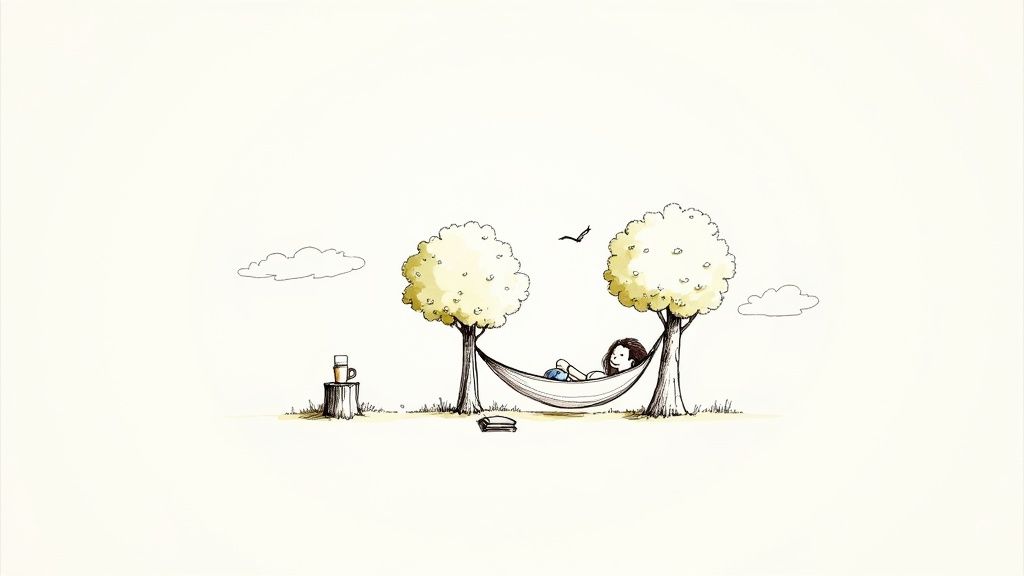
Tailor the Day to What's Draining You
How you spend the time should depend on what's actually wearing you down. Wiped out from back-to-back meetings and social obligations? A quiet day with a good book might be exactly right. Feeling isolated and disconnected? A long, unhurried lunch with a trusted friend could be the better fix. There's no one-size-fits-all formula — the trick is getting honest about what you need right now.
- For mental exhaustion: keep it low-focus. Listen to a podcast, take a slow walk in nature, or try a guided meditation.
- For emotional fatigue: reconnect with a hobby you've let slide — painting, an instrument, time in the garden.
- For physical tension: move your body gently. Stretching, a restorative yoga session, or a slow bike ride helps release stored stress.
The payoff is real. Oxford University research, conducted with workers at the telecoms firm BT, found that employees were 13% more productive in weeks when they were happier — and that gain came from performing better in the same hours, not working longer ones. Recovery feeds performance.
Ideas for a Restorative Day Off
If you're drawing a blank, keep a running list of low-effort, high-reward activities for when your brain feels too fried to decide:
- Spend time in a park or green space — and leave your phone in your pocket.
- Cook a comforting meal you love, without rushing.
- Wander through a museum, library, or quiet café.
- Take a long bath or an uninterrupted nap. No guilt allowed.
Whatever you choose, make sure it genuinely helps you disconnect from work and reconnect with yourself.
Step 5: Ease Back In Without Undoing the Benefit
How you walk back into work matters as much as how you walked out. A chaotic return can undo the calm you just worked to build, so plan a gentle re-entry rather than diving headfirst into the digital noise.
Your First Hour Back
Forget trying to catch up immediately. Your first hour is about easing in with intention — taking control before your inbox does:
- Scan, don't read. Give your email subject lines a quick once-over, looking only for anything genuinely on fire. Ignore everything else for now.
- Check your calendar. Get a clear picture of the day's meetings and deadlines.
- Make a priority list. Based on that scan, jot down just two or three top priorities. That short list becomes a shield that pushes less important things into the background.
This puts you in the driver's seat rather than letting a flood of notifications dictate your day.
The clarity you gained on your day off is a powerful tool. Use it to build healthier, more sustainable work habits — turning a single mental health day into a long-term strategy to improve work-life balance.
You're far from alone in this. ComPsych, analysing leave data from millions of employees, found that mental health leaves of absence rose 300% between 2019 and 2024, climbing from 2% of all leaves before the pandemic to 8%. That isn't a blip — it's a lasting shift in how people think about work and well-being. Yet support hasn't kept pace: nearly half of US adults who experience mental illness still receive no treatment — a care gap that's fuelling fast-rising demand for trained mental-health counsellors.
A Few Common Questions
Do I have to tell my boss the real reason? No. You're not required to share the specifics of why you're taking a day off. You can simply say you're using a sick day for a health issue, which is entirely true. Keep your communication brief and professional — there's no need to over-explain.
What if my company culture isn't supportive? Don't get hung up on the label. Focus on the logistics: frame your request around your absence and your coverage plan, using your allotted sick or personal leave. The goal is to take the time you're entitled to for your health, even if you don't explicitly call it a "mental health day." It's also worth noting that many companies are moving toward more flexible models — these flexible working examples show how workplaces are evolving to support their teams.
How often is reasonable? Treat it as preventative care. Taking a day each quarter, or when you notice early signs of burnout, is a healthy rhythm — and far more effective than waiting until you're in a full-blown crisis.
If you find yourself needing these days more and more often, that's worth paying attention to. It may be a sign that the underlying stressors in your role need addressing — and that the structure of the job itself, not just your recovery habits, is the thing to change. A better work-life balance shouldn't depend on rationing days off; plenty of employers now build their schedules around it — browse companies with the best work culture to find one, and know that it is a perfectly reasonable next step.




Get 4-day week jobs in your inbox
Create a free account to receive curated opportunities weekly.
Sign up for freeFree forever. No spam, unsubscribe anytime.