
Work-life integration is the practice of letting your professional and personal life flow together instead of forcing them into separate, rigid boxes. It is less a balancing act than a deliberate blend. The point is not to work more — it is to have the freedom to manage your day around what matters most, rather than what the clock dictates. The approach rests on two things: autonomy and flexibility.
Understanding Work-Life Integration
At its core, work-life integration is a shift away from the familiar, often stressful juggling of "work-life balance." Instead of picturing your life as two separate buckets — one for work, one for everything else — you treat it as a single, dynamic schedule you get to arrange. Tasks and activities are slotted in an order that matches your energy and your priorities.
This way of thinking accepts a simple truth: for many people, neatly separating the work self from the personal self is no longer realistic. Remote work and always-on tools have already blurred the old boundaries. Integration takes that reality and turns it into a strength rather than a source of guilt.
What Integration Looks Like Day to Day
So what does this look like on a typical Tuesday? It is about designing a schedule that serves your whole life, not just your job.
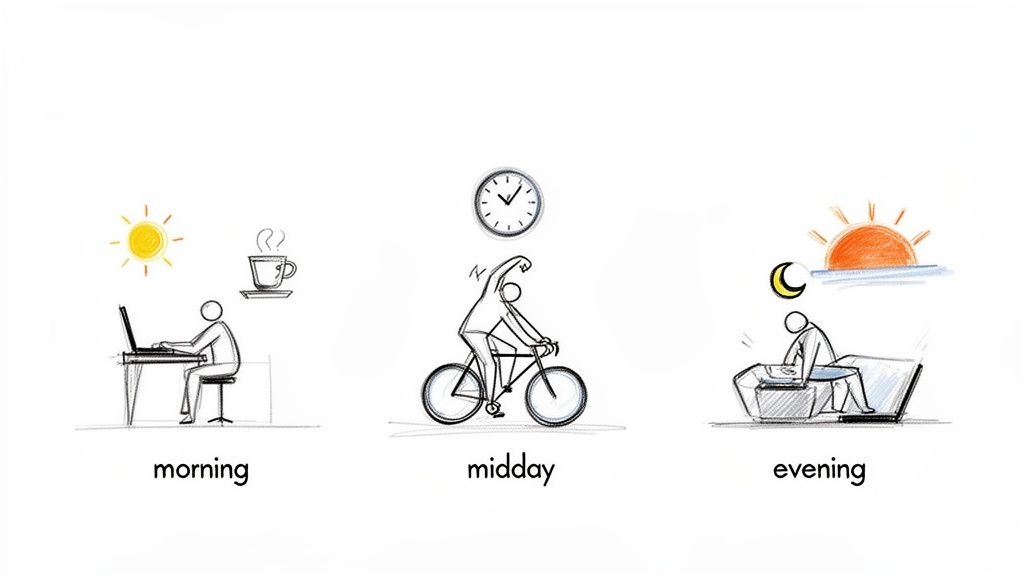
An integrated day might run like this:
- Morning: You tackle a high-priority report first thing, hitting it during your peak focus hours.
- Midday: You log off for a couple of hours — no guilt attached — to catch a child's school play or get to a medical appointment.
- Afternoon: Back online, you handle a few calls from your home office, then break to cook dinner with your family.
- Evening: Once the house is quiet, you might spend a focused half-hour clearing your inbox and prepping for tomorrow.
The aim is not to cram more work into your personal time. It is to distribute your energy intelligently — putting it where it is needed most, whenever that happens to be.
Work-life integration is less about finding a perfect, static balance and more about creating a sustainable, fluid rhythm. It is a life designed so your career supports your wellbeing and your personal life sharpens your professional focus.
The whole philosophy rests on trust and autonomy. It moves the measure of success from hours logged to results delivered — the same principle that underpins forward-thinking models like the four-day work week. When you gain real control over your time, stress tends to fall and a sense of fulfilment tends to rise.
Work-Life Integration Versus Work-Life Balance
"Work-life integration" and "work-life balance" are often used interchangeably. They are not the same thing. They represent two genuinely different ways of thinking about how work fits into a life.
The traditional idea of work-life balance is usually pictured as a set of scales: your job on one side, your personal life on the other, with the goal of keeping them even so neither tips the whole thing over. The model is built on a single premise — separation.
The trouble is that perfect equilibrium is hard to sustain. When a big project demands extra hours, the "life" side of the scale crashes down and guilt creeps in. Take a personal day and it can feel like you are dropping the ball at work. It becomes a constant juggle in which you always seem to be compromising and never fully present.
The Shift From Separation to Synergy
Work-life integration drops the scales metaphor entirely. Instead of treating work and life as opposing forces to be held apart, it treats them as interconnected parts of a single whole.
The goal is not to balance competing factions. It is to combine them into a lifestyle that genuinely works for you. You weave professional and personal tasks through your day based on what is most important — not on what a rigid 9-to-5 clock allows.
This approach brings together a few core elements: your lifestyle, your priorities, and your personal autonomy.

The thread running through all of it is freedom — the freedom to manage your entire life, not just your work tasks.
Integration vs Balance: A Side-by-Side Comparison
To pin down the differences, here is how each model plays out in practice.
| Aspect | Work-Life Balance (Separation Model) | Work-Life Integration (Blended Model) |
|---|---|---|
| Core philosophy | Work and life are separate and should be kept apart. Success means keeping them in equilibrium. | Work and life are interconnected parts of one whole. Success means how well they blend. |
| Scheduling | Rigid and compartmentalised. Strict "work hours" and "personal time." | Fluid and dynamic. Tasks are scheduled by priority, energy, and opportunity, regardless of the hour. |
| Boundaries | Hard boundaries are essential — a firewall between professional and personal life. | Flexible boundaries. The focus is being present and effective in the current task. |
| Mindset | Tends toward trade-offs. "If I do more of this, I must do less of that." | Tends toward synergy. "How can I arrange my day to accomplish what matters?" |
This shift from balance toward integration is not a passing fad. It tracks a real change in what people want from work. In late 2025, recruiter Randstad found that — for the first time in more than two decades of its Workmonitor survey of 26,000 workers across 35 countries — work-life balance had overtaken pay as the leading motivator, cited as important by 83% of respondents against 79% for salary. People are actively searching for roles that respect their whole lives.
If you want to dig into why this has become non-negotiable for so many candidates, our piece on the importance of work-life balance covers its impact on job satisfaction in more depth. For a step-by-step guide to acting on it, see how to improve work-life balance in 5 steps.
The Real-World Benefits of an Integrated Life
So what does an integrated life actually deliver? The advantages are concrete, and they show up for employees and employers alike.
For individuals, the most immediate change is a drop in burnout pressure. The nagging sense that you must be "on" for work while also juggling personal responsibilities fades. Instead of feeling guilty about a midday appointment or stepping out for a school event, you feel free to own your time.
That autonomy is a genuine lever for wellbeing. It lets you align demanding work with your sharpest hours and push lighter tasks to your natural energy dips. The result is a stronger sense of control and a real lift in job satisfaction. Chronic pressure is the warning sign that this balance has broken down — the 8 signs of workplace burnout is worth knowing so you can catch the drift early.
Advantages for Employees
An integrated approach translates directly into a better quality of life:
- Greater personal autonomy. You manage your schedule around your actual priorities, not a rigid 9-to-5 box.
- Improved mental headspace. Less stress and less guilt over handling personal tasks tend to mean clearer thinking and more resilience.
- More presence. With work and life woven together rather than fighting each other, you can be fully present in whatever you are doing — a client meeting or a family dinner.
A Competitive Edge for Employers
The case for companies is just as strong. When people feel trusted and respected, loyalty and engagement tend to follow.
This is not a soft perk; it is a retention strategy. Demand for flexible work is no longer niche. In Remote's 2025 Global Life-Work Balance Index, flexitime was rated essential by 93% of surveyed desk-based workers — and a UK Global Workforce Report found that roughly three-quarters of hiring leaders had lost staff in the prior six months to organisations less tied to traditional hours and locations.
Flexibility also reshapes an employer brand. Organisations known for championing integration become magnets for the kind of talent actively looking for smarter, more sustainable ways to work.
Prioritising employee wellbeing through integration tends to produce a workforce that is more engaged and more committed. This is not a trade-off between productivity and happiness — done well, one fuels the other.
The effect compounds. A focused, energised team is less likely to make costly mistakes and more likely to deliver strong work. Greater flexibility also brings knock-on effects worth noting, such as the environmental benefits of remote work that come with fewer commutes.
See Work-Life Integration in Action
Theory is one thing; seeing integration in practice is what makes it click. Here is what a blended day looks like for real people in different roles — tangible scenarios rather than pie-in-the-sky ideals.
A Day in an Integrated Life
The software developer. Alex is a senior developer whose best coding hours run from 8am to noon. Rather than forcing productivity through the afternoon energy dip, Alex's schedule flexes:
- Morning (8am–12pm): Deep-focus time, heads-down on a complex new feature. No distractions.
- Midday (12pm–3pm): A real break — the gym, a few errands, a proper lunch, fully unplugged.
- Afternoon (3pm–5pm): Back online for meetings, code reviews, and collaborative work that does not need the same intense concentration.
- Evening: After dinner, maybe 30 minutes clearing non-urgent messages, then a clean disconnect.
This is not about working strange hours. It is about aligning work with natural energy cycles. Alex ships high-quality code, dodges the afternoon slump, and protects time for wellbeing.
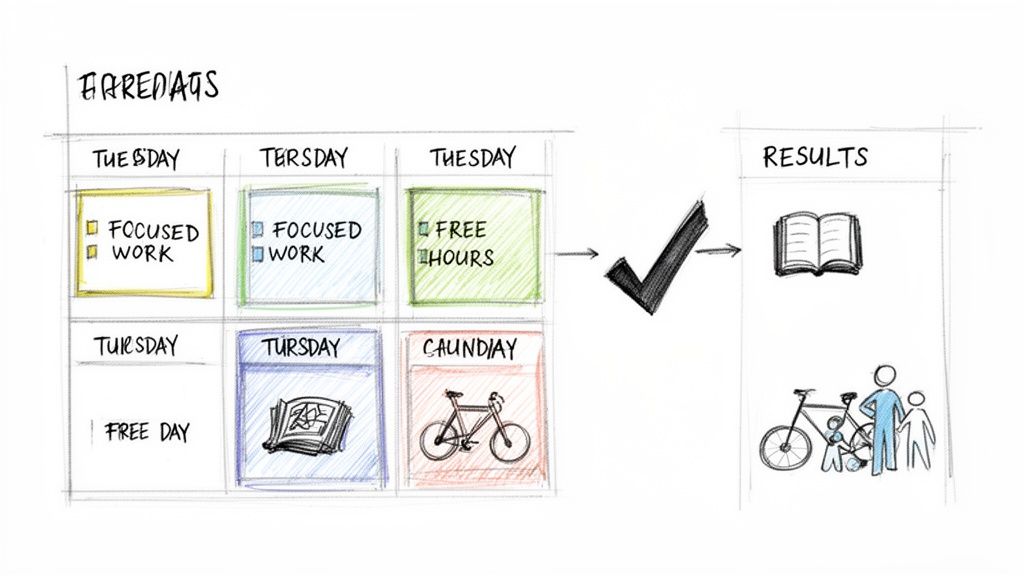
The marketing manager. Jamie works at a company that adopted a four-day week. She works a compressed schedule of four eight-hour days, with every Friday off.
Predictable, structured flexibility is a cornerstone of effective integration. A dedicated day for life's necessities — appointments, home projects, personal pursuits — frees up mental space during the working week.
Because Jamie knows Friday is hers, her Monday-to-Thursday workdays are sharply focused. She is not squeezing a dentist appointment into a packed Tuesday. Work gets her full attention; her life gets its own day.
Structured Flexibility Models
These scenarios do not happen by accident. They are powered by deliberate work structures. Companies that genuinely support integration do not just say "be flexible" — they build frameworks that make it real:
- 9-day fortnight. You work your standard hours across nine days instead of ten, taking every other Friday off. The result is a regular three-day weekend.
- Half-day Fridays. Full days Monday to Thursday, wrapping by noon on Friday.
- Results-only work environment (ROWE). Output is the only thing that matters. As long as the work meets a high standard, employees have full autonomy over when and where they do it.
Each of these chips away at the old habit of judging performance by hours at a desk. They run on trust, autonomy, and a shared understanding that people do their best work when they control their own time.
How the Four-Day Week Champions Integration
Flexible schedules open the door to work-life integration. The four-day week builds a direct route to it. It is more than a shorter schedule — it is a framework that redesigns the relationship between professional output and personal life.
Work-Life Balance Jobs with Genuinely Reduced Hours
Save one to come back to it — it's free.

The model forces a healthy shift in focus, moving the measure from hours logged to results delivered. That naturally builds the autonomy and trust at the heart of an integrated lifestyle.
From Philosophy to Practical Reality
The real value of the four-day week is how it turns integration from a nice idea into an everyday reality. A full, dedicated day for personal life eases the pressure to squeeze errands, appointments, and rest into evenings and weekends.
That structural change allows a calmer blend during the actual workdays. You are far less likely to feel torn between a deadline and a doctor's appointment when there is a built-in day for life's logistics.
The four-day week is not about working less; it is about working smarter. It creates intentional space for both deep work and deep life, letting each enrich the other instead of competing.
The evidence is encouraging. The UK's 2022 four-day-week pilot — the largest trial of its kind, covering 61 organisations and around 2,900 workers — found that 71% of employees reported reduced burnout, sick days fell, and revenue held broadly steady. The model works because people are often more productive when measured by output than by the hours they clock.
How It Builds a Culture of Integration
Running a four-day week requires a company-wide commitment to efficiency and trust — the ideal soil for integration to grow. To make it work, teams adopt smarter habits:
- Rethinking meetings. Cutting unnecessary meetings to free time for focused work.
- Prioritising asynchronous communication. Using tools that let people collaborate on their own schedules.
- Defining clear goals. Making sure everyone knows what success looks like, regardless of when or where the work happens.
These practices do more than make a shorter week possible. They build a culture where employees are trusted to manage their time and energy, with the focus squarely on performance and wellbeing.
The result is a workforce that is more engaged and more present. Knowing they have a full day to recharge, people bring more clarity to their four workdays. Different versions suit different teams — our breakdown of the four-day work week schedule shows how the model can be adapted.
How to Land an Integration-Friendly Job
Knowing you want work-life integration is the easy part. Finding a company that genuinely lives it is the real challenge. It takes a little strategy — both in how you read job posts and in the questions you bring to the interview.
Treat your job search as a two-way street. While they decide whether you fit, you do your own detective work: is their culture actually what they claim? You are looking for the small signals of a real commitment to flexibility and trust.
Decode Job Descriptions for Clues
The language a company chooses says a lot. Look past the responsibilities for phrases that signal a genuinely integration-friendly culture:
- Flexible schedule. Obvious — but read the context. Does it sound like a core value or a copy-pasted perk?
- Asynchronous communication. A strong indicator that the company trusts people to deliver on their own timeline rather than be online around the clock.
- Results-oriented culture. A good sign that success is measured by what you accomplish, not hours at a desk.
- Autonomy and ownership. Suggests they want people they can trust to manage their own time and projects without micromanagement.
Sifting through thousands of listings is a grind. It is far easier on a board built for this — you can browse jobs with flexible hours or explore companies offering reduced-hours schedules to cut straight to employers already on board. Our breakdown of the different types of flexible work can also help you identify which model suits your life best before you apply.
Ask the Right Questions in Your Interview
Once you have the interview, use it to see what is really going on behind the curtain. The goal is to get past polished, HR-approved answers and understand what day-to-day life actually looks like.
Do not just ask if the company supports flexibility. Ask for proof. Concrete examples separate a company that talks the talk from one that walks it.
A few questions worth bringing:
- "Can you give me an example of how someone on the team uses the flexible schedule to integrate their work and life?"
- "How does the team handle communication and collaboration when people are on different schedules or in different time zones?"
- "What does autonomy actually look like for this role in a typical week?"
- "How do you measure success for this position, beyond hours logged?"
When you raise your own desire for integration, frame it as a benefit to them: you do your best work when you have control over your energy and focus. That positions you not as someone asking for a perk, but as a self-aware, high-performing candidate who knows how to work sustainably.
Answering Your Top Questions
Even once the concept clicks, practical questions surface. Here are the ones that come up most.
Is Work-Life Integration Just a Sneaky Way to Make Me Work More?
It is a fair concern, and one of the most common myths. The honest answer is no.
True integration is not about letting your job swallow your personal time. It is about designing your day to be more effective and more fulfilling, in and out of work. The real aim is control — being able to be fully present whether you are leading a meeting or having dinner with family. You swap the rigid 9-to-5 for a more fluid approach built on trust and measured by output.
What if I Can't Disconnect From My Job?
Boundaries matter just as much in an integrated model — they just look different. The trick is to create intentional off-ramps rather than a rigid wall between work and life:
- Time-block for your life. You block time for big work projects; do the same for personal commitments. Put that workout or reading time on the calendar with equal weight.
- Communicate your availability. Tell your team when you will be offline. A quick status update sets clear, respectful expectations.
- Use technology deliberately. Your phone does not have to be a 24/7 portal to the office. Turn off work notifications after a set hour.
Is Integration Only for Remote Workers?
Working from home certainly makes integration easier, but the philosophy is not tied to a location. Plenty of in-office and hybrid roles adopt integration-friendly policies, because it is less about where you work and more about how much your employer values your autonomy and time. That might mean flexible start and end times, compressed weeks, or simply a culture where nobody blinks at a midday break for an appointment.
Ultimately, work-life integration is about building a sustainable career in which your professional goals and your personal wellbeing genuinely support each other. It takes a shift in mindset — toward trust, clear communication, and mutual respect — but the payoff is a working life that feels whole rather than split in two.




Get 4-day week jobs in your inbox
Create a free account to receive curated opportunities weekly.
Sign up for freeFree forever. No spam, unsubscribe anytime.