
Remote work has rewritten the rules of business coordination.
What used to happen in one office, one time zone, and one shared calendar now spans continents, calendars, and chaos.
Managers face a puzzle that constantly changes shape: how to make schedules work for people who might never share a physical space. Staff scheduling has always been a tricky job, but in the remote era, it’s turned into a daily balancing act of fairness, technology, and timing.
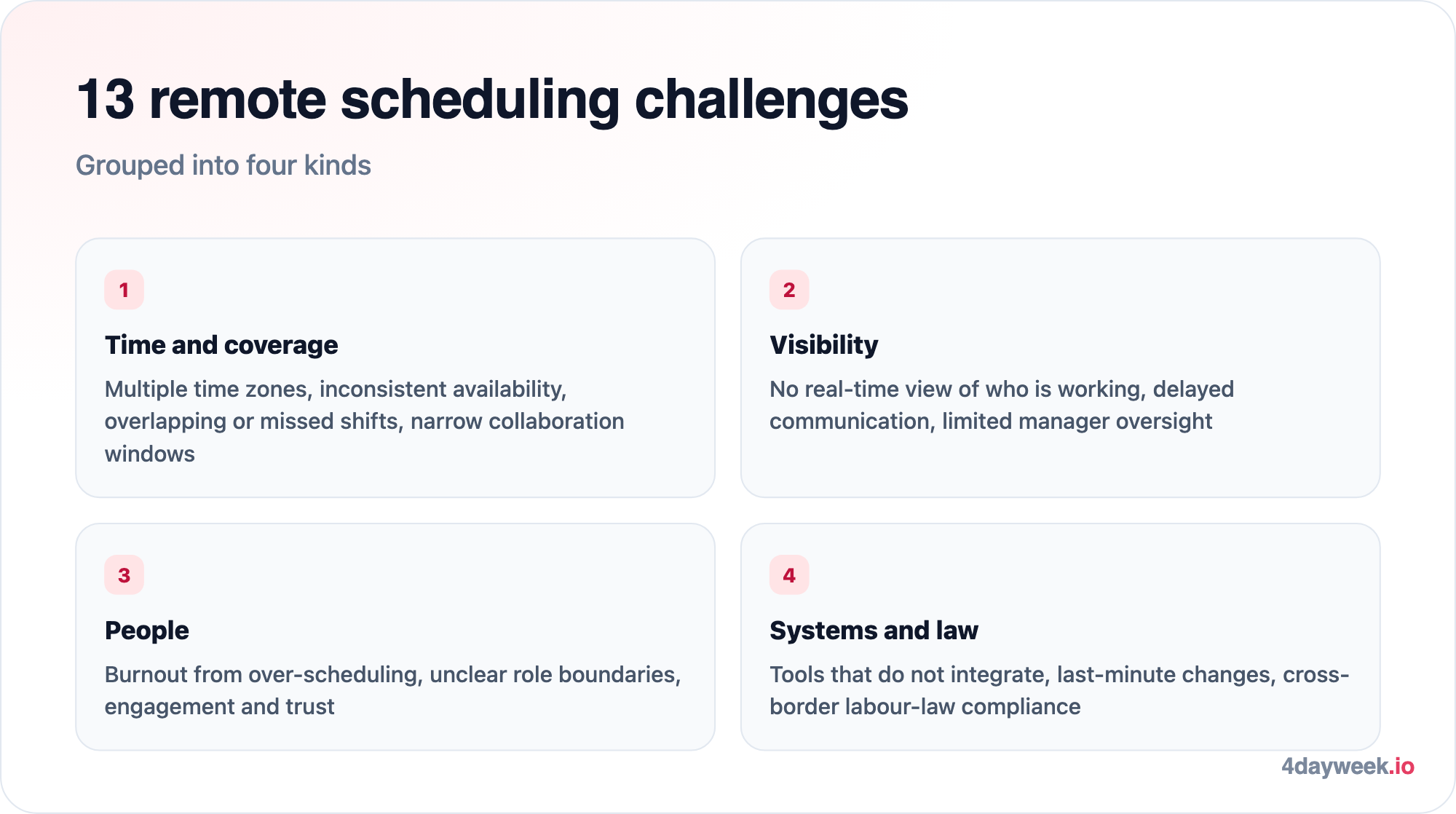
Below are 13 of the biggest challenges companies face and what can be done to fix them.
1. Managing Multiple Time Zones
When teams stretch from Singapore to San Francisco, one person’s morning meeting is another’s midnight call. It’s not just inconvenient; it’s unsustainable if ignored. Managers now rely on shared calendars that automatically convert time zones and highlight overlapping hours. Without them, scheduling becomes a guessing game that frustrates everyone involved.
2. Inconsistent Work Availability
Not everyone clocks in at nine or logs off at five anymore. Personal routines, local holidays, and flexible contracts all mean availability is unpredictable. Unless teams clearly define when people are reachable, projects start slipping. The solution often lies in transparency: shared availability charts and structured communication about working hours prevent missed connections.
3. Lack of Real-Time Visibility
In an office, you can glance around and see who’s working. Remotely, that’s gone. Managers lose track of who’s online, what’s in progress, or when someone’s on break. Without visibility, workload balance becomes guesswork. Modern dashboards and time-tracking tools fill the gap, helping teams see activity patterns without turning into surveillance systems.
4. Communication Delays and Misalignment
Messages get buried, responses take hours, and suddenly tasks pile up in confusion. The delay in communication across time zones isn’t about laziness; it’s logistics. Asynchronous tools like recorded updates, shared project boards, and clear status tags can prevent unnecessary follow-ups. Communication isn’t just about speaking; it’s about designing how the message flows.
5. Overlapping or Missed Shifts
When people rely on outdated spreadsheets or manual calendars, mistakes happen. Two people show up for the same task, or worse, no one does. Automated reminders and AI-based scheduling tools reduce this mess. They detect overlaps and fill in empty shifts before they become problems, keeping operations smooth and predictable.
6. Burnout and Over-Scheduling
Remote workers often feel invisible pressure to stay online longer, just to prove they’re present. Managers sometimes pile on extra shifts without realizing the impact. Burnout grows quietly in these moments. Tracking workloads and enforcing mandatory rest periods helps. The healthiest teams know that sustainable productivity beats constant activity every time.
7. Limited Collaboration Windows
Time zone gaps create small pockets of overlap where everyone can meet. When those hours are overused, fatigue sets in fast. Smart teams plan a few fixed collaboration hours each week and let the rest run asynchronously. It’s not perfect, but it preserves energy while maintaining a sense of unity.
8. Unclear Role Boundaries
Remote work often blurs who’s responsible for what. Without physical cues or direct supervision, staff might take on overlapping duties or ignore tasks they assume belong to someone else. Defining roles in scheduling software can prevent chaos. When responsibilities are visible, collaboration becomes structured rather than confusing.
9. Difficulty Adapting to Last-Minute Changes
People get sick. Power goes out. Wi-Fi collapses. Last-minute disruptions are part of remote work life. The real challenge isn’t the event itself but how fast teams adapt. Flexible scheduling systems that allow easy swaps or quick adjustments can make these surprises less damaging. Agility has become just as valuable as planning.
10. Technology Integration Issues
Remote Jobs with a Great Work-Life Balance
Save one to come back to it — it's free.



Every team has its collection of apps, from chat to calendars to project trackers. The problem starts when these systems don’t sync. One platform updates, another doesn’t, and schedules fall apart. Integrating everything into a unified tool or at least automating data transfers between systems saves hours of cleanup later.
11. Compliance and Labor Law Complexity
Global teams mean multiple labor laws, overtime regulations, and rest requirements. A scheduling system that works in one country might break laws in another. This is where AI-assisted compliance tracking matters. It ensures shifts respect local rules automatically, sparing companies from costly mistakes and protecting employee rights across borders.
12. Limited Manager Oversight
In remote setups, managers can’t casually check attendance or see who’s stretched thin. Oversight becomes abstract. Too little control leads to chaos; too much feels invasive. Transparent logs and regular check-ins provide a balance. Managers get the visibility they need without crossing into micromanagement territory.
13. Employee Engagement and Trust Issues
Scheduling isn’t just logistics; it’s about respect. When employees have no say in their hours, trust erodes. Remote workers especially crave autonomy, and rigid schedules can kill morale. Collaborative scheduling that lets staff swap shifts or submit preferences creates a sense of ownership. When people feel heard, they show up with more energy.
Building a Smarter Scheduling Strategy
Solving these challenges takes more than clever tools. It requires a shift in mindset. The best systems mix automation with empathy. Technology can handle time zones, notifications, and compliance, but only humans can understand motivation and fatigue. That’s where real leadership happens.
The most effective staff scheduling strategies start with communication. Managers who talk openly about expectations build flexibility into their structure. Instead of treating scheduling like a puzzle to complete, they treat it as a living process that adjusts to changing workloads and team moods.
AI-driven scheduling platforms now make it easier to adapt in real time. They analyze availability, detect workload imbalances, and suggest optimized plans automatically. Yet the best managers don’t hand full control to algorithms. They use these tools as aids, checking that every automated decision still makes sense for human beings.
Conclusion
Remote staff scheduling isn’t simple. It’s a complex dance of time, technology, and temperament. Yet every challenge on this list has a solution waiting in better design, clearer communication, and smarter planning.
Managers who rethink scheduling as a human-centered process, supported by adaptable tools, will see more than efficiency. They’ll see loyalty. They’ll see energy. They’ll see a team that feels balanced and respected, even across continents.
The future of remote scheduling isn’t about eliminating challenges; It’s about mastering flexibility. And the organizations that do will find that distance doesn’t divide; it just demands smarter coordination.




Get 4-day week jobs in your inbox
Create a free account to receive curated opportunities weekly.
Sign up for freeFree forever. No spam, unsubscribe anytime.