
Constantly feeling pulled between your job and everything else? If you're trying to figure out how to improve work-life balance, the real answer isn't about finding more hours in the day. It's about setting intentional boundaries, managing your energy rather than just your time, and advocating for the flexibility you actually need.
Think of it as a series of small, consistent adjustments that steadily reclaim your personal time and dial down work-related stress. This guide walks through five practical steps you can start using this week.
Why a Balanced Life Feels Just Out of Reach

If you feel like you're perpetually juggling, you're in good company. For many of us, the line between professional and personal life has become genuinely blurry, which leaves people feeling drained, overwhelmed, and disconnected from what matters most. This isn't just a feeling — it's a measurable, widespread reality.
The constant pressure to be "on," paired with the non-stop buzz of notifications, means work follows us everywhere: home, evenings, even holidays. That makes it hard to mentally switch off and properly recharge.
A Major Shift in What We Value at Work
Today's workforce is sending a clear message: balance is no longer a "nice-to-have" perk. It has become a core driver of career satisfaction. Randstad's 2025 Workmonitor — a survey of more than 26,000 workers across 35 markets — found that, for the first time in the report's 22-year history, work-life balance edged out pay as a top motivator (83% rated balance important versus 82% for pay). The same study found 44% of workers had quit a job they considered toxic.
This isn't a passing trend. It's a fundamental change in how people define a "good job," and they're actively seeking out roles and cultures that respect personal time. Recognising that shift is the first step toward making a real change of your own.
Your Guide to Reclaiming Balance
This guide cuts through the fluff and gives you a clear roadmap of practical strategies. Here's a quick look at the common pain points and the five steps that address them.
| Common Challenge | Core Strategy in This Guide |
|---|---|
| Feeling constantly drained and unfocused | Manage your energy, not just your calendar — energy audits and time blocking. |
| Struggling to say "no" or unplug after hours | Set firm boundaries that stick, with clear communication scripts. |
| Wanting more flexibility (like a four-day week) | Build a business case and negotiate for a schedule that fits your life. |
| Burnout from a culture of overwork | Learn from the countries and policies that protect personal time. |
Let's start building a more sustainable working life, one step at a time.
Step 1: Master Your Energy, Not Just Your Calendar
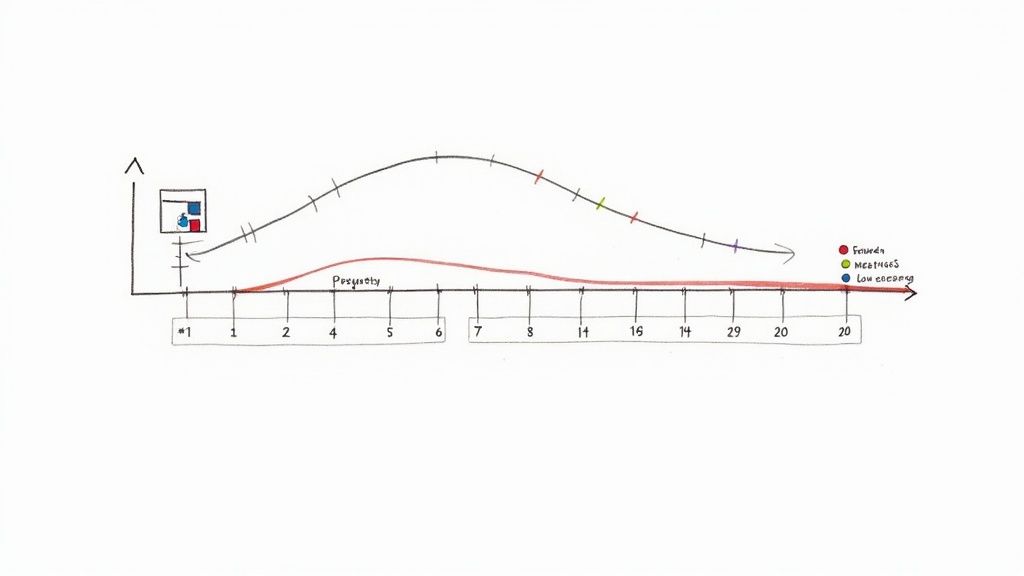
Most of us have been sold the myth of time management — the idea that every hour on the clock is created equal. It isn't. The hour you have at 9 AM, fresh off your first coffee, is a world away from the one at 3 PM when the afternoon slump hits.
The real key to reclaiming balance isn't cramming more into your day. It's working with your body's natural rhythm. When you match your most important work to your peak energy windows, you get more done in less time — freeing up mental space and stopping work from bleeding into your evenings.
Conduct a Personal Energy Audit
Before you can manage your energy, you need to know what you're working with. A personal energy audit is a simple but revealing exercise. For one week, pay attention to how you feel through the day: when are you sharp, creative, and focused? When do you feel sluggish or easily distracted?
Grab a notebook or spreadsheet and jot down your energy level on a scale of 1 to 10 every couple of hours. By the end of the week, you'll have a clear map of your personal energy patterns:
- Morning lark? Your sweet spot for deep focus might fall between 8 AM and 11 AM.
- Night owl? Your best ideas may show up after 8 PM.
- Afternoon slump? 2 PM is a common low point for many people.
This isn't just data — it's a blueprint for a smarter workday. You stop fighting your natural rhythm and start flowing with it.
Design Your Day with Time Blocking
Once you know your peaks and valleys, put that knowledge to work with time blocking. Instead of staring at a chaotic to-do list, you proactively assign specific blocks of time on your calendar for specific tasks — matching each task's difficulty to your energy level.
Say you're a project manager whose audit shows mornings are sharpest. Your calendar might look like this:
- 9 AM – 11 AM (high energy): Deep work on a complex strategic plan. No email, no notifications.
- 11 AM – 12 PM (medium energy): Team check-ins or clearing important emails.
- 2 PM – 3 PM (low energy): Autopilot tasks like updating software or organising files.
This fences off your most productive hours from low-value distractions. For an extra boost, try the Pomodoro technique within these blocks — see how tomato timers boost productivity by creating intense, focused sprints.
Prioritise with the Eisenhower Matrix
One of the biggest energy drains is the constant flood of "urgent" requests that aren't actually important. The Eisenhower Matrix sorts your tasks into four quadrants so you can see what truly deserves your attention.
By categorising tasks this way, you shift from a reactive state to a proactive one. The framework helps you reclaim control of your day and dedicate your best energy to what genuinely matters.
Here's the breakdown:
- Urgent and important (do): Crises, pressing deadlines, major problems. Tackle these immediately.
- Important, not urgent (schedule): Strategic planning, relationship building, skill development. Schedule these during your peak energy hours — this is where the long-term payoff lives.
- Urgent, not important (delegate): Most emails, some meetings, other people's minor requests. Delegate where you can, or minimise the time you spend on them.
- Neither urgent nor important (delete): Mindless scrolling, unnecessary notifications, time-wasting habits. Be ruthless and cut them.
When you filter your to-do list through this lens, you stop letting other people's priorities run your day and start protecting your time for the work that actually moves the needle.
Step 2: Set Boundaries That Actually Stick
Setting boundaries is probably the single most powerful thing you can do to reclaim your life from work. So why is it so hard?
Most of us hate the idea of looking uncooperative, or worse, letting the team down. We worry about missing out on the next big project. But if you don't draw clear lines, you're on a fast track to burnout — and the 8 signs of workplace burnout shows just how quickly the warning signals can accumulate.
The trick is to stop thinking of a boundary as a wall. It isn't. It's a clear set of instructions on how to work with you effectively. Being professional and predictable builds trust — it doesn't break it.
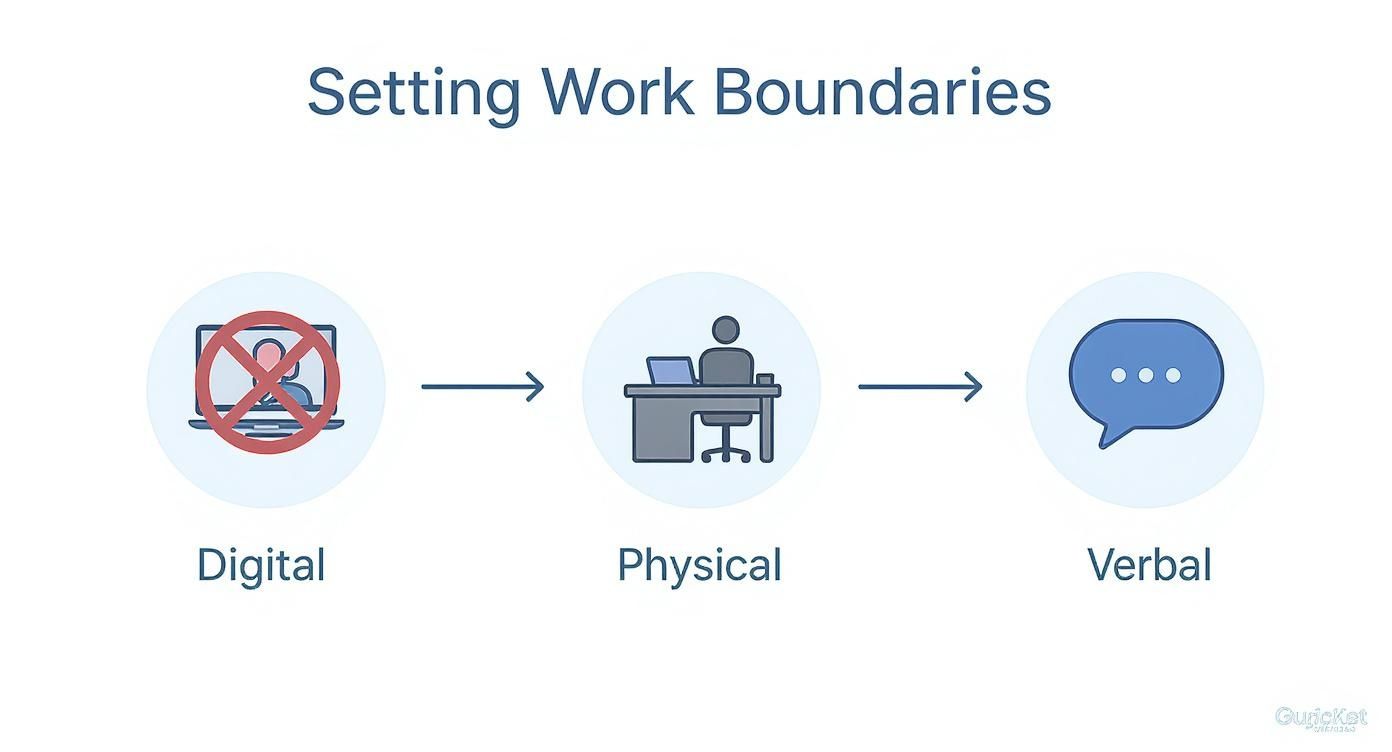
Create Your Digital Fortress
In an always-on world, your first line of defence has to be digital. Your phone and laptop are the main routes work uses to creep into personal time, often so subtly you don't notice. That constant ping from Slack or email creates a low-grade hum of anxiety that makes it impossible to truly switch off.
Taking back control of your digital world isn't optional — it's essential:
- Silence the noise. Go into your phone's settings and turn off notifications for work apps. Banners, sounds, badge alerts — disable them all for Slack, Teams, and email. If there's a genuine emergency, someone will call.
- Set a digital curfew. Decide on a hard stop for the day. After that time, the work laptop stays closed and your phone is for you, not your boss.
- Use scheduling tools. Have a great idea at 10 PM? Don't send the email. Use the "schedule send" feature in Gmail or Outlook so it lands in the recipient's inbox at 8 AM. This respects your team's downtime and stops you triggering a late-night chain reaction.
This matters because the boundary erosion is real. SurveyMonkey's research found that 54% of workers check work email while on holiday, and 28% say they're asked to do work during their time off. Remote work gave us flexibility, but it also blurred the lines so badly that many people feel they live at the office.
Learn the Art of the Professional No
Saying "no" at work is a skill, and like any skill it takes practice. It feels uncomfortable at first, but you can do it without torching your reputation. The goal is to decline the request, not the person — communicating your current capacity and helping the other person find another way forward.
A polite but firm "no" is one of the most effective productivity tools you have. It protects your time for high-priority work and signals that your workload is managed with intention.
Here are a few scripts you can adapt:
- When you're already swamped: "Thanks for thinking of me for this. My plate is full with [Project X] and [Project Y] right now, and I wouldn't be able to give this the attention it deserves. Have you considered asking [colleague]? Or could we revisit it next quarter?"
- When the deadline is unrealistic: "I can take this on, but meeting that Friday deadline would mean pushing back the client report. I'm happy to prioritise either — which is more important for you right now?"
- When the request lands after 5 PM: "Thanks for sending this over. I'm offline for the day, but I'll pick it up first thing tomorrow and get back to you."
Notice the pattern: each response is collaborative. You're not a brick wall — you're a strategic partner offering a solution, forcing a priority check, or managing expectations. This shows you're committed and engaged, and that you're the one in control of your time.
Fortify Your Physical Space
If you work from home, physical boundaries matter as much as digital ones. When your office is also your living room, your brain never gets the signal that it's okay to shut down. Creating a real, physical separation tells your mind the workday is over.
If you have a dedicated office, close the door at the end of the day — and don't go back in. If your "office" is a corner of the kitchen table, build a shutdown ritual instead: pack your laptop and notebook into a bag, turn off the monitor, or drape a cloth over your desk setup. These small physical acts create a surprisingly powerful mental shift from "work mode" to "home mode."
Step 3: Make the Case for a More Flexible Work Life
You've set boundaries and started managing your energy — but what if the real problem is the 9-to-5 structure itself? Pitching a more flexible schedule (a four-day week, a hybrid model, or different hours) can feel like a big leap. It's often the most direct path to a working life you can actually sustain.
The trick is to stop framing it as a personal favour. This isn't about getting more time off; it's about proposing a smarter, more efficient way of working that benefits both you and the company. Frame it as a strategic business decision and you're halfway there.
Build Your Case on Mutual Wins
Before you book a meeting with your manager, do your homework. Your boss will have immediate concerns about productivity, availability, and the impact on the rest of the team. Your job is to walk in with answers before the questions are asked.
Start by quietly tracking your own performance for a few weeks. Document key accomplishments, how quickly you complete projects, and any standout results. The goal is a clear picture of high, consistent output.
It also helps to lean on the bigger picture. The four-day week, in particular, now has real evidence behind it. The UK's 2022 pilot — the largest trial of its kind, covering 61 organisations and around 2,900 employees — found that 71% of staff reported reduced burnout and 39% were less stressed, with no adverse impact on company revenue. A year on, 89% of the participating organisations had kept the policy and 51% had made it permanent. Flexibility isn't just a perk — it's a proven driver of retention and performance.
Work-Life Balance Jobs with Genuinely Reduced Hours
Save one to come back to it — it's free.


Prepare a Clear and Confident Proposal
Use this step-by-step table to prepare a compelling proposal for a flexible arrangement.
| Preparation Step | Key Action | Example Metric to Track |
|---|---|---|
| 1. Define your ask | Decide on the exact schedule. Be specific: a compressed four-day week? A 3/2 hybrid model? | "I propose Monday–Thursday, 9 AM – 6 PM, with Fridays off." |
| 2. Track your output | For 2–4 weeks, document completion rates, achievements, and positive feedback. | "Completed 5 major milestones, exceeding the Q2 target by 10%." |
| 3. Anticipate concerns | Think like your manager. What are their biggest worries? Write them down and prepare answers. | "Concern: availability for urgent questions. Solution: core hours 10 AM – 2 PM." |
| 4. Outline the "how" | Detail your communication plan and how you'll keep team collaboration intact. | "All updates logged in Asana by EOD Thursday; available for emergencies via Slack." |
| 5. Propose a trial | Suggest a 30- or 60-day trial with clear success metrics to lower the perceived risk. | "Let's review output, feedback, and project status after 30 days." |
Once you have your data, structure your proposal around exactly how you'll maintain — or improve — your current performance. For example:
- For collaboration: "I'll block dedicated hours for team meetings and stay fully responsive on Slack during core business hours, even on remote days."
- For availability: "I'll wrap up key responsibilities before my day off and keep a shared status document updated so the team can see where my projects stand."
- For productivity: "By batching deep work into focused, uninterrupted days, I expect to cut meeting time and channel that energy into the highest-priority tasks."
A plan like this shows you're thinking about the team's success, not just your own. There are many ways to structure these arrangements — explore some flexible working examples to find a model that fits your role. Our guide to what a flexible job actually means breaks down the different schedule types so you can choose the right one to propose.
Use a Script to Guide the Conversation
Walking into the meeting with a script calms the nerves and keeps things focused. Adapt this template to your own voice:
"Thanks for making the time. I'd like to discuss my work structure and propose a change I genuinely believe will boost my productivity and benefit the team. I'm consistently hitting my goals on [Project A] and [Project B], and I've been thinking about how to optimise my workflow further.
I'd like to propose a trial period for a [hybrid schedule / four-day week]. My plan is to [one-sentence overview of availability and collaboration]. I'm confident this will give me more focused time for key projects, and I've put together a document outlining how I'll keep everything running smoothly for the team."
This opens a discussion rather than making a demand, and frames you as a proactive, solution-focused team member.
Propose a Trial Period
Suggesting a trial run is the single most effective move here — it instantly lowers the stakes for your manager and gives you a concrete chance to prove the setup works. Ask for a 30- or 60-day trial, and define clear success metrics before you start: hitting deadlines, maintaining response times, gathering positive feedback from colleagues.
When the trial ends, schedule a follow-up to review the results together. When you can point to hard data, it's far harder for anyone to say no — and it shows you're committed to making the arrangement a win for everyone. If you want a full set of scripts and tactics, our guide on how to ask your boss for a four-day work week walks through the whole conversation.
Step 4: Learn From Countries That Master Work-Life Balance
Sometimes it helps to zoom out. Some countries have woven work-life balance into their cultural and legal fabric, showing what's possible when well-being is treated as a genuine priority rather than an afterthought.
These nations consistently top global rankings, and it isn't an accident. It's the result of deliberate policy and a shared mindset that values life outside the office. By looking at what they get right, you can find practical ideas to bring to your own workplace.
What Top-Ranking Countries Get Right
Countries like New Zealand, Ireland, and Norway don't just pay lip service to balance — they've built systems to support it: generous leave, shorter working weeks, and a cultural understanding that productivity isn't about being constantly available.
New Zealand currently tops Remote's Global Life-Work Balance Index, scoring 86.59 out of 100 — its third year at number one, with Ireland close behind on 81.17. Norway pairs a short average working week with one of the world's most generous parental-leave systems — 49 weeks at full pay, or 59 weeks at 80%. And Germany, despite a working week that Eurostat data puts at under 34 hours on average, remains one of the most productive economies in the world — strong evidence that hours logged and value delivered are not the same thing.
The common thread: when people can rest, recover, and care for their families without taking a financial hit, performance holds up. Rest isn't the enemy of productivity — it's a precondition for it.
Principles You Can Advocate For at Work
You don't need to emigrate to borrow these ideas. The core principles are surprisingly portable:
- Discourage after-hours communication. France's right-to-disconnect law — in force since 2017 — protects employees who don't respond to messages outside working hours. You can champion the same mindset with a simple team guideline: no non-urgent emails or messages after a set time.
- Champion generous, genuinely-used leave. Advocate for clear policies around sick days, mental health days, and parental leave — and, crucially, a culture that encourages people to actually take them.
- Focus on output, not hours. Germany's culture tends to prioritise focused, efficient work over long days. Suggest performance metrics that reward results rather than time logged at a desk.
The biggest lesson from these countries is that rest isn't the enemy of productivity — it's a key ingredient. When people are supported by strong policies and a culture that respects personal time, they bring their best, most energised selves to work.
These ideas aren't just good for employees — they're a strategic advantage for any company trying to attract and keep talent. If you're looking for employers who already work this way, browse our directory of companies offering four-day weeks and flexible schedules. Our guide on companies with the best work culture helps you separate employers with genuine structural commitments from those with good marketing copy.
Step 5: Build a Sustainable Practice, Not a One-Off Fix
Finding a better work-life balance isn't a one-and-done deal. It's an ongoing practice, built from the small, intentional choices you make every day: managing your energy, holding firm boundaries, and being willing to ask for the flexibility you need to thrive.
This isn't about perfection — it's about progress. Meaningful change starts with small, manageable steps, so don't feel you have to overhaul your entire life by tomorrow. Pick one thing that feels doable right now:
- Try a digital curfew. For one week, turn off all work notifications after a set time and see how it feels.
- Block off deep work time. Schedule a single two-hour block for your most important task and treat it as sacred.
- Practise saying "no." Use one of the scripts above to decline a single low-priority request this week.
These might seem minor, but they create momentum. Each step reinforces your control over your time and well-being.
True balance is a dynamic process of continuous adjustment. It's about recognising when things are off-kilter and having the tools and confidence to gently guide them back into alignment.
A Few Common Questions
How do I manage balance if my company celebrates long hours? Shift the conversation from time spent to results delivered. Become ruthlessly efficient during core hours and let your output do the talking. Communicate your availability clearly — a simple line in your email signature, such as "My working hours are 9 AM to 5 PM," sets expectations without sounding confrontational. It also helps to find allies who value balance and can reinforce the same standard.
Is real balance possible in a competitive industry? Yes, but you have to play differently. In high-pressure fields, simply unplugging isn't always realistic. Lean on technology to automate repetitive work, be selective about what you say yes to, and — most importantly — schedule your downtime with the same seriousness you'd give a major client meeting. That scheduled recovery is what sustains performance over the long haul.
What small things deliver an immediate improvement? Set a hard stop time and stick to it. Take a real lunch break away from your desk — even 20 minutes of genuine separation resets your focus. And turn off work-app notifications on your personal phone after hours. These small wins build the momentum that makes bigger changes easier.
Ultimately, the power to build a sustainable working life is in your hands. Start small, stay consistent, and remember that every intentional choice is a step toward the balance you're looking for. And if you decide the structure itself needs to change, you don't have to settle — there are employers built around reduced hours and flexibility, and they're hiring.




Get 4-day week jobs in your inbox
Create a free account to receive curated opportunities weekly.
Sign up for freeFree forever. No spam, unsubscribe anytime.