
Reducing stress at work is about far more than telling employees to practise mindfulness. It is a strategic business decision. Real change happens when leaders grasp the financial and operational drains that chronic pressure creates, then build policies that fix the root causes — usually poor work-life balance and unrealistic workloads.
The Hidden Costs of Workplace Stress

Many leaders still treat employee stress as a personal problem — a soft metric that is hard to pin down. But unchecked pressure quietly erodes a company's foundation, creating real financial and operational holes.
When stress becomes the default setting, the consequences ripple through every team. We are not talking about minor dips in productivity. Chronic stress feeds directly into business costs that show up on the balance sheet.
The Financial Drain of a Stressed Workforce
The economic hit from job-related stress is substantial. The costs are difficult to total with precision — widely circulated headline figures rest on shaky, decades-old estimates — but the components are concrete and measurable, and they appear in three main areas.
- More sick days. Stressed employees call out more often, for mental health as well as physical illness. That means missed deadlines and a heavier load on everyone else.
- People quitting. Burnout is one of the leading reasons people walk away, and replacing them is expensive. The Society for Human Resource Management estimates the cost of replacing an employee at between roughly half and twice their annual salary once recruiting, hiring, onboarding, and lost productivity are counted — and far more for specialised roles.
- Less innovation. A team running on fumes is in survival mode, not growth mode. Creativity dries up and problem-solving slows, because nobody has the bandwidth for big-picture thinking.
A stressed employee is not just an unhappy employee — they are a direct risk to a company's financial health and competitive edge. Addressing wellbeing is a core business strategy, not a perk.
The Link Between Stress and Engagement
Beyond the obvious costs, chronic stress corrodes engagement. A disengaged employee is psychologically checked out: work quality drops, and the connection to company goals frays.
This creates a vicious cycle in which low engagement fuels more stress, making the team environment worse for everyone. Poor work-life balance is a major contributor — a pattern reflected across the work-life balance statistics we track. Knowing the 8 signs of workplace burnout helps managers catch the warning signals before this cycle takes hold.
Investing in stress reduction is not an expense. It is a practical investment in building a resilient, innovative, and profitable business.
On-the-Spot Stress Relief for Individuals

Big-picture policies are essential for lasting change, but sometimes you just need to get through the next five minutes. An unexpected deadline, a project hitting a wall, a difficult conversation — these moments call for immediate, personal tools you can use right at your desk.
Think of these techniques as circuit breakers. They interrupt the cycle of rising pressure before it takes over your day, letting you reset and approach the problem with a clearer head.
Ground Yourself in the Present Moment
When your thoughts are racing, grounding techniques pull you out of the "what-if" loop and back into reality. One of the simplest and most effective is the 5-4-3-2-1 method, which uses your senses to reconnect you with your immediate surroundings.
You can do it discreetly at your desk in under a minute. Take one slow, deep breath, then silently identify:
- 5 things you can see: your monitor, a pen, the plant in the corner, a scuff on the floor, the colour of your mousepad.
- 4 things you can feel: the texture of the desk, the chair against your back, your feet flat on the floor, the cool side of a water bottle.
- 3 things you can hear: the hum of a computer, distant chatter, the sound of your own breathing.
- 2 things you can smell: the faint scent of coffee, soap on your hands.
- 1 thing you can taste: the lingering trace of your morning tea or coffee.
The exercise forces your brain to stop spiralling and focus on tangible, neutral information. It is a useful tool when your mind feels overloaded.
Master Your Breath to Calm Your Nerves
Your breath is the fastest way to influence your body's stress response. Under stress, breathing naturally turns shallow and quick, signalling to your nervous system that you are in danger. Slowing it down deliberately reverses that signal.
A reliable technique is "box breathing" — also used by emergency responders and military personnel to stay calm under pressure. Slow, rhythmic breathing at roughly five to six cycles a minute activates the parasympathetic nervous system, the part responsible for the body's "rest and digest" state.
How to practise box breathing:
- Inhale slowly through your nose for a count of four.
- Hold your breath for a count of four.
- Exhale slowly through your mouth for a count of four.
- Hold at the bottom of the exhale for a count of four.
Repeat the cycle three to five times. The steady, predictable pattern helps regulate your heart rate and sends a clear message to your brain: it is safe to relax.
Take Strategic Micro-Breaks
Stepping away when you are overwhelmed can feel impossible, but a short, intentional break is one of the best things you can do for your focus. A five-minute micro-break is not about scrolling social media — that usually adds to the noise. It is about fully disengaging from work.
A purposeful five-minute break can reset your cognitive function more effectively than grinding through another hour. It is an investment in productivity, not a loss of time.
Try one of these next time you feel stuck:
- Walk to a window and look outside for a few minutes.
- Do a few simple stretches at your desk.
- Put on headphones and listen to one calming song with your eyes closed.
- Get up, pour a glass of water, and drink it slowly.
These small pauses stop mental fatigue from compounding, leaving you more resilient for the rest of the day. If you want to get more structured about it, productivity techniques like tomato timers build effective work-rest cycles into your routine.
Building a Low-Stress Team Culture
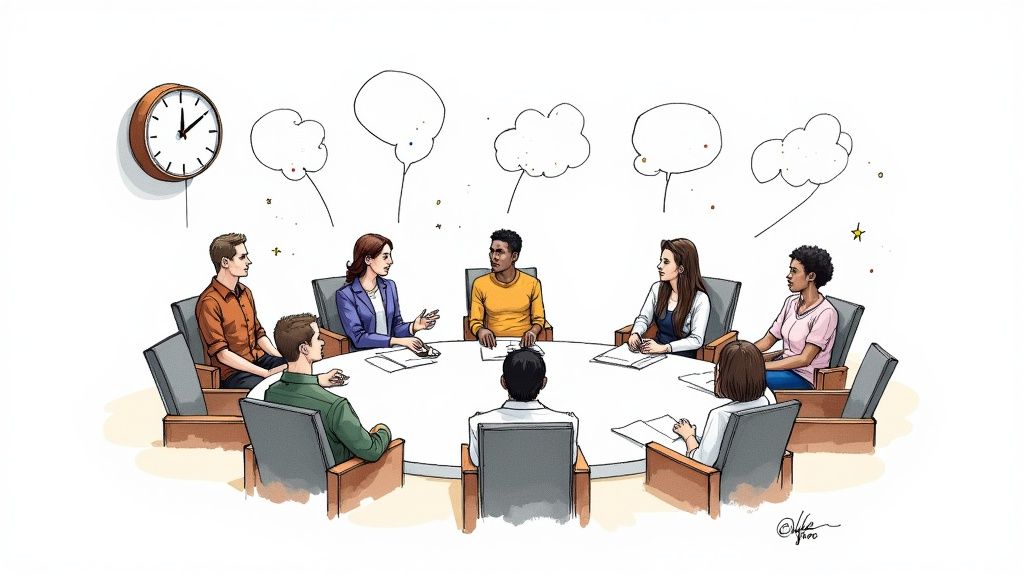
Personal coping skills help, but on their own they are a bandage on a bigger problem. To tackle stress properly, you have to build a team culture where pressure is managed together rather than shouldered alone. As a leader, you are the architect of that environment.
Everything you do — how you communicate, how you run meetings, how you handle deadlines — sets the tone. By deliberately creating psychological safety and support, you build a buffer against the daily grind that leads to burnout. The aim is not to eliminate pressure but to build a team resilient enough to handle it.
Establish Crystal-Clear Communication
Nothing fuels anxiety like ambiguity. When people do not know what is expected, what the priorities are, or how they are performing, their minds fill the blanks with worst-case scenarios. A manager's first job is to bring clarity.
That means ditching vague instructions. Instead of "let's get this done soon," give a specific deadline: "I need the first draft by 3pm on Thursday." The shift removes the guesswork and lets people plan their time without stress.
Clear communication also means:
- Defining channels. Make it obvious where each kind of conversation happens — quick updates in one place, formal records in another, task-specific questions in your project tool.
- Setting response times. Be explicit about when people should respond, especially after hours. This prevents the always-on feeling that wears people down.
- Encouraging questions. Build an environment where asking for help or clarification reads as a strength, not a weakness.
Redesign Your Meetings to Energise, Not Drain
Meetings are a strong contender for the most draining part of the workday. A poorly run meeting does not just waste time — it pulls the energy out of the room. Rethinking your approach can turn meetings into genuinely productive sessions.
First, ask whether a meeting is needed at all. Could it be a message or a short written update? If you do need one, give it a clear agenda, a firm goal, and a hard stop.
A meeting without a clear purpose is a recipe for stress. Respect your team's time by making every minute count — focus on collaboration and decisions, not status updates that could be written down.
Get creative where you can. A walking meeting for a one-on-one breaks the monotony and adds fresh air. For team-wide sessions, an interactive tool such as a virtual whiteboard keeps people engaged and focused on the outcome.
Model and Protect Healthy Boundaries
Your team is watching you. If you fire off emails at 10pm or work through your holiday, you send a loud message: this is what it takes to succeed here. Modelling healthy boundaries is one of the most powerful moves a leader can make to lower team stress.
That means visibly logging off. Tell your team when you are done for the day, and stick to it. Encourage them to do the same. This matters especially when managing distributed teams, where the line between home and work blurs fast. For employees looking for practical scripts to hold their own boundaries, how to improve work-life balance in 5 steps is a useful complement to manager-led action.
When leaders get this right, the results are measurable. ADP Research's People at Work 2025 report found that the share of workers reporting daily on-the-job stress fell from 15% in 2023 to 7.5% in 2024 — evidence that workload management, flexibility, and supportive policies make a real, trackable difference.
For quick reference, here is a breakdown of high-impact actions a manager can take to address specific stressors.
Manager's Action Plan for Reducing Team Stress
| Managerial action | Primary stressor addressed | Implementation tip |
|---|---|---|
| Set specific, realistic deadlines. | Ambiguity and overload | Instead of "ASAP," say "by end of day Friday." Track timelines visibly in a project tool. |
| Schedule "no-meeting" blocks. | Meeting fatigue and burnout | Block a few hours on team calendars (e.g. Wednesday afternoon) for focused, uninterrupted work. |
| Publicly sign off for the day. | Always-on culture | A quick "signing off for the day" message in a team channel signals the workday is over. |
| Run regular, informal check-ins. | Lack of support and isolation | Brief 15-minute one-on-ones focused on wellbeing, not just project status. Ask, "how's your workload feeling?" |
| Acknowledge effort, not just results. | Fear of failure | When a project does not go to plan, recognise the team's hard work and problem-solving in the retrospective. |
Putting even a few of these into practice starts shifting a team from constant pressure toward sustainable performance.
High-Impact Policies for a Healthier Workplace
Individual coping skills and solid team leadership are critical pieces of the puzzle. But for a low-stress environment to stick, you need company-wide policies behind them. When an organisation puts wellbeing at its core, it sends a clear message: employee health is a value, not a line item in a wellness memo.
Moving beyond quick fixes means weaving respect for personal time and autonomy into the company's DNA — rethinking traditional work structures and adopting policies that give employees real control over their lives.
Redefining the Workweek With Flexibility
The rigid 9-to-5, five-day week is, for many people, a significant source of stress. Modern policies that offer flexibility are not just perks; they are strategic tools for reducing it, because they acknowledge that people have full lives outside their jobs.
Several models give people more control over their own time:
- Flexible schedules. Employees shift their start and end times. A parent might start at 7am to be home for school pickup; someone else might work 10am to 6pm. It eases the daily pressure of commutes and appointments.
- Hybrid work. Combining office and remote work offers the collaboration of the office and the deep focus of home, while cutting commute time and cost — two major daily stressors.
- Compressed workweeks. Working the same hours across fewer days, such as a four-day, ten-hour schedule, gives employees a full extra day to recharge.
Policies like these signal trust. They let people manage their energy and responsibilities in a way that genuinely works for them.
The Rise of the Four-Day Work Week
One of the most powerful policy shifts gaining traction is the four-day work week. This is not about cramming five days of work into four. The most successful models reduce hours to around 32 a week while maintaining 100% pay, shifting the focus from hours logged to efficient, productive output.
The results from companies that have made the switch are compelling. In the UK's 2022 four-day-week pilot — the largest of its kind, covering 61 organisations — 71% of employees reported reduced burnout and sick days fell by around two-thirds, while company revenue held broadly steady. Giving an entire day back to employees creates real space for rest, hobbies, and family — a potent antidote to chronic stress.
Adopting a four-day week is not just about cutting hours. It is a fundamental redesign of how work gets done. It forces everyone to slash inefficiencies, streamline meetings, and focus on what truly drives results. The outcome is a less stressful, more impactful way of working.
If you are considering the change, it is worth exploring how to structure it. Our guide to the four-day work week schedule breaks down practical models and examples to help you find the right fit.
Investing in Accessible Mental Health Support
Even with the best policies in place, people still face personal and professional challenges. That is why robust, confidential, easy-to-access mental health resources are non-negotiable. Stigma remains a real barrier, so making support visible and simple to use is key.
Employee Assistance Programmes (EAPs) are a strong starting point. These confidential programmes offer short-term counselling, referrals, and follow-up services for everything from financial stress and anxiety to family issues.
Work-Life Balance Jobs with Genuinely Reduced Hours
Save one to come back to it — it's free.

It is worth going further too:
- Generous therapy coverage. Make sure the health plan includes comprehensive mental health coverage with a low co-pay.
- Mental wellness app subscriptions. Free access to meditation, mindfulness, or digital therapy apps offers useful daily support.
- Mental health days. Formalising mental health days within the sick-leave policy encourages people to take time off when overwhelmed, without fear of judgement. Our guide on taking mental health days covers how to use them effectively — both for employees and the managers who need to model the behaviour.
Training Managers to Be the First Line of Defence
Managers have the most direct impact on an employee's daily experience — they are on the front line. The problem is that few are naturally equipped to spot the early signs of burnout or handle sensitive conversations about mental health.
This is where manager training becomes essential. Good training gives leaders the practical skills to:
- Recognise burnout. Spot behavioural changes — increased irritability, disengagement, a drop in work quality.
- Start supportive conversations. Practise asking "are you okay?" in a way that feels supportive rather than intrusive.
- Connect people with resources. Know exactly how to confidentially refer a team member to the EAP or other mental health benefits.
- Model healthy behaviour. Reinforce the value of breaks, holiday time, and logging off at a reasonable hour — by doing it themselves.
When managers are trained to be empathetic and observant, they can step in before stress spirals into a crisis, becoming genuine guardians of their team's wellbeing.
How to Measure the ROI of Your Wellbeing Initiatives
To win long-term support for reducing workplace stress, you have to speak the language of business leaders. Everyone likes the idea of better morale, but what turns a wellbeing initiative from a temporary perk into a strategic priority is a clear return on investment.
That means going beyond satisfaction surveys and into hard data. By tying stress-reduction efforts to key performance indicators, you can show that investing in your team is not an expense — it is an investment in the company's financial health and operational strength.
Connecting Wellbeing to Business Metrics
The first step is to identify the concrete business problems stress is causing. Are you losing good people to burnout? Are projects slipping because of constant sick days? High-stress environments leave a data trail; your job is to follow it.
Focus on numbers that hit the bottom line:
- Retention and turnover. Replacing an employee is costly — and steep for specialised roles. SHRM puts the cost at between roughly half and twice the employee's annual salary, rising sharply for hard-to-fill positions. Track voluntary turnover before and after new policies.
- Absenteeism. Watch the number of unplanned sick days. A drop is a strong sign of a healthier, less burned-out team.
- Productivity and output. Harder to quantify, but trackable through project completion rates, sales targets, or customer satisfaction scores.
- Healthcare costs. A longer game, but a healthier workforce can lead to lower premiums and fewer claims — a powerful metric for long-term ROI.
Flexible work, robust health benefits, and dedicated manager training are the foundational pillars of a low-stress, high-performance workplace.
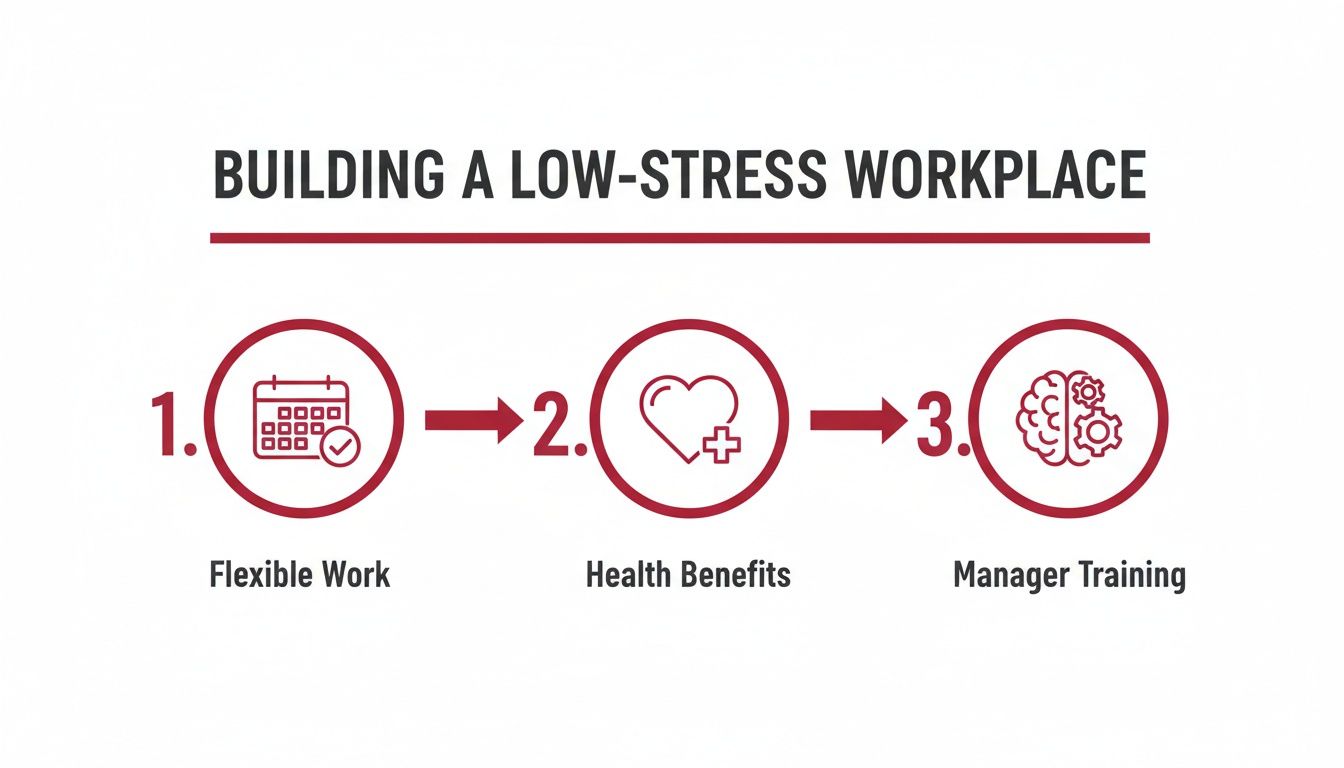
Tracking data across these three areas lets you draw a straight line from your programmes to measurable improvements in both team health and company productivity.
Establishing a Baseline and Tracking Progress
You cannot prove progress if you do not know where you started. Before launching any new programme — a flexible-schedule pilot, a series of manager workshops — collect baseline data. Aim for at least six months of historical data on the KPIs you plan to track, so you have a clear picture.
Once the initiative is live, track those same metrics quarterly. That rhythm lets you spot trends, celebrate wins, and adjust before small issues become big ones. Presenting the data in a simple dashboard makes the impact easy for leadership to see.
Do not wait a full year to report back. Sharing early wins — a drop in sick days in the first quarter, say — builds momentum and reinforces the value of your efforts from the start.
Companies that switch to a four-day week tend to track their results closely rather than hoping for the best. The software-engineering intelligence platform Uplevel, for instance, monitored productivity and wellbeing metrics through its 32-hour-week trial to build the business case for the policy; you can read the outcomes in their four-day week case study.
To get started, here is a set of metrics that tells a compelling story, combining hard numbers with human feedback.
Key Metrics for Tracking Workplace Stress Reduction
| Category | Specific KPI | How to measure | Target outcome |
|---|---|---|---|
| Quantitative | Employee turnover rate | Track voluntary departures via HR records. | Lower turnover, especially among high performers. |
| Absenteeism rate | Monitor unplanned sick days in HR systems. | Fewer sick days per employee on average. | |
| Productivity metrics | Measure output relevant to the role (sales, tickets closed). | Stable or higher output despite fewer hours. | |
| Healthcare claims | Analyse anonymised insurance claim data. | Fewer stress-related claims. | |
| Qualitative | Employee engagement | Use pulse surveys. | Higher engagement scores and positive comments. |
| Stress and burnout levels | Anonymous self-reported surveys. | Lower reported emotional exhaustion and stress. | |
| Manager feedback | One-on-one notes and performance reviews. | Managers report more focused, collaborative teams. | |
| Exit interview data | Collect feedback on reasons for leaving. | Fewer mentions of burnout or workload as exit reasons. |
Measuring the ROI of wellbeing is, in the end, about telling a story with data. Show a clear link between a healthier team and a stronger, more profitable company, and you secure the buy-in needed to build a workplace where people can genuinely thrive.
Your Top Questions About Reducing Workplace Stress, Answered
Even with the best intentions, knowing where to start with workplace stress can feel like a huge task. It is easy to get stuck in the planning phase. Don't — the most important thing is to begin. Here are straight answers to the questions leaders ask most.
What Is the Single Most Effective Policy for Reducing Stress?
There is no silver bullet, but there is a common principle behind the best policies: autonomy.
Any policy that gives your team genuine control over their time and how they work tends to be a major win. It is the thread tying together flexible schedules, hybrid models, and the four-day week.
When people can fit work around their lives — instead of cramming their lives into the gaps left by work — a significant source of daily friction disappears. A parent can make it to a school play without guilt. A team member can book a doctor's appointment without burning a whole day off. That sense of control is a powerful antidote to the helplessness that fuels burnout.
So while a four-day week may be the ultimate goal, the most effective first move is often a flexible-schedule policy: high-impact, low-disruption, and a fast way to hand your team the autonomy they need.
How Can Small Businesses With Limited Budgets Get Started?
You do not need a six-figure wellness budget to make a real difference. Some of the most effective stress-reduction strategies are essentially free — they just require a genuine commitment to changing how you operate.
For a small business, focus on low-cost, high-impact cultural shifts:
- Model healthy boundaries. This costs nothing. Leaders visibly log off, stop sending late-night emails, and encourage people to take their full lunch breaks.
- Fix your meeting culture. Set a simple rule — no agenda, no meeting. Keep them short and purposeful. Giving people back their time is one of the best gifts you can offer.
- Offer flexible hours. Letting employees shift their start and end times is a zero-cost policy that delivers real value, easing the stress of commutes and daily logistics.
One huge but often invisible burden is financial stress. PwC's Employee Financial Wellness Survey has consistently found that financially stressed employees are roughly five times more likely to say money worries distract them at work. Being transparent about pay scales, or partnering with a local credit union for financial-literacy workshops, are low-cost ways to show you care.
Once you have the fundamentals in place, you can look at more structured benefits. Start small and build on your wins.
How Long Until We See a Real Change in Company Culture?
Turning a high-stress culture into a supportive one does not happen in a week — it is a marathon, not a sprint. You will likely see encouraging signs within the first three to six months, perhaps a dip in sick days or more positive comments in team surveys. But for the changes to stick and become "just how we do things here," you need to be in it for the long haul.
A realistic timeline:
- First 3–6 months. Early green shoots. People feel heard and are cautiously optimistic. Metrics may show small improvements.
- 6–12 months. New behaviours start to become habits. Managers grow comfortable leading with trust, and the team begins to believe the changes are real.
- 12–18 months. The lower-stress culture becomes the default — visible in retention rates, the calibre of people you attract, and how teams collaborate to solve hard problems.
Consistency is everything. A one-off wellness week is pleasant but will not move the needle. You have to reinforce these values day in and day out — through your policies, your leadership, and your actions. Stick with it, and the payoff for your people and your business is substantial.




Get 4-day week jobs in your inbox
Create a free account to receive curated opportunities weekly.
Sign up for freeFree forever. No spam, unsubscribe anytime.