
That standard chronological resume sitting on your hard drive is probably the biggest thing holding you back. When you are switching careers, your resume cannot just be a list of past jobs. It needs to be a strategic marketing document that tells a compelling story about your future potential — one built on transferable skills, not a linear career path.
This guide walks through the format to choose, the summary that bridges your old and new fields, how to translate your experience into the language of the new industry, and how to get past the software filters. It includes a copy-and-adapt resume template you can fill in section by section.
Why a Standard Resume Sabotages a Career Change
Using a traditional resume for a career pivot is like bringing a map of New York to navigate London. The format feels familiar, but it will lead you astray.
Recruiters skim. The Ladders' 2018 eye-tracking study — an update of its widely cited 2012 research — found professional recruiters spend an average of 7.4 seconds on an initial resume scan. In that tiny window, a standard chronological format forces the reader to connect the dots between your old roles and their open job — a connection they rarely have the time or energy to make.
That structure quietly pigeonholes you. It makes valuable experience look irrelevant, because your past job titles read as anchors tying you to an old industry instead of launching you toward a new one. For a career changer, the story is not a straight line of promotions. It is a collection of skills ready for a brand-new application.
The Strategic Shift: From Past Duties to Future Value
A standard resume is backward-looking. It answers "What have you done?" But a hiring manager in a new field is asking something different: "What can you do for us?" That demands a fundamental shift in how you frame your professional story.
This matters more than ever. Most workers hold many jobs across a career — BLS National Longitudinal Survey data shows younger baby boomers held an average of 12.7 jobs between ages 18 and 56, and a fair share of those moves crossed industry lines. Hiring is also shifting toward skills: in NACE's Job Outlook 2026 survey, 70% of employers reported using skills-based hiring, up from 65% the year before. Your resume has to immediately show a hiring manager what sets you apart from other candidates.
The goal of a career change resume is not to erase your past — it is to reframe it. Every bullet point should build a bridge between a proven ability and a specific need of the new role.
Comparing Resume Strategies
Seeing the two approaches side by side makes the difference obvious. One is a passive record of employment; the other is an active, forward-looking pitch for a new opportunity.
| Element | Traditional Resume Focus | Career Change Resume Focus |
|---|---|---|
| Opening | Generic summary of past experience and responsibilities. | A forward-looking summary connecting past skills to future goals. |
| Structure | Chronological, emphasising a linear career progression. | Skills-first (hybrid or functional), emphasising transferable abilities. |
| Experience | Lists job duties and tasks performed in previous roles. | Highlights quantified achievements that showcase transferable skills. |
| Keywords | Tailored to the old industry and previous job titles. | Optimised with keywords and competencies from the new industry's job descriptions. |
One is a history lesson; the other is a sales pitch. When you are changing careers, you are a salesperson — and your transferable skills are the product.
Choosing the Right Resume Format for Your Story
For a career changer, layout is more than a design choice — it is your opening argument. A reverse-chronological resume tells a linear story, which is perfect if you are climbing a predictable ladder. For a career pivot, that format can be a dead end: it pushes a recruiter to focus on irrelevant job titles instead of the skills that actually matter for the new role.
Your goal is to pick a structure that puts your most compelling qualifications directly under the recruiter's nose. For a pivot, that almost always means moving away from a purely chronological list.
The Hybrid Resume: A Best-of-Both-Worlds Play
The hybrid resume — sometimes called a combination resume — is the go-to for most career changers. It blends a skills-focused resume with a traditional chronological one. It lets you lead with a "Core Skills" or "Areas of Expertise" section right at the top.
You use that prime real estate to showcase your most relevant transferable abilities, grouped into compelling categories such as Project Management, Client Relations, or Data Analysis. Directly below, you add a concise reverse-chronological work history. That gives a recruiter the context and credibility they need, while ensuring your skills — not your old job titles — make the first impression.
Picture a teacher moving into corporate training. A hybrid format lets them highlight Curriculum Development and Public Speaking before a hiring manager ever reaches the words "public school." It reframes the entire experience in a corporate context.
The Functional Resume: A Purely Skills-Based Approach
The functional resume takes the idea further, focusing almost entirely on skills and abilities. The bulk of the document is dedicated to detailed skill categories, with specific achievements listed under each. Work history is relegated to a brief list at the bottom — often just company name, job title, and dates.
This format is a powerful tool if you have significant employment gaps, a non-traditional work history, or past roles that look completely unrelated to your target industry. It builds a case based purely on what you can do. The trade-off: many recruiters distrust the functional format precisely because it obscures the timeline, so reserve it for cases where a hybrid genuinely cannot tell your story.
The functional resume sells your capabilities. The hybrid resume sells your capabilities backed by a clear work history. Both answer the recruiter's main question: "Why are you the right fit for this job, right now?"
For most career changers, the hybrid is the safer, stronger default.

The takeaway: a career change fundamentally requires a skills-first narrative. It is a different game from a traditional job search within the same field.
The Career Change Resume Template
Here is a hybrid-format template you can copy into a clean document and adapt. Keep it to a single column with standard headings — fancy layouts trip up the software screeners covered later. Replace every bracketed prompt with your own details, and delete any section that does not apply.
[ YOUR NAME ]
[ Target Job Title — match the role you are applying for ]
[ City, Country ]  ·  [ Email ]  ·  [ Phone ]  ·  [ LinkedIn / portfolio URL ]

────────────────────────────────────────────────────────
SUMMARY
────────────────────────────────────────────────────────
[ 2–4 sentences. Past identity + years of experience →
  2–3 transferable skills pulled from the job description →
  the role you are targeting and how you will apply those skills. ]

────────────────────────────────────────────────────────
CORE SKILLS
────────────────────────────────────────────────────────
[ Skill group 1 ]: [ specific skills / tools ]
[ Skill group 2 ]: [ specific skills / tools ]
[ Skill group 3 ]: [ specific skills / tools ]

────────────────────────────────────────────────────────
RELEVANT EXPERIENCE
────────────────────────────────────────────────────────
[ Job Title ] — [ Company ]                  [ Start–End ]
  • [ Quantified achievement that proves a transferable skill ]
  • [ Quantified achievement: action → result → number ]
  • [ Quantified achievement framed in the new industry's language ]

[ Job Title ] — [ Company ]                  [ Start–End ]
  • [ For a less-relevant role: 1–2 bullets on a single
      strong transferable skill — keep it short ]

────────────────────────────────────────────────────────
EDUCATION & CREDENTIALS
────────────────────────────────────────────────────────
[ Degree / certification ] — [ Institution ]   [ Year ]
[ Recent course, bootcamp, or credential relevant to
  the new field — this is where a career changer
  signals fresh, deliberate investment ]

────────────────────────────────────────────────────────
PROJECTS / ADDITIONAL EVIDENCE  (optional)
────────────────────────────────────────────────────────
[ Freelance work, volunteering, side projects, or a
  portfolio piece that demonstrates the new skill set
  in action — especially valuable when paid experience
  in the target field is thin ]
The structure does the heavy lifting: it forces a recruiter to read your transferable skills before the work history that might otherwise stop them. The sections below explain how to fill the two hardest parts well — the summary and the experience bullets.
Writing a Resume Summary That Bridges Past and Future
Your resume summary is the most valuable real estate on the page. For a career changer it is critical: you have a few seconds to convince a hiring manager that a seemingly unrelated background is, in fact, a strong fit.
This short paragraph has one job — connect the dots. It needs to build a bridge from your past career to their open role, leaving no room for confusion.
The trick is to translate your history into their language. Clichés like "results-driven professional" or "highly motivated team player" are red flags for recruiters: they are vague, say nothing specific, and waste space. Your summary should be a concise, concrete story that tackles the pivot head-on.
The Formula for a Career Change Summary
A strong summary weaves three things into a pitch of two to four sentences:
- Start with your past identity and experience. Open with a confident statement about your previous role and how long you held it — for example, "Former hospitality manager with a decade of experience..."
- Highlight key transferable skills. Pinpoint two to three specific skills from your past that are directly relevant to the new job. Pull these straight from the job description.
- State your future ambition clearly. Wrap up by naming the role you are targeting and how you will apply those skills. This shows you are intentional, not blindly applying.
Your resume summary is the thesis statement for the whole resume. It tells the reader exactly what to look for in your experience section and frames how to interpret your work history.
From Vague to Valuable: A Worked Example
The difference between a generic summary and a strategic one is what lands the interview.
Before: "Results-driven professional with extensive experience in management and customer service. Seeking a challenging new opportunity to utilise my skills in a dynamic environment."
This is the kind of summary that gets ignored. It is packed with clichés and gives a recruiter zero real information.
After — pivoting from retail to HR: "Accomplished retail manager with 8+ years leading teams of up to 20 and driving employee development. Eager to apply proven skills in talent acquisition, onboarding, and performance management to an entry-level Human Resources Coordinator role."
The second version is specific, quantified, and builds an immediate, logical connection between retail management and HR. It showcases relevant skills before the recruiter scans the rest of the page.
For more on framing accomplishments, our guide to the STAR method for resumes helps you structure achievements with real impact.
How to Translate Your Experience for a New Industry
This is where the real work happens — where you stop listing old job duties and start building a portfolio of high-value, transferable achievements. The biggest mistake career changers make is copying and pasting what they did in their last role.
A hard truth: recruiters in a new industry do not care much about the specific tasks you performed. They care about the skills you built and the results you delivered.
Think of yourself as a translator. Take your old roles, deconstruct them, and rebuild them in the language of your target industry. That requires a mental shift — from responsibilities to outcomes. Every bullet point should be a piece of evidence that proves your value.
The best way to do that is to quantify. Numbers cut through industry jargon and demonstrate real impact.
Work-Life Balance Jobs with Genuinely Reduced Hours
Save one to come back to it — it's free.


From Duty to Quantified Achievement
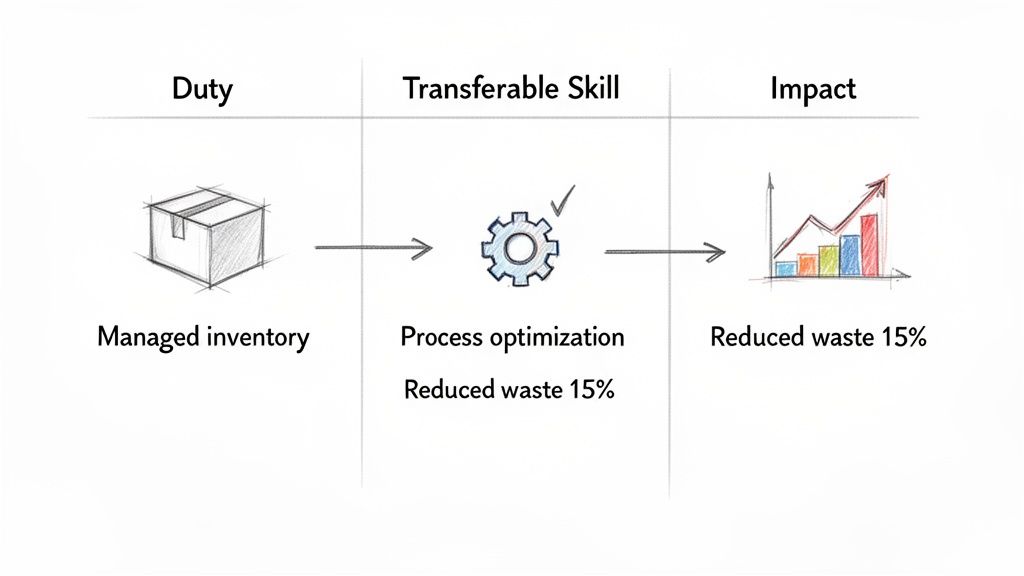
How do you move from a flat task list to a resume that shows results? Reframe. Look at each past responsibility and ask one question: "So what?" What was the actual result? How did it help the organisation?
Here is the shift in practice:
-
Instead of: "Managed the store's inventory."
-
Try: "Oversaw a $50K inventory system and introduced a tracking process that cut waste 15% in six months."
-
Instead of: "Answered customer support calls."
-
Try: "Resolved 40+ customer inquiries daily and maintained a 95% satisfaction score through structured problem-solving."
This does two things at once. It names the skill — process optimisation, customer service — and backs it with hard data.
It also matters because the bar for adaptability is rising. The World Economic Forum's Future of Jobs Report 2025 estimates that 39% of workers' core skills will be transformed or outdated by 2030, and 63% of employers name skills gaps as a major barrier to business transformation. A resume that translates experience into quantifiable achievements speaks directly to that anxiety.
Uncovering Your Hidden Transferable Skills
Sometimes the connection between an old career and a new one is not obvious. You have to look past job titles to the core competencies that made you good at the work.
Your past experience is a goldmine of transferable skills. Think about processes you improved, people you managed, budgets you oversaw, and problems you solved.
Two worked scenarios show how this translation works across very different fields.
Scenario 1 — Healthcare to Human Resources
A nurse pivoting into HR. On the surface, patient care and employee relations look miles apart. The underlying skills are not.
| Old Skill (Nursing) | New Translation (HR) |
|---|---|
| Patient communication and education | Stakeholder management and employee training |
| Managing patient caseloads | Case management and employee relations |
| Triage and prioritisation under pressure | Workload management and escalation handling |
Scenario 2 — Legal Assistant to Marketing
A legal assistant aiming for a marketing coordinator role. Different industries, overlapping core abilities.
| Old Skill (Legal) | New Translation (Marketing) |
|---|---|
| Legal research and document preparation | Market research and content creation |
| Managing client files and deadlines | Project coordination and campaign management |
| Drafting clear, accurate written briefs | Copywriting and editing |
Even short-term project experience can be reframed to show valuable skills. If you have done freelance work, our guide on how to list contract work on a resume covers strategies for presenting it effectively. Focus on the fundamental abilities, and you can build a credible case no matter how big the leap.
Getting Your Resume Past the Software and the Recruiters
Crafting a compelling story about your pivot is only half the battle. A brilliant resume is useless if it never reaches human eyes.
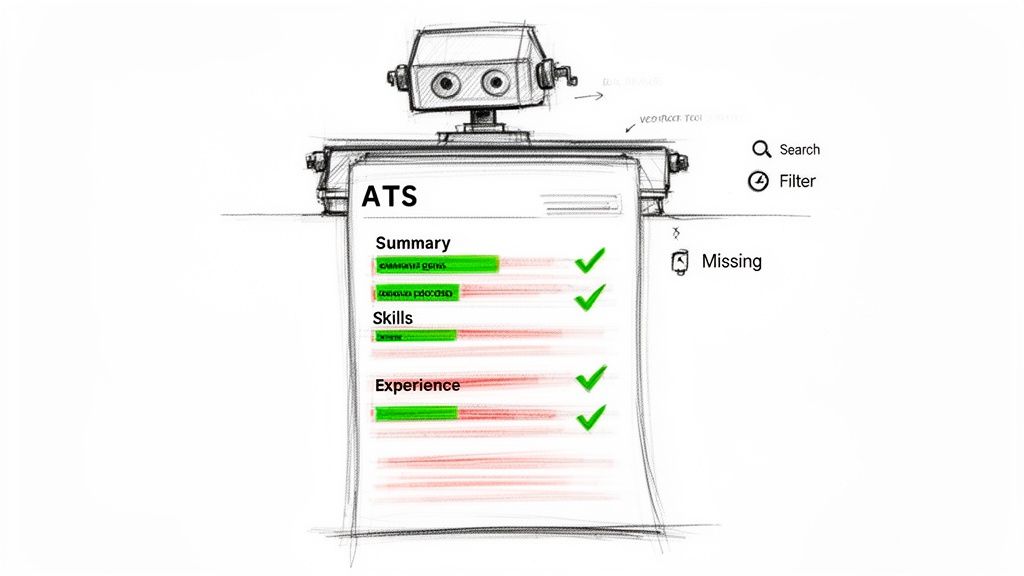
Before a recruiter sees your application, it will almost certainly be scanned by an applicant tracking system (ATS) — software that filters and organises incoming resumes. Adoption is near-universal at large employers: Jobscan's analysis found roughly 98% of Fortune 500 companies use an ATS. Modern systems rarely auto-reject on keywords alone, but they do rank and surface candidates by how well a resume matches the job description — so the right terms still need to run through your whole document.
Working With the ATS, Not Against It
Start with the job posting. Pull it up and hunt for keywords — specific skills, software, qualifications, and action verbs that recur. Those are your targets.
Then weave them in naturally. Do not dump every keyword into one skills section. Place them where they make sense:
- Summary: Your most important keywords belong at the top for immediate impact.
- Core Skills: Group technical and soft skills here, matching the job description's exact phrasing.
- Experience: Embed keywords into achievement-focused bullets that show how you actually used the skill.
If a project-coordinator posting keeps mentioning "stakeholder communication" and "risk mitigation," your bullets should tie those exact phrases to real results. That satisfies the software and signals competence to the human reader who comes next.
A common formatting mistake is using multi-column layouts, text boxes, or graphics for core content. Many ATS parsers read these poorly. Stick to a clean, single-column layout with standard fonts and clear headings — it ensures the software can actually read your resume.
Tailoring for Today's Work Culture
Once you are past the parser, you have to appeal to recruiters who are often hiring for specific work environments — including remote and four-day week roles. Flexible workplaces value a particular set of skills, and your resume should prove you have them.
If you are targeting a remote position, highlight your ability to work autonomously — to thrive without someone looking over your shoulder. A "Remote Work Proficiencies" or "Collaboration Tools" line is a good place to list the software and methods distributed teams rely on.
Skills worth emphasising for remote and flexible roles:
- Asynchronous communication — you can communicate clearly across time zones without back-to-back meetings.
- Self-management and prioritisation — you manage your own workload and hit deadlines independently.
- Project management tools — naming platforms such as Asana, Trello, or Jira signals remote-readiness.
- Communication platforms — experience with Slack or Microsoft Teams shows you are comfortable in a digital office.
Optimise for both the automated systems and the evolving expectations of recruiters, and your career-change resume has the best possible chance of landing where it counts — on a decision-maker's desk.
Common Questions From Career Changers
Finishing a new resume tends to bring a flood of last-minute questions. When you are making a major pivot, a little uncertainty is normal. Here are the worries that trip people up most.
How do I handle an employment gap? Be strategic, not secretive. A hybrid format helps — it leads with skills rather than a strict timeline. You can then explain the gap briefly and positively in your cover letter, framing it as time spent upskilling, caregiving, or on focused personal development.
Is a cover letter really necessary for a career change? Yes. Your resume shows what you have done; the cover letter explains the why behind the change. It is your best chance to tell a coherent story about your motivation and connect an unusual background to the new field. Skip it, and you leave recruiters to fill in the blanks about your intentions — a gamble you cannot afford when breaking into a new industry.
Your resume shows what you've done. Your cover letter explains the why. For a career changer, the why is the whole pitch.
Curating Your Work History
A lot of people get stuck on whether to cut old or unrelated jobs. The right mindset is to curate your experience, not list everything you have ever done. As a general rule, stick to the last 10 to 15 years.
- Completely irrelevant roles. If a job from far back adds zero transferable value and only creates clutter, cut it.
- Recent but unrelated roles. For recent jobs that are not a direct match, minimise the description. Use one or two bullets to highlight a single strong transferable skill — "client relationship management" or "budget oversight" — and move on.
That keeps the resume focused, relevant, and easy to read in a short scan.
A career change resume is not a confession that your past was a detour. It is the argument that everything you have done so far adds up to exactly what this next role needs. Build that argument with a skills-first format, a summary that bridges the gap, and bullet points that translate duties into measurable results — then point it at companies whose values match where you are headed. Browse open roles and forward-thinking companies to find work that rewards your new direction with genuine work-life balance.




Get 4-day week jobs in your inbox
Create a free account to receive curated opportunities weekly.
Sign up for freeFree forever. No spam, unsubscribe anytime.