
Switching careers can feel like trying to open a locked door with the wrong key. You have the skills, the drive, and the ambition — but your resume looks different from the other applicants'. That is where a strong career-change cover letter earns its keep. It is not a summary of your past. It is the bridge connecting your experience to the role you actually want.
A generic cover letter falls flat when you are making a real professional pivot. Your resume tells a hiring manager what you have done; your cover letter has to tell them what you can do for them, using your unconventional background as proof rather than apology. It reframes your journey, translates your accomplishments into the new field's language, and demonstrates value in a context where your job titles do not speak for themselves.
This guide breaks down seven specific career-change cover letter scenarios — moving from engineering into product management, from a corporate role into a startup, from teaching into marketing, and more. For each, you will get a strategic breakdown of what works and why, plus concrete tips you can apply to your own letter. We also cover how to tailor your message for four-day-week and flexible roles, where the ability to deliver focused, autonomous work is exactly what employers are buying.
1. Tech Professional Moving into Product Management
Transitioning from a specialised technical role — engineering, data analysis, QA — into product management is one of the most common pivots, and one of the trickiest. Your success hinges on reframing technical expertise as a strategic asset: something that helps you understand user needs, guide development, and make data-driven product calls. The job is to show you can shift from a "how" mindset (implementation) to a "what and why" mindset (strategy and vision).
This transition fits reduced-hours environments well. On a four-day, 32-hour week, product managers have to be efficient communicators and comfortable with asynchronous collaboration to keep teams aligned on a compressed schedule. A technical background is a real advantage here — you can unblock your engineering counterparts quickly, without a calendar full of clarifying meetings.
Example: Backend Engineer to B2B SaaS Product Manager
Picture a backend engineer with five years of experience applying for a Product Manager role at a B2B SaaS company on a 4-day, 32-hour week. The cover letter has to bridge the gap between writing code and leading product.
Strategic breakdown:
- Address the pivot immediately. The opening paragraph should name the career change directly. Do not make the hiring manager guess why an engineer is applying for a PM role.
- Connect technical skills to product outcomes. Instead of listing technologies, explain how your grasp of the stack let you influence product decisions or flag roadblocks before they cost time.
- Quantify your impact. Use real metrics — a feature that lifted adoption, a fix that improved retention. Numbers cut through ambiguity.
- Emphasise cross-functional collaboration. Highlight work with designers, data analysts, and marketing. Mention sprint planning, roadmap discussions, or stakeholder presentations.
Key tactic: Open with a product-minded story. For example: "As a Senior Backend Engineer on our payments platform, I identified an architectural limitation that would have blocked our planned international expansion. By proposing a microservices-based alternative, we hit the deadline and cut API latency by roughly a third — a measurable win for user experience."
That kind of opening shows you already think beyond the code, weighing business and user impact.
Tips for Your Cover Letter
- Lead with product thinking. Start with a specific product decision you influenced or an insight that improved a feature.
- Show, do not just tell. Reference experience with quarterly planning, roadmap prioritisation, or managing stakeholder expectations.
- Highlight asynchronous skills. Mention fluency with tools like Jira, Asana, or detailed written documentation — the things that keep a four-day-week team aligned without constant meetings.
- Frame your ambition. State clearly why you want to move into product. Connect it to solving user problems and driving the business forward.
If you are making this move, it helps to understand the day-to-day of a technical product manager role before you start tailoring your application — it gives you a clearer roadmap of what the hiring manager is screening for.
2. Corporate Professional Moving to a Tech Startup
Moving from a structured corporate environment — finance, consulting, large-company operations — into a fast-paced startup requires a genuine mindset shift. Your cover letter has to translate formal experience into the language of agility, growth, and resourcefulness that startups prize. The goal is to prove that your expertise in process, scale, and strategy can fuel a young company's trajectory rather than slow it down.

This pivot is common among people targeting companies with a four-day workweek. These roles reward high-impact, focused work over hours logged. A corporate background in building efficient systems and driving outcomes is a strong match for a company that has to make every hour of a 32-hour week count.
Example: Management Consultant to Head of Operations at a Fintech Startup
Picture a management consultant from a large firm applying for a Head of Operations role at a Series B fintech startup that runs a compressed schedule. They need to show they can shed corporate bureaucracy and embrace lean, iterative work — bringing structure without stifling speed.
Strategic breakdown:
- Reframe corporate experience. Translate "managing large-scale projects" into "building scalable systems from the ground up." Your experience is a blueprint for growth, not a liability.
- Speak the startup language. Use words like "agile," "MVP," "iterate," and "pivot" — accurately. It signals you understand the culture and can integrate fast.
- Show scrappy problem-solving. Highlight a time you achieved a significant result with a limited budget or a small team, not just with corporate resources behind you.
- Emphasise learning velocity. Startups change fast. State plainly that you can learn new domains, tools, and processes quickly.
Key tactic: Frame your motivation around impact. For example: "After five years optimising supply chains for a Fortune 500 company, I want to apply that expertise in a more agile environment — to directly build and scale the operational backbone behind a product. I was drawn to [Startup Name] specifically because of your mission to make financial data accessible to smaller businesses."
That positions your corporate past as a deep well of knowledge ready to be applied at startup speed.
Tips for Your Cover Letter
- Lead with your "why." Explain early why you are drawn to the startup world and to this company's mission specifically. Genuine interest beats wanting any job.
- Demonstrate adaptability. Share a story about pivoting a project quickly based on new data or feedback.
- Connect your value to a four-day week. Tie your process-optimisation and efficiency skills to the company's goal of achieving more in less time. Make clear you value deep, focused work over performative busyness.
- Quantify process improvements. A workflow that saved your team hours each week, or a system that reduced errors — use hard numbers.
This kind of move signals a desire to build, not just maintain, and it is increasingly common for people entering tech without a traditional pedigree. Breaking in is possible even if you are a software developer without a degree.
3. Education or Non-Profit Professional Moving into Tech Marketing
Pivoting from a mission-driven sector like education or non-profit work into tech marketing is a strong, credible change. Your success rests on translating experience in community building, stakeholder communication, and program growth into the language of customer acquisition and user engagement. The cover letter has to show that your ability to inspire and educate an audience transfers directly to building a loyal user base.
This transition appeals to people targeting four-day-week companies. Many come from demanding, high-burnout environments, and they can honestly frame their move toward better work-life balance as a way to sustain high performance — not step back from it. Your skill in clear, empathetic communication is a real asset on a compressed schedule, where every message has to land.
Example: High School Teacher to EdTech Content Marketing Manager
Picture a high school teacher with seven years of experience applying for a Content Marketing Manager role at an EdTech startup on a four-day week. The cover letter must reframe classroom experience as a strategic asset for creating engaging content that drives user acquisition.
Strategic breakdown:
- Translate your mission alignment. Connect your past work to the company's mission early. Show you are not just looking for a tech job — you are drawn to their product and impact.
- Reframe "audience" as "users." Talk about target demographics and segments rather than students and parents. Explain how you built "content" — lesson plans, curriculum — to meet specific needs and drive engagement.
- Quantify with sector-relevant metrics. Did you grow enrolment in an elective program? Lift conference attendance through a new communication approach? Put numbers on it.
- Highlight communication and empathy. Emphasise turning complex subjects into clear, compelling narratives. That is the core of good content marketing.
Key tactic: Start with a story that bridges both worlds. For example: "For seven years, my job was making complex historical events accessible to roughly 150 students a year. I learned that driving real engagement is not about presenting facts — it is about telling a story that speaks to your audience's questions and curiosities. I am excited to bring that user-centric approach to content at [Company Name]."
That positions a teaching background as a genuine strength in understanding and connecting with the target user.
Tips for Your Cover Letter
- Lead with shared values. Open by stating your connection to the company's mission, drawing a line from your work in education or non-profits.
- Translate your skills explicitly. Connect the dots: curriculum development becomes content strategy, student engagement becomes user engagement, program growth becomes lead generation.
- Show you have done the homework. Mention any marketing courses or certifications — Google Analytics, HubSpot — or personal projects you have taken on to learn the technical side.
- Emphasise asynchronous strengths. Highlight your experience writing detailed lesson plans and resources students could use independently. That demonstrates the clear documentation skills a four-day week depends on.
If you are coming from a mission-driven field, understanding what a product marketing manager actually does will help you articulate how your skills map onto bringing a product's story to life.
4. Sales Professional Moving into Product, Customer Success, or Solution Engineering
Shifting from sales into product, customer success, or solution engineering leverages something valuable: your deep, first-hand understanding of the customer. Your success depends on showing how front-line market insight and relationship-building translate into better products and stronger long-term customer value. The cover letter has to prove you can move from "what can we sell" to "what problems can we solve."
This transition appeals to people seeking four-day-week roles. The high-pressure, quota-driven world of sales can be draining, and a move toward sustainable customer impact pairs naturally with the better balance a compressed schedule offers. Your ability to build rapport and read customer pain points is a major asset in these outcome-focused environments.

Example: Enterprise Account Executive to Customer Success Manager
Consider an experienced enterprise software account executive applying for a Customer Success Manager role at a B2B SaaS company on a compressed schedule. The cover letter needs to show that sales acumen is the foundation for a real commitment to post-sale value and retention.
Strategic breakdown:
- Lead with customer advocacy. Open with a specific instance where you put a customer's long-term success ahead of a short-term sales win.
- Quantify relationship management. Move beyond quota numbers. Use metrics like client retention, net revenue retention, or expansion revenue you influenced through strategic account management.
- Show intellectual curiosity. Demonstrate that you want to understand the "why" behind the product. Mention times you fed customer insight back to product teams and saw it shape the roadmap.
- Address the technical gap. If you are moving into a more technical role like solution engineering, show proactive learning — relevant certifications, courses, or projects that build your technical foundation.
Key tactic: Use a narrative that bridges sales and success. For example: "While managing a key enterprise account, I realised their core problem was not a missing feature but a workflow inefficiency our product could solve with better integration. By documenting that need and working with our product team, we retained the account and unlocked an expansion opportunity that meaningfully increased their usage."
That reframes sales experience as customer-centric problem-solving, which is exactly what a success-oriented role needs.
Tips for Your Cover Letter
- Frame sales as research. Position your sales conversations as continuous market and user research that can inform product strategy.
- Connect insights to business outcomes. Explain how a customer insight you uncovered led to reduced churn, higher engagement, or a new market opportunity.
- Highlight your consultative skills. Emphasise your ability to teach customers, tailor solutions, and guide a conversation toward a genuinely good outcome.
- Link the four-day week to your motivation. Be honest that you want a compressed schedule to shift focus from high-volume transactions to deeper, more meaningful customer relationships.
If you are targeting this pivot, preparing for the role's specific demands matters — working through common customer success manager interview questions will help you articulate your transferable skills clearly.
5. Healthcare or Regulated-Industry Professional Moving into Tech Compliance, Risk, or Operations
Pivoting from a heavily regulated industry — healthcare, finance, law — into tech is a strong move. Your expertise in navigating complex rules, managing risk, and running meticulous processes is genuinely sought after, especially in fintech and healthtech. The cover letter has to translate your background from a "blocker" mentality into one of "risk-aware growth": you uphold standards while enabling innovation.
This transition fits four-day-week companies well. In a compressed schedule, operational efficiency and proactive risk management matter even more. Building robust, streamlined compliance frameworks lets a company spend its limited work time on growth rather than reactive firefighting.
Example: Hospital Compliance Officer to Risk & Compliance Manager at a Healthtech Startup
Picture a hospital compliance officer with seven years of experience applying for a Risk & Compliance Manager role at a healthtech startup on a 4-day, 32-hour week. The cover letter needs to prove they can adapt a rigorous, process-driven background to the faster pace of a tech company.
Strategic breakdown:
- Reframe regulatory expertise. Position your compliance background as a business enabler, not a hindrance — a strategic advantage that lets the company scale faster and safer.
- Show adaptability, do not just claim it. Acknowledge the difference in pace. Give a specific example of streamlining a bureaucratic process or adapting quickly to a new regulation.
- Connect past experience to tech challenges. Name tech-specific frameworks like HIPAA, GDPR, or SOC 2, and explain how your grounding in privacy and risk management transfers directly.
- Highlight process improvement. Rather than saying you enforced rules, describe how you designed or improved a process that increased efficiency or reduced errors.
Work-Life Balance Jobs with Genuinely Reduced Hours
Save one to come back to it — it's free.

Key tactic: Open with a story that shows a growth-oriented compliance mindset. For example: "While managing HIPAA compliance at a large hospital, I redesigned our patient-data handling protocol. It held up to a full audit and cut data-retrieval times for the clinical team substantially. I build compliance frameworks that accelerate operational excellence rather than inhibit it."
That positions you as a strategic partner who understands that robust compliance is the foundation for sustainable growth.
Tips for Your Cover Letter
- Use the language of tech. Talk about "scaling," "mitigating risk to enable innovation," and "building efficient operational guardrails."
- Quantify your impact. Show how your work saved money, reduced fines, or improved operational speed — for example, "decreased incident reporting time by a quarter" or "zero compliance breaches across three years."
- Address the four-day-week advantage. Note that a proactive, process-driven approach suits a compressed schedule, because it minimises unexpected issues and frees the team for strategic work.
- Demonstrate a learning mindset. State your enthusiasm for adapting your skills to the tech landscape and learning challenges like data privacy in a SaaS environment.
If you are making this pivot, looking closely at what a compliance manager role involves in tech will help you align your existing skills with industry expectations.
6. Freelancer or Contractor Moving into a Full-Time Tech Role
Shifting from freelancing or contracting into a full-time role is a strategic move for stability, benefits, and deeper project impact. It calls for a cover letter that frames your independent experience as a strength. You need to demonstrate self-discipline, project ownership, and asynchronous communication — proof that you thrive without constant supervision.
This pivot pairs naturally with four-day-week companies. Freelancing has already trained you to be results-oriented and efficient — non-negotiable traits on a compressed schedule. Your cover letter should present that ingrained autonomy as a clean cultural fit for a flexible workplace.
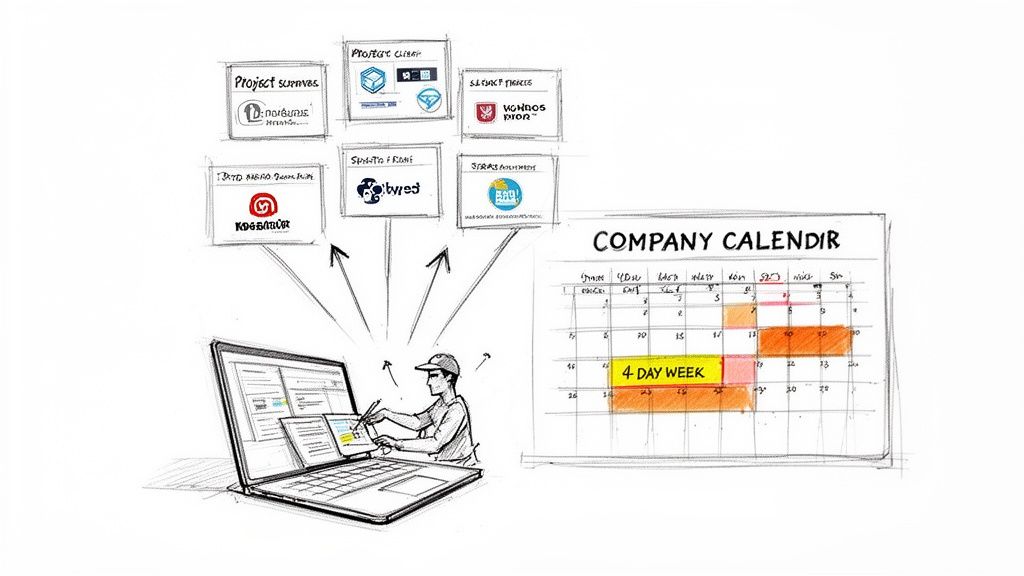
Example: Freelance Full-Stack Developer to Senior Engineer
Consider a freelance full-stack developer with a varied portfolio applying for a Senior Engineer position at a remote-first startup on a 4-day, 32-hour week. The cover letter needs to convince the hiring manager that varied client experience is more valuable than a single-company career path, not less.
Strategic breakdown:
- Lead with quantifiable wins. Start with your most impressive client project, using data to show the tangible business value you delivered.
- Show self-direction and ownership. Highlight running entire project lifecycles — discovery, scoping, deployment, maintenance. That level of responsibility exceeds a typical siloed role.
- Address the "why now." Explain your motivation for going full-time, framed positively: deeper collaboration, long-term impact on a single product, joining a strong team.
- Connect your skills to the four-day week. State plainly how freelancing prepared you for a compressed schedule — mastery of asynchronous tools, time management, and a focus on outcomes over hours.
Key tactic: Frame diverse client work as a strategic advantage. For example: "Over four years as an independent developer, I have partnered with more than a dozen startups to build and scale their core products. For one health-tech client, I architected a HIPAA-compliant patient portal that supported a 200% rise in sign-ups within six months. Working across different stacks and business challenges has trained me to adapt and deliver quickly in a dynamic environment."
That positions a freelance career not as a lack of commitment, but as a rich training ground for exactly the skills a modern tech company needs.
Tips for Your Cover Letter
- Build a "greatest hits" reel. Instead of listing every client, pick two or three high-impact projects and detail the problem, your solution, and the measurable result.
- Highlight your tooling fluency. Mention proficiency with modern tools like GitHub, Figma, Linear, Slack, and Notion — proof you can slot into a remote, async-first team.
- State your intentions clearly. Reassure the employer this is a deliberate, long-term decision. Mention your desire for stability, equity, and the chance to mentor others.
- Frame the four-day week as a perfect fit. Explain that its autonomy and results-driven nature match the work style you have already perfected as a freelancer.
This kind of cover letter is essential for freelancers who want to show they are ready to bring entrepreneurial drive and diverse expertise to a dedicated team.
7. Military or Government Professional Moving into Tech Operations or Program Management
Transitioning from a highly structured environment — military or government service — into tech requires a deliberate reframing of your skills. Your experience in leadership, process discipline, and executing complex initiatives under pressure is invaluable, but you have to translate it into private-sector language. The cover letter has to show you can adapt operational rigour to a more dynamic, often ambiguous, tech culture.
This pivot suits four-day-week companies. Their focus on high-impact, efficient execution aligns closely with the mission-oriented mindset service cultivates. Your ability to lead teams, manage resources, and deliver on tight timelines is a strong match for a structure that prioritises outcomes over hours logged.
Example: Military Logistics Officer to Operations Director
Picture a former military logistics officer applying for an Operations Director role at a healthcare tech company on a compressed schedule. The cover letter has to translate experience managing complex supply chains and personnel into a clear narrative about driving operational excellence in a corporate setting.
Strategic breakdown:
- Translate, do not transcribe. Reframe military terminology immediately. "Leading a platoon" becomes "managing a cross-functional team of 30." A "mission" becomes a "project"; "logistical oversight" becomes "supply chain optimisation."
- Focus on measurable outcomes. Tech runs on data. Quantify achievements — a budget you managed, an efficiency gain you drove, a project spanning a hundred-plus stakeholders across multiple sites.
- Show adaptability, not rigidity. Service members are sometimes assumed to be too rigid for tech's fluid environment. Address that head-on with an example of adapting a plan to changing circumstances.
- Connect service to business impact. Link your skills to company goals — experience in risk management, security protocols, and contingency planning translates straight into business continuity and operational resilience.
Key tactic: Open with a quantified achievement that mirrors a business challenge. For example: "As a logistics officer, I redesigned the supply chain for a 500-person operation, cutting delivery times by 40% and operational costs by 15%. I want to apply that same data-driven approach to optimising processes as Operations Director."
That establishes your value in language any hiring manager understands, sidestepping jargon in favour of tangible results.
Tips for Your Cover Letter
- Lead with leadership and scale. Start by describing a specific large-scale initiative you managed — budget, team size, outcome.
- Highlight soft skills. Emphasise mentoring, training, and developing people. That is a highly valued leadership quality in collaborative tech environments.
- Demonstrate tech awareness. Show you have been proactive — relevant certifications (PMP, Agile), coursework, or personal projects that signal a commitment to learning tech-specific methods.
- Explain your "why." State why you are moving to tech and why a four-day week appeals. Frame it around a desire for sustainable, high-impact work after a demanding service career.
What Every Career-Change Cover Letter Needs
Each of these seven scenarios is different, but the same core principles run through every successful pivot. Think of them as the strategic DNA of a compelling career-change narrative.
Your cover letter is not a formality — it is the bridge connecting past achievements to future aspirations. For a career changer, that bridge is essential. A hiring manager needs to see not just what you have done, but what you can do for them, and your letter is the first and best place to make that case explicitly.
Address the pivot head-on. The biggest mistake career changers make is avoiding the subject of their transition. Silence creates doubt. Lead with confidence: your opening paragraph should name the career change and frame it as a deliberate, strategic move toward a field where you can add greater value. That demonstrates self-awareness and intentionality — two traits employers value highly.
Translate, do not just transfer. Your past experience is your greatest asset, but only if the hiring manager understands it. Do not simply list old responsibilities. Act as a translator, reframing your skills into the vocabulary of your new industry. A teacher who managed a classroom of 30 has experience in stakeholder management, project-based delivery, and performance tracking — described in the right language, that reads as directly relevant.
Quantify everything. Numbers cut through ambiguity and build trust. "Managed a team" is vague; "led a team of eight to lift project completion rates by 25% in six months" is a concrete statement of impact. Comb your history for quantifiable achievements — time saved, costs reduced, revenue increased, an audience grown — and attach a number to each. Concrete data lets a hiring manager picture the value you will bring.
Tailoring Your Letter for Flexible and Four-Day-Week Roles
The world of work is shifting, and your application materials should shift with it. The rise of the four-day week reflects a real move toward high-focus, results-driven cultures — and the evidence backs it up. The UK's 2022 four-day-week pilot, the largest trial of its kind across 61 organisations, found 71% of employees reported reduced burnout, and 89% of the companies were still running the policy a year later. Employers offering compressed schedules are not lowering the bar — they are betting on people who deliver.
When you apply for these roles, two emphases matter:
- Autonomy and efficiency. Four-day-week companies are betting on employees who produce exceptional results in less time. Highlight experiences where you worked independently, owned your projects, or built processes that raised efficiency.
- Communication. In a flexible or remote-first environment, clear and proactive communication is paramount. Mention experience with asynchronous tools like Slack, Asana, or Notion, and your ability to keep stakeholders informed without leaning on constant meetings.
The best career-change cover letters all share one trait: they tell a coherent, authentic story. They connect the dots for the reader, showing a clear progression from a successful past toward an even more promising future. Your career change is not a liability — it is a story of growth, adaptability, and ambition. Own that narrative, apply these principles, and the locked door starts to open.




Get 4-day week jobs in your inbox
Create a free account to receive curated opportunities weekly.
Sign up for freeFree forever. No spam, unsubscribe anytime.