
Finding the right remote job is not about spraying your resume across the internet and hoping for the best. It is about having a plan: zeroing in on roles that fit the life you want, sharpening your resume to highlight remote-friendly skills, and knowing where to look — especially the niche job boards that already get what you are after. A targeted, quality-over-quantity approach saves you a lot of time and produces far better results.
Charting Your Course in the New World of Work

The game has changed. Searching for a remote job is no longer hunting for a needle in a haystack — it is navigating a large, crowded field to find the one role that genuinely works for you. The good news is that the odds are finally in your favour.
The remote-work expansion since the pandemic has made these roles far more accessible. According to the U.S. Bureau of Labor Statistics, remote-capable jobs grew from roughly 4% of US opportunities before 2020 to more than 15% today — a near-fourfold increase that shows no sign of slowing. This guide is your playbook for cutting through the noise and being intentional from the start.
To keep things on track, the whole search breaks down into a few core phases:
| Stage | Key Action | Goal |
|---|---|---|
| Preparation | Define your non-negotiables and tailor your resume. | A clear target and a compelling professional story. |
| Discovery | Search niche job boards and set up alerts. | Find high-quality, relevant opportunities efficiently. |
| Application | Craft personalised outreach and cover letters. | Stand out from the crowd of generic applicants. |
| Vetting | Research company culture and ask smart questions. | Make sure the company is a genuine fit. |
| Negotiation | Discuss schedule, flexibility, and compensation. | Secure an offer that fits your ideal work-life balance. |
Each stage builds on the last, turning what feels like an overwhelming task into a manageable, step-by-step process.
First Things First: Define Your Ideal Role
Before you even open a job board, get crystal clear on what "remote work" means to you.
Are you after a fully asynchronous role with total control over your schedule? Or are you fine with a few core working hours? Is a four-day workweek a must-have, or is a standard five-day schedule fine as long as you are working from home?
Nailing down these non-negotiables is the single most important first step. It flips your search from a passive, endless scroll into a focused mission.
Your ideal remote job exists, but you cannot find it if you do not know what it looks like. Clarity on your needs — schedule, autonomy, and company culture — is the most powerful filter you have.
The Power of Niche Platforms
Massive job sites have their place, but they can be a firehose of irrelevant listings. The real value is on specialised platforms — curated boards filled with high-quality roles from companies already committed to progressive work models.
This is especially true if you are targeting a specific arrangement, like a four-day workweek. A dedicated platform is the smartest route. You can find four-day-week roles on 4dayweek.io, where every company listed is actively looking for people who value a better work-life balance. By focusing your energy on curated platforms, you skip the misleading postings, raise your application success rate by targeting better cultural fits, and apply with confidence that the employers have already embraced modern work principles.
Where to Find the Best Remote and Flexible Jobs
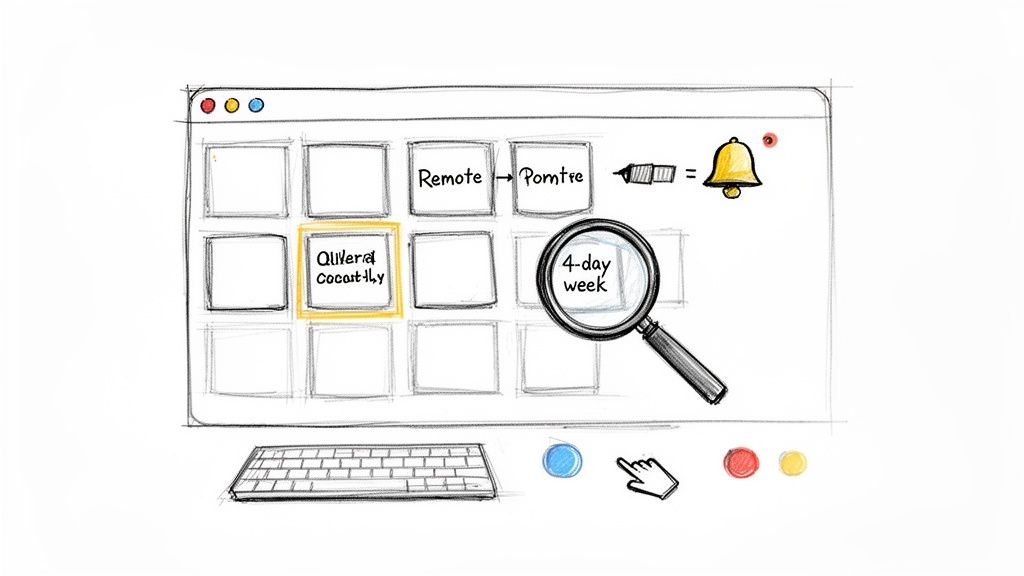
The quality of the jobs you find is a direct result of where you look. You could spend hours scrolling through giant aggregators, but the best remote roles are usually on specialised platforms that do the heavy lifting for you — curating listings from companies already committed to flexible work, so you skip the soul-crushing task of sifting through "remote-ish" jobs that still want you in an office three days a week.
Master Your Search Terms and Filters
Even on the best platforms, knowing how to search is a real advantage. Companies use all sorts of different language, so getting creative with keywords surfaces hidden gems.
Do not just search "remote job." Get specific with terms that reflect the culture you want — and sometimes search for the type of work arrangement rather than the job title itself.
Think like a recruiter trying to attract a certain kind of talent. A company that supports a four-day schedule might use phrases like "condensed week," "flexible schedule," or "results-oriented work environment" in its job descriptions.
Here is how to level up your search terms:
| Generic Search | More Specific Search |
|---|---|
| "Remote marketing manager" | "4-day week marketing" or "Asynchronous content lead" |
| "Work from home developer" | "Fully distributed engineering team" or "Remote-first software engineer" |
| "Virtual customer support" | "Flexible schedule customer success" or "Work from anywhere support agent" |
These small tweaks surface roles that generic searches miss entirely. And do not forget the advanced filters — filter by timezone requirements (or the lack of them), company size, and specific tags like "4-day week" or "asynchronous."
Use LinkedIn for More Than Just Applying
LinkedIn is a powerhouse, but its real value sits well beyond the "Jobs" tab. Use it as an intelligence-gathering tool to vet companies and figure out what their culture is actually like.
Once you find an interesting role, investigate the company's LinkedIn page. Look for clues. Do employees list locations all over the world? Does the company post about remote team-building or its commitment to work-life balance? Those are green flags.
You can also use LinkedIn to connect with current or former employees. A short, polite message asking about their experience with the company's remote policy can give you insights you will never find in a job description. This turns your search from a passive numbers game into an active investigation.
Fine-Tuning Your Resume and Profile for Remote Roles
In the world of remote work, a generic resume is a dead end. It is not enough to show you can do the job — you have to prove you can do it well without someone looking over your shoulder.
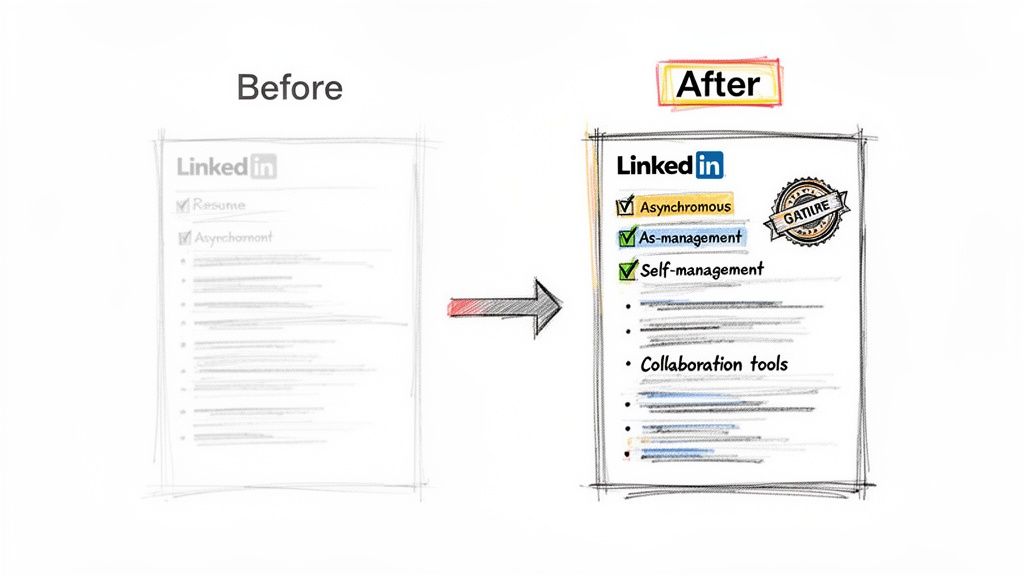
Your resume and online profiles are your first, and often only, chance to make an impression. They need to answer the hiring manager's biggest unspoken question right away: can this person actually thrive without being in the office? That means less listing of duties and more translating your experience into the language of remote work.
Highlighting the Right Remote Skills
Look at every bullet point through a remote-first lens. Instead of stating what you did, show how you did it in a way that proves you are independent, collaborative, and communicative from anywhere. The competencies to spotlight:
- Asynchronous communication. Your ability to get a point across clearly in writing, without needing back-to-back meetings.
- Self-management and autonomy. Proof that you can own a project from start to finish with minimal hand-holding.
- Proactive collaboration. Evidence that you know how to use modern tools to work with teammates across time zones.
Your resume has to tell a story of how you get results on your own, communicate with precision, and keep projects moving without constant oversight.
From In-Office Tasks to Remote-Ready Wins
The real shift happens when you reframe past achievements — moving the focus from the tasks you did to the measurable, remote-friendly outcomes you delivered.
Here is a before-and-after for a project manager:
- Before: "Responsible for coordinating project timelines and team meetings."
- After: "Managed a cross-functional project with team members across three time zones, using Asana and Slack to maintain a strong on-time delivery rate without a single in-person meeting."
The second version names the tools, highlights asynchronous work, and backs it with a result. If you want to go deeper, our guide on how to prepare your resume for remote work has more examples.
Tuning Up Your LinkedIn Profile for Recruiters
Recruiters live on LinkedIn, so treat your profile as your digital storefront.
Start with the headline. Do not just put your job title — try something like "Senior Software Engineer | Building Scalable Systems | Seeking Remote Opportunities." It signals immediately what you do and what you want.
Next, get strategic with the "Open to Work" feature. Do not just flip the switch — customise it to specify remote roles and set your desired locations to "Remote" so you appear in the right recruiter searches.
Your "About" section is where you build the narrative:
- Talk about your tools. "Fluent in remote-first workflows using Miro, Notion, and Slack to keep communication and documentation crystal clear."
- Describe your communication style. "I thrive in asynchronous environments, prioritising concise written updates to keep everyone in the loop without clogging calendars."
- Show your autonomy. "A self-starter who consistently delivers high-quality work on schedule in fully distributed teams."
Finally, make sure the experience section echoes the outcome-focused language from your resume. A tailored resume plus an optimised LinkedIn profile makes you far easier for the right recruiters to find.
Modern Networking Strategies for Remote Job Seekers
When you are hunting for a remote job, you cannot bump into your future boss at a happy hour. Your networking playbook has to be different — more intentional, more authentic, and conducted entirely online. This is not about spamming people with connection requests; it is about building real relationships from behind a screen.
The secret to good remote networking is simple: give before you get. Offer something of value before you ask for a favour. That could be a thoughtful comment on someone's post, a genuinely helpful resource shared in a community, or a quick note complimenting a project they nailed. This shift changes everything — you stop being another person asking for a job and become a peer building a connection. Referrals matter, too: candidates who come in through a personal connection are several times more likely to be hired than those who apply cold.
Dive into Niche Online Communities
The best networking happens where your future colleagues already gather. Skip the massive, dead LinkedIn groups — the real action is in smaller, focused communities: industry-specific Slack or Discord channels, professional forums, and paid groups built around a particular skill. A content marketer might join a community like Superpath, while a product manager could find their people through Mind the Product.
To make a real impact:
- Be a giver, not a taker. Answer questions, share useful articles, and congratulate people on their wins.
- Participate thoughtfully. Do not just "like" a post — add your perspective or ask a smart follow-up.
- Become a familiar face. Consistency matters. If you have been an active, helpful member for a few weeks, later outreach will feel warm rather than cold.
Master the Art of the Informational Interview
Remote Jobs with a Great Work-Life Balance
Save one to come back to it — it's free.

Informational interviews let you peek behind the curtain at a company's culture and often uncover roles that have not been posted yet. You are not asking for a job — you are asking for advice, and people are far more willing to share their experience than to hand a referral to a stranger.
Your first message is everything. Keep it short, respect their time, and make it about them:
"Hi [Name], I came across your profile and was really impressed with your work on [Specific Project] at [Company]. I'm a [Your Role] exploring remote roles in the [Industry] space and would love to hear about your experience. Would you be open to a quick 15-minute chat in the coming weeks? I'd be grateful for any insights you could offer."
This works because it is specific, complimentary, and a clear, low-pressure ask. You are not demanding a job — just a conversation.
Leverage Warm Connections for Introductions
A warm introduction from a mutual connection is far more powerful than any cold message. Think of it as a trusted friend vouching for you. LinkedIn is the ideal tool for finding these pathways.
Find someone at a target company you want to talk to, then check their profile for mutual connections. If you find one, reach out to your shared contact — and make it ridiculously easy for them to say yes by giving them a "forwardable" blurb they can copy and paste:
- To your mutual connection: "Hey [Name], hope you're well. I see you're connected to [Target Person] at [Company]. I'm really interested in their work on [Project]. Would you be comfortable making a brief introduction?"
- The blurb to forward: "Hi [Target Person], my contact [Your Name] is a [Your Role] who is very interested in the work you're doing at [Company]. They'd love to ask a few questions about your experience there — mind if I connect you two?"
You have done the work for your connection, which makes the introduction feel natural and credible, and gets your foot in the door.
How to Vet Companies and Negotiate for Flexibility
Getting a remote job offer is a real win — but hold off on the celebration. Your work is not quite done.
"Remote" can mean anything from total autonomy to being micromanaged through a webcam. Your final task is to put on your detective hat and confirm that the company's promise of flexibility is genuine. A job description might sing the praises of flexibility while the reality is activity-tracking software and an unspoken rule that you are always online. This is where you flip the script: stop selling yourself and start vetting them.
Digging Deeper During the Interview
The interview is your best shot at the unvarnished truth about a company's remote culture. Ask questions that go well beyond "What does a typical day look like?"
Think of it as cultural due diligence — you are trying to understand their communication style, their expectations around availability, and whether they genuinely respect boundaries:
- On communication: "How does the team distinguish between urgent issues and things that can wait? What's the general expectation for response times on Slack or email?"
- On autonomy: "Could you walk me through the balance between collaborative projects and solo, focused work? How are tasks assigned and tracked?"
- On boundaries: "What are the core working hours, if any? How does the company actively help people disconnect after the day is over?"
These questions push for specific answers and paint a far clearer picture than vague chats about "company culture."
Spotting Red Flags and Green Flags
As you gather intel, patterns emerge — clues that point to either a healthy remote setup or a toxic one.
A company's commitment to remote work is not measured by its perks, but by the level of trust and autonomy it gives its team. Look for evidence of a results-oriented culture, not one obsessed with monitoring activity.
Listen carefully to the words your interviewers use. A genuinely remote-first company will have thoughtful, clear processes for making distributed work succeed. Vague answers are almost always a bad sign.
| Area of Concern | Red Flag (Warning Sign) | Green Flag (Positive Sign) |
|---|---|---|
| Productivity | Mentions of employee-monitoring software or "tattleware." | A clear focus on outcomes, goals, and deliverables. |
| Communication | Vague answers about how the team collaborates. | Well-defined processes for asynchronous communication and documentation. |
| Availability | An expectation of immediate responses outside core hours. | Encouragement to set clear boundaries and actually take PTO. |
| Meetings | A calendar packed with back-to-back, mandatory video calls. | A culture that protects deep work and uses meetings intentionally. |
Keep this in mind during interviews. The patterns you notice tell you a great deal about what daily life in the role would really feel like.
Negotiating Beyond Just Your Salary
Once the offer is in your hands, the real negotiation starts. For a remote role, your schedule and working conditions are as valuable as your salary — this is your chance to advocate for the structure that helps you thrive.
Whether you are pushing for a four-day week, a compressed schedule, or simply the freedom to work when you are most productive, frame it as a win-win. It is not just about what you want; it is about how the arrangement helps the company succeed:
"I'm really excited about this offer. I've found that I produce my best, highest-quality work when I can structure my week in large, focused blocks of time. Would you be open to discussing a four-day workweek arrangement?"
That framing presents your ideal schedule as a tool for better performance, not just a personal perk. If you want more ideas, our template for requesting flexible working hours has scripts and guidance you can adapt.
The endgame is to land a role that genuinely supports your work-life balance — not just one that lets you skip the commute. Vet companies carefully and negotiate with confidence, and you can find a remote job that truly delivers on its promise.
Common Questions About Finding Remote Work
How do I get remote experience without a remote job?
The classic chicken-and-egg problem — and it is easier to solve than it looks. You do not need a past "remote" job title; you need to frame what you have already done. Focus on the transferable skills: managing a project with teammates in another office is remote collaboration; relying on Slack, email, and detailed briefs to keep everyone aligned is asynchronous communication; taking a task from start to finish with minimal hand-holding is the self-management every remote manager wants. You can also build new experience — volunteer for a remote-run non-profit, take on a small freelance project, or get certified in tools like Asana or Trello.
Are four-day-week jobs only in tech?
Not anymore. The tech world helped kickstart the four-day-week movement, but it has gone mainstream. You will now find four-day-week roles in customer support, marketing, finance, HR, and creative agencies. The common thread is not the industry — it is a company culture that cares more about output than hours logged. Niche job boards pull these roles from every corner of the economy, which shows just how far the trend has spread.
How can I spot and avoid remote job scams?
The popularity of remote work has attracted scammers, but the red flags are usually clear once you know them. According to the U.S. Federal Trade Commission, an honest employer will never ask you to pay to get a job — anyone who asks you to pay for equipment, background checks, or training is running a scam. Be wary of offers that arrive out of nowhere, seem too good to be true, or come from a generic email address, and be especially cautious of unsolicited job offers by text or social media. Always check for an official company website and a real LinkedIn presence, and never share sensitive financial information until you have a signed, legitimate employment contract.
How should I answer "Why do you want to work remotely?"
This is a make-or-break interview question, and your answer should focus on the benefit to the employer, not the perks for you. Instead of "I want a better work-life balance," reframe it around results: "I've found that a remote setting lets me build an environment free from typical office distractions, so I can focus deeply and produce higher-quality work. I'm more efficient and deliver better results when I can structure my day around project milestones, which helps the team hit its goals faster." That shows you are a strategic thinker who connects your ideal work style directly to the company's outcomes.
Finding a remote job that genuinely fits your life takes more effort than firing off a hundred applications — but it takes far less than you would spend recovering from the wrong one. Define what you actually need, search where companies already share that priority, present your experience in the language of distributed work, and vet every offer before you sign. Do that, and the role that respects both your work and your time is well within reach.




Get 4-day week jobs in your inbox
Create a free account to receive curated opportunities weekly.
Sign up for freeFree forever. No spam, unsubscribe anytime.