
Workplace fatigue management is more than telling your team to get more sleep. It's a deliberate way of spotting, tracking, and reducing fatigue-related risk across an organisation — so your people stay healthy and the business keeps performing. The work is structural: it means looking past the individual and addressing the real culprits, like unmanageable workloads, rigid schedules, and a culture that quietly rewards burnout.
A solid fatigue management plan puts policies and practices in place to stop chronic exhaustion before it erodes safety, productivity, and morale. This guide is written for the managers, founders, and people leaders who own that problem and want a practical, evidence-led way to fix it.
Why Workplace Fatigue Is a Business Imperative

It's tempting to write off workplace fatigue as a personal problem — something employees should manage on their own time. But that framing misses the point. When fatigue spreads through a team, it stops being an individual issue and becomes an organisational risk with real, measurable costs.
One tired employee might make a small mistake. A whole team running on fumes creates a pattern: more errors, missed deadlines, and a steady drop in quality. This isn't ordinary sleepiness. It's deep physical and mental exhaustion that degrades cognitive function, slows reaction times, and clouds judgement.
Moving Beyond Simple Tiredness
There's an important difference between being tired and being chronically fatigued. Tiredness is normal, short-term, and usually fixed by a good night's sleep. Workplace fatigue is a cumulative drain on a team's energy, built up over weeks or months of sustained pressure.
Picture a marketing team scrambling to hit aggressive quarterly targets. An occasional late night before a big launch is one thing. But when that becomes the norm — back-to-back meetings, a constant barrage of notifications, an unspoken rule to always be online — the team's collective energy evaporates. Creativity dries up, strategic thinking stalls, and engagement flatlines. That is exactly when proactive fatigue management stops being optional.
When you ignore fatigue, it acts like a silent tax on productivity. Companies with high burnout rates don't just see a drop in output; they see more safety incidents, higher turnover, and a slow decay of the culture they worked hard to build.
The Tangible Costs of Inaction
Letting systemic fatigue take hold creates a domino effect. The impact isn't just a "vibe" — it shows up in ways any business leader should care about:
- Reduced productivity. Exhausted employees aren't operating at full capacity. Fatigue is consistently flagged among the health conditions with the highest cost of lost productivity through presenteeism — people physically at their desks but unable to perform.
- Increased safety risk. In industries from logistics to healthcare, tired workers are far more likely to have accidents. A single lapse in judgement can have devastating consequences.
- Higher turnover. Burnout is one of the leading reasons strong people quit. Recruiting, hiring, and training a replacement costs far more than building a sustainable work environment in the first place.
- Erosion of morale. A culture of exhaustion breeds cynicism and disengagement. When people are constantly running on empty, collaboration breaks down and an "every person for themselves" attitude sets in.
Tackling fatigue isn't a wellness perk — it's a strategic necessity for building a resilient, high-performing organisation. That means moving past quick fixes and making structural changes, such as a well-designed four-day workweek, that get to the root of the problem. A proactive approach doesn't just support your team's mental health; it strengthens the whole business against the hidden costs of burnout.




Hiring for a 4-day week?
List your roles on 4dayweek.io and reach candidates who want a better balance.
Get started freeIdentifying the Real Causes of Employee Burnout
To get a genuine handle on workplace fatigue, you have to do some detective work. Noticing that a team is drained is the easy part. The real work is digging deeper to find the specific, often hidden, reasons they're running on fumes. A wellness app or a team lunch almost never helps when the problem is baked into your systems.
The true causes of burnout are rarely big, dramatic events. They're the small, nagging pressures that pile up day after day — a slow leak rather than a blowout. That gradual drain is exactly why proactive fatigue management matters.
Beyond the Obvious Workload Issues
A monster workload is a common culprit, but it's usually a symptom of something bigger. Left unchecked, the underlying issues create a perfect storm for burnout, even among your most committed people.
Take a tech team. They may not be tired from the coding itself, but from a relentless cycle of back-to-back sprints with no time to breathe. Add unclear project goals that force constant rework, and exhaustion is almost guaranteed.
Or consider a remote employee whose fatigue comes not from the tasks but from "digital presenteeism" — the unspoken rule that you must be online and instantly responsive at all hours. It blurs the line between work and life until real rest feels impossible. Burnout is often less about what people are doing and more about how they're doing it.
The scale of the problem is significant. In the American Psychological Association's 2023 Work in America survey, 77% of workers reported experiencing work-related stress in the previous month. More than half had felt at least one effect associated with burnout, including emotional exhaustion (31%), and 23% said they wanted to quit. That is stress turning directly into burnout — and into lost talent.
Connecting Causes to Observable Signs
Diagnosing root causes gets easier when you learn to connect them to what you can actually see and measure. An abstract issue like "poor communication" shows up in concrete ways — a spike in cynicism during team meetings, or a sudden rise in missed deadlines on simple tasks.
The table below is a diagnostic tool. It connects common workplace stressors to the behaviours and emotions they tend to produce, helping you move from a vague "something feels off" to something you can act on.
| Root Cause Category | Specific Cause Example | Observable Signs in Employees |
|---|---|---|
| Excessive workload | Consistently high task volume with unrealistic deadlines. | Increased errors, missed deadlines, regular late working. |
| Lack of control | Micromanagement or no autonomy over one's own work. | Decreased initiative, passive-aggressive behaviour, low morale. |
| Inefficient processes | Clunky software, excessive meetings, bureaucratic red tape. | Frustration, vocal complaints, ad-hoc "workarounds". |
| 'Always-on' culture | Expectation to respond to messages outside working hours. | Anxiety, inability to disconnect, signs of sleep deprivation. |
| Poor communication | Vague instructions, no feedback, shifting priorities. | Cynicism, disengagement, confusion about goals. |
Treat this as a practical tool, not a theoretical exercise. If a manager notices a rise in sick days, they can work back through the "Specific Cause" column to investigate the likely driver. Is it an unsustainable workload, or a culture that quietly discourages people from taking time off?
Burnout often whispers before it screams. The earliest warning signs are subtle shifts in behaviour — a star performer who suddenly goes quiet in meetings, or a reliable team member who starts missing small details. Catching those whispers is the key to preventing a full-blown crisis.
By mapping these connections, you can build a targeted strategy that addresses the real disease — inefficient processes, a lack of autonomy — instead of bandaging the symptoms.
Building a System to Manage Fatigue Proactively
Once you've worked out what's driving exhaustion, the real work begins: building a system that stops fatigue before it starts. Genuine fatigue management is more than telling people to take more breaks. It's a structural shift in how the company operates.
In practice, that means creating a formal Fatigue Risk Management System (FRMS) — a set of clear, protective boundaries around your team's most valuable resource: their energy. A proactive system like this moves you out of the reactive "burn out and replace" cycle and into a sustainable model that actually preserves wellbeing. It isn't about micromanaging how people rest. It's about designing a work environment where rest is a natural, expected part of the culture.
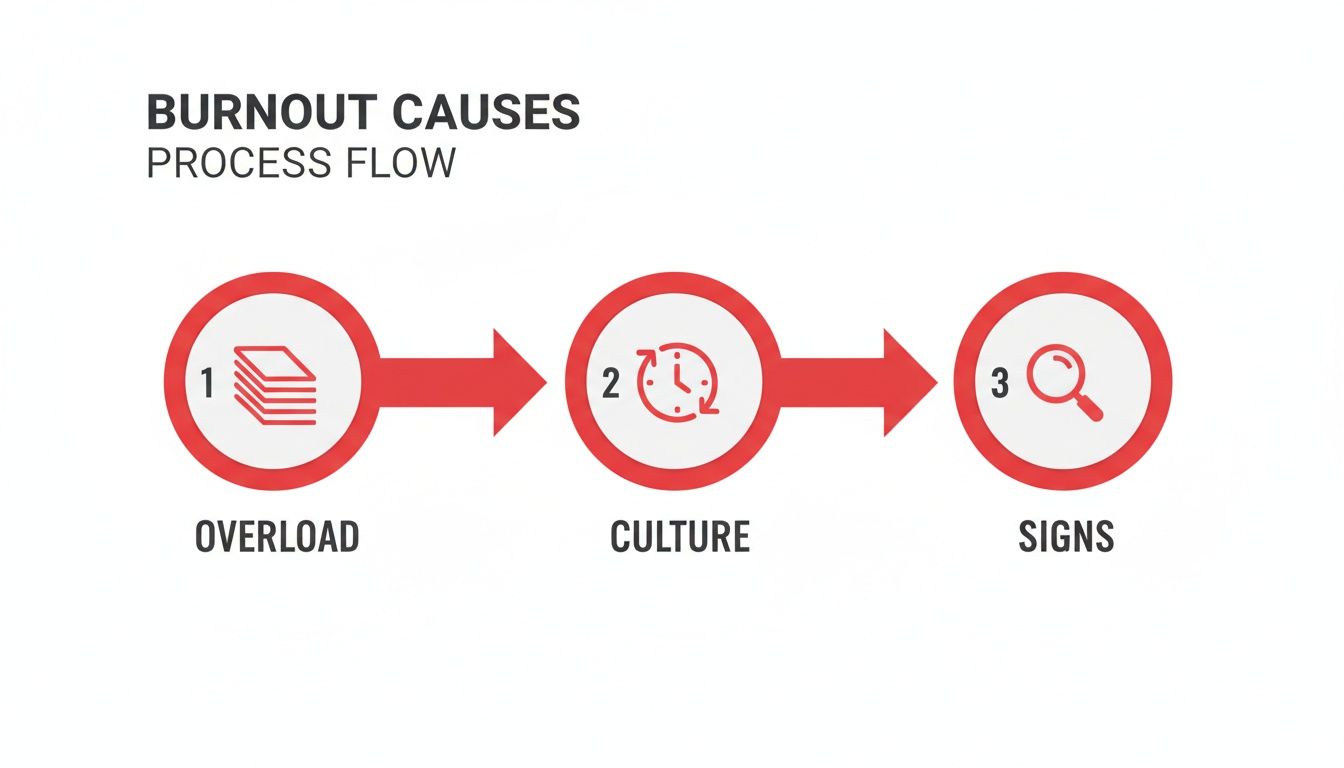
Burnout isn't a single event. It's a slow burn — and the most effective way to fight it is to tackle the root causes, like workload and culture, early.
Crafting Policies That Protect Energy
The foundation of any solid FRMS is a set of clear, enforceable policies. These aren't flimsy suggestions; they are guardrails that prevent the slow, quiet creep of exhaustion. Your policies need to address the most common energy drains directly.
Start by auditing what you already do. Are there unwritten rules secretly contributing to fatigue? When someone is praised for a lightning-fast reply to a 9pm email, that sends a powerful message: work never stops.
A practical policy toolkit includes:
- Working-hour guidelines. Define clear start and end times, even for flexible roles. This helps people mentally clock out at the end of the day.
- After-hours communication rules. Adopt a "right to disconnect" position. Make it explicit that employees aren't expected to answer non-urgent messages outside their working hours.
- Meeting-hygiene protocols. Set rules to fight meeting fatigue: mandatory agendas, default meeting lengths of 25 or 50 minutes to build in breaks, and protected "no-meeting" blocks during the week.
An effective FRMS does more than list rules; it changes the default settings of your workplace. When the default is rest and recovery, you make it easy for employees to do the right thing — for their wellbeing and their performance.
Innovative Scheduling as a Core Strategy
Policies are the guardrails, but nothing tackles chronic fatigue more directly than rethinking the workweek itself. Reduced-hour models — a four-day, 32-hour week or a nine-day fortnight — are powerful systemic tools.
These models aren't about cramming five days of work into four. They force a root-and-branch re-evaluation of your processes: cutting low-value tasks and sharpening everyone's focus on what truly matters. By giving employees an entire extra day for rest, errands, and life, you give them back the one thing they can't make more of — time.
For any schedule change to work, though, it has to be stable and predictable. Constant change, even positive change, is itself a source of stress. Gartner research found the share of employees willing to support enterprise change collapsed to 38% in 2022, down from 74% in 2016, as the average worker absorbed ten planned organisational changes a year. A well-run four-day week offers consistency: once it's in place, it provides a stable foundation for recovery rather than another disruption to absorb.
Your FRMS Audit Checklist
Use this checklist to see where you stand and find opportunities to build a stronger system. It's designed to surface the gaps between good intentions and day-to-day reality.
-
Workload and hours
- Do we regularly track team workloads to prevent chronic overload?
- Are there clear expectations for working hours and breaks?
- Is after-hours work a rare exception, or the norm?
-
Communication and culture
- Do we have an explicit policy on after-hours communication?
- Is our meeting culture respectful of people's time and energy?
- Do our leaders actually model healthy work-life boundaries?
-
Scheduling and flexibility
- Have we seriously explored alternative schedules, such as a four-day week or nine-day fortnight?
- Do employees have a reasonable amount of autonomy over their schedules?
- Does our approach to paid time off encourage genuine rest?
Building this kind of system isn't a one-and-done project. It needs continuous feedback, monitoring, and a willingness to adapt. Moving from diagnosing the problem to taking systemic action is what creates an organisation where people thrive rather than just survive.
Practical Strategies Managers Can Model Right Now
Big-picture, systemic change is the goal — but you don't have to wait for new policies to take effect. Managers can model better energy habits immediately, and giving teams permission to use them makes a real difference to day-to-day wellbeing and performance.
This isn't the usual "get more sleep" advice. It's a set of practical, in-the-moment techniques that work in a modern, distraction-filled job. The underlying shift is from time management to energy management: time is finite, but energy is renewable. When a team understands and respects its natural energy cycles, the working day can be structured for sustained performance instead of a grind toward a wall.
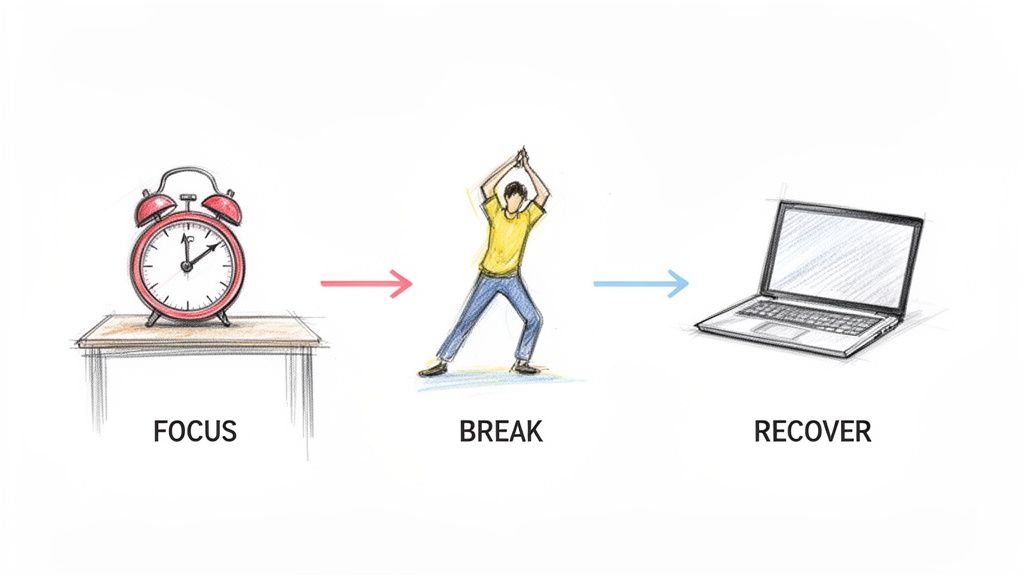
Encourage Focused Work in Structured Sprints
One of the best ways to manage cognitive energy is to work in focused bursts. Sustaining laser concentration for hours rarely works. Structured sprints respect the brain's natural limits and prevent the slow drain that leads to burnout.
The Pomodoro Technique is a simple example: an intense, 25-minute sprint on a single task, then a short five-minute break, with a longer break after roughly four cycles. It's an easy way to fight distraction and build momentum, making large tasks feel more manageable. Managers can encourage it without mandating it — the point is to legitimise focused, uninterrupted work.
Make Room for Strategic Micro-Breaks
When focus starts to drift, that's a signal the brain needs a reset. Pushing through it is usually counterproductive. Strategic micro-breaks are short, intentional pauses — not long coffee breaks:
- The 20-20-20 rule. To fight screen fatigue, look away from the screen every 20 minutes at something roughly 20 feet away for at least 20 seconds.
- Physical movement. Standing up, stretching, or walking to refill a glass of water boosts blood flow and re-energises the mind.
- Mindful disconnection. Sixty seconds with eyes closed, focused only on breathing, can lower stress and restore clarity.
A culture that treats these as normal — rather than as slacking — gets more sustained output, not less.
Protect Real Psychological Detachment
One of the biggest drivers of modern fatigue is the failure to psychologically detach from work. Someone physically off the clock but still mentally running their to-do list or checking email isn't actually recovering.
Firm boundaries are essential, and managers set the tone. The brain doesn't reliably distinguish between actively working and worrying about work, so a hard stop matters — a simple ritual like closing the laptop and saying "work is done for today" signals that it's time to switch off. When leaders visibly do this themselves, the rest of the team feels safe to follow.
How Flexible Work Models Reduce Burnout
When the conversation about fatigue shifts away from individual responsibility toward systemic solutions, one strategy stands out: flexibility.
Giving your team genuine control over where and when they work is more than a popular perk. It pushes back directly against the most common drivers of burnout. It rebalances the dynamic, giving people the autonomy to fit work into their lives rather than the other way around.
That autonomy is meaningful. When someone can align their schedule with their natural energy cycles or life's demands — handling the school run without a spike of anxiety, or running an errand during a quiet midday hour — it peels away a layer of constant, low-grade stress. This isn't about working less; it's about working in a way that respects each person's reality.
Reclaiming Time and Energy from the Commute
One of the most immediate, tangible wins from remote and hybrid models is the death of the daily commute. For many people, that grind eats one to two hours of unpaid, often stressful time. Removing it hands that time straight back.
Reclaimed time is valuable. It becomes extra sleep, a morning workout, family breakfast, or a quiet coffee — all things that actively fight fatigue and replenish energy. Instead of starting the day already drained, people log on rested.
Designing a Workspace for Deep Focus
The traditional open-plan office, once celebrated for collaboration, is often a minefield of distraction. Constant chatter, frequent interruptions, and little privacy make the deep focus that high-value work demands nearly impossible. That constant battle for concentration is mentally exhausting.
Flexible arrangements let people take back control of their environment — a silent room for coding, a busy coffee shop for creative brainstorming, a home office with proper ergonomic support. Control over physical space improves focus and cuts the cognitive load of constantly filtering out noise.
A key part of effective fatigue management is recognising that the "where" of work shapes the "how". Giving someone control over their environment hands them a powerful tool for managing their own energy and attention.
The data backs this up. IE University's Global Life-Work Survey 2023, covering 1,000 people across several continents, found a clear link between remote work and lower burnout: office workers reported burnout symptoms 41% of the time, against 26% for remote workers.
Ultimately, flexibility is about trust. It signals that you trust your team to deliver without being physically watched, and that trust cultivates ownership and responsibility — powerful motivators in their own right. Combine it with a reduced-hour model like a four-day week, and flexibility becomes one of the strongest tools available for building a sustainable, high-performing culture.
Is Your Fatigue Management Program Actually Working?
So you've rolled out a fatigue management programme. It's a serious investment in your team — but how do you prove it's moving the needle? To earn buy-in and keep momentum, you need real, tangible results, not anecdotal wins.
This isn't about counting how many wellness seminars you hosted. It's about connecting your efforts to the core health of the business.
Choosing KPIs That Tell the Real Story
To measure real impact, track metrics that are genuinely sensitive to your team's energy, stress, and engagement. "Improving morale" is a fine intention but nearly impossible to quantify. Hard data tells a clearer story:
- Voluntary turnover. Rested, engaged people don't usually quit. A meaningful drop in voluntary turnover is one of the strongest signals your initiatives are working.
- Absenteeism. Track both frequency and duration of unplanned absence. When burnout runs high, sick days follow; a healthier environment leads to better attendance.
- Productivity benchmarks. This looks different for every team — deal-closure rates for sales, story points per sprint for engineering — and that's the point. A well-rested team is an effective team.
- Safety incidents. In manufacturing, healthcare, and similar fields, fatigue is a direct cause of accidents. Fewer incidents shows the programme is protecting people.
Use Pulse Surveys to Capture How Your Team Feels
Hard data is essential, but you also need the human side. Anonymous pulse surveys are a simple way to get honest feedback on workload and stress without the pressure of a face-to-face conversation.
These aren't the monster annual surveys everyone dreads — they're short, frequent check-ins, perhaps three to five questions a month, giving a real-time read on wellbeing. Ask direct questions to see how specific changes are landing.
Think of pulse surveys as an early-warning system. They surface rising stress or frustration well before it shows up in your turnover figures, giving you a chance to adjust.
After introducing a no-meeting Friday, for example, a pulse survey might ask: "On a scale of 1 to 5, how has Focus Friday affected your ability to do deep work?" That gives immediate, actionable feedback.
A Worked Example: Measuring a Four-Day-Week Pilot
Consider a mid-sized software company losing talent, with high burnout and expensive voluntary turnover. It decides to pilot a four-day, 32-hour week as the cornerstone of a new fatigue management strategy, and tracks a handful of metrics before and during a six-month pilot.
| Metric | Before Pilot (6-month avg) | During Pilot (6-month avg) | Change |
|---|---|---|---|
| Voluntary turnover (annualised) | 18% | 7% | -61% |
| Average sick days per employee | 4.1 days | 1.9 days | -54% |
| Customer ticket resolution time | 24 hours | 18 hours | -25% |
| Pulse survey: work-life balance | 2.8 / 5.0 | 4.6 / 5.0 | +64% |
The figures above are an illustrative example, not reported results — they show the kind of before-and-after picture a structured pilot produces.
A pattern like this makes the decision easy: a sharp fall in turnover and absenteeism saves real money on recruitment and lost productivity, while faster support resolution shows a shorter week can make a team more efficient. This is the broad shape of the evidence base, too. In the UK's six-month four-day-week pilot — the largest of its kind, run by 4 Day Week Global with the think tank Autonomy and researchers at Boston College and Cambridge — the number of staff leaving fell by 57% and 71% of employees reported reduced burnout, with revenue holding broadly steady.
Pick the right things to measure, gather both hard numbers and human feedback, and tell a clear story with the results. Done well, you can show that investing in your team's wellbeing is one of the smartest business decisions available.
Common Questions About Workplace Fatigue
Even with a solid plan, a few questions come up consistently when leaders start tackling fatigue.
Isn't workplace fatigue just a fancy word for being tired?
Not at all. We've all felt tired after a long day, and a good night's sleep usually fixes it. Workplace fatigue is different: a chronic state of physical, mental, and emotional exhaustion that sleep alone can't resolve. It's the result of prolonged stress, and it lingers — in persistent low motivation, an inability to focus, and a creeping cynicism about the job. That's why effective fatigue management has to go deeper than telling people to rest. It has to fix the systemic issues causing the drain.
Will a four-day workweek solve our burnout problem on its own?
A four-day workweek can be a powerful lever, but it isn't a magic wand — success hinges entirely on how you implement it. Done well, by focusing on smarter processes and cutting low-value work, it tackles one of the biggest causes of fatigue head-on: too many hours with too little time to recover. A shorter week forces efficiency and gives the team a genuine extra day for rest and life admin, so they return more focused. But it only works when paired with a culture that genuinely respects boundaries.
We're a small business. Where do we start?
For a small business, tackling fatigue can feel overwhelming — but you don't need to do everything at once. A few practical starting points:
- Just ask. An anonymous survey is a fast way to check your team's real stress levels and pinpoint the biggest pain points, giving you actual data to work with.
- Review the unwritten rules. Be honest about your culture. Is there an "always-on" expectation? Set clear ground rules for after-hours communication so people can truly switch off.
- Find quick wins. You may not be ready for a four-day week, and that's fine. A no-meeting Friday to protect deep work, or core working hours to reduce cognitive load, are small changes that build momentum.
These first steps show you're listening, build trust, and give you the insight to plan bigger changes later.
Workplace fatigue is rarely solved by one dramatic gesture. It's the compound effect of sensible workloads, clear boundaries, capable managers, and a schedule that respects the rest of someone's life. Treat your team's energy as the finite, valuable resource it is — design the work around protecting it — and you build an organisation that performs because its people are well, not in spite of how tired they are.
Hiring for a 4-day week?
List your roles on 4dayweek.io and reach candidates who want a better balance.
Get started free