
Improving team morale isn't about grand, expensive gestures. It's about building an environment where people feel valued, heard, and supported — and that consistently translates into higher engagement and better performance.
In practice, it comes down to a focused effort on three things: authentic recognition, transparent communication, and a real investment in employee wellbeing and growth. This guide is written for managers and people leaders who own the morale problem on their team and want a practical, evidence-based way to fix it.
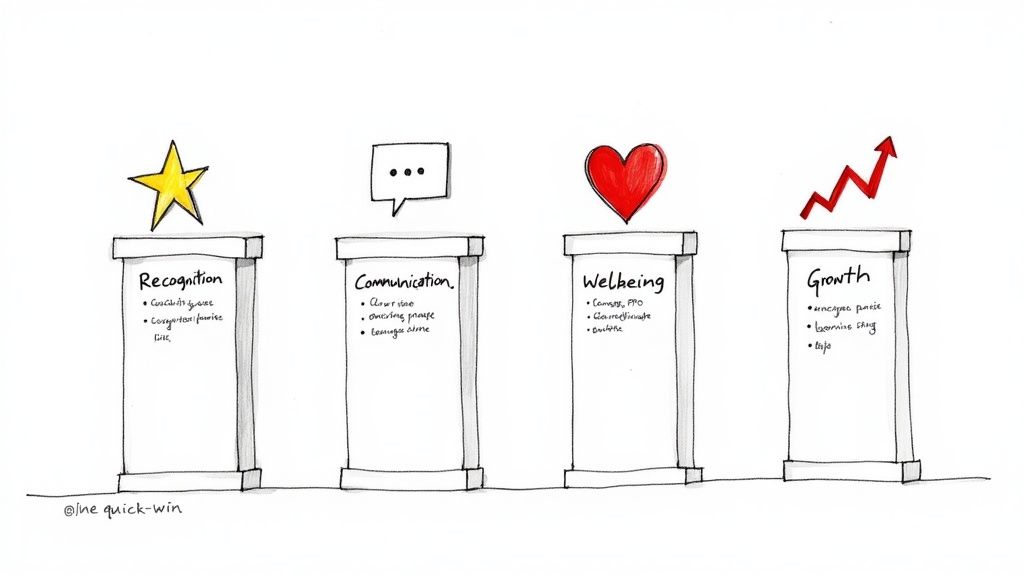
The Four Pillars of a High-Morale Workplace
When morale is low, it's more than a bad mood drifting around the office. It's a quiet productivity drain that slowly erodes a team's foundation — and the cost is real. Gallup's long-running meta-analysis of engagement data finds that business units in the top quartile for engagement see around 23% higher profitability and 18% higher productivity than bottom-quartile units, alongside markedly lower turnover and absenteeism.
Most of the time, the root causes are clear: people feel unappreciated, communication from leadership is murky, there are no visible paths for growth, or the culture quietly ignores wellbeing. The fix isn't complicated. It's about consistently reinforcing a positive culture through small, deliberate actions across four fundamental pillars.

Recognition, communication, wellbeing, and growth are all connected. They form the bedrock of a thriving team, and letting one slide quietly undermines the others — which is why a balanced approach matters.
Core Pillars for High Team Morale
| Pillar | Core Principle | Immediate Action Example |
|---|---|---|
| Recognition | Acknowledging contributions makes people feel valued. | Add a "wins of the week" segment to team meetings where anyone can give a shout-out. |
| Communication | Transparency builds trust and psychological safety. | Host a casual "Ask Me Anything" with leadership once a month. No scripts. |
| Wellbeing | Supporting health prevents burnout and builds resilience. | Protect a no-meeting block on everyone's calendar for a real lunch break. |
| Growth | Investing in skills shows you're invested in their future. | Offer a small, fixed budget for each person to spend on books, courses, or workshops. |
Focusing on these areas gives you a solid framework for making immediate, tangible improvements.
Why Recognition Is Such a Powerful Lever
Of the four pillars, recognition often delivers the fastest morale boost. When people feel their work is genuinely seen and appreciated, motivation and loyalty climb — and the effect on retention is well documented.
This isn't only about feelings. Bersin & Associates, surveying 834 organisations, found that companies with recognition programmes highly effective at driving engagement had 31% lower voluntary turnover than peers with ineffective ones. Notably, only 17% of the organisations studied fell into that "recognition-rich" category — meaning most companies are leaving an easy retention win on the table.




Hiring for a 4-day week?
List your roles on 4dayweek.io and reach candidates who want a better balance.
Get started freeA simple, specific "thank you" for a job well done can have a more lasting impact on morale than a generic annual bonus. It's the consistency and authenticity that matter.
That makes recognition the natural starting point for any manager looking to make a change. A lasting strategy, though, needs all four pillars working together — so the sections below give you actionable steps for each. You can also explore complementary employee motivation techniques to keep your team engaged.
Diagnosing the Real Causes of Low Morale
Before you can fix morale, you have to stop guessing. Quiet meetings, missed deadlines, and a general lack of enthusiasm are symptoms — not root causes. To make a real difference, you have to dig deeper and find out what's actually going on.
Jumping to conclusions is a classic misstep. It's easy to throw a team-building event at the problem, but that's wasted effort if the real issue is burnout from an impossible workload. The first step is always to open up channels for honest, unfiltered feedback where people feel safe enough to speak.
Go Beyond Standard Engagement Surveys
Annual surveys have their place, but they're far too slow and formal to capture the day-to-day pulse of a team. You need lightweight, frequent methods to gather timely signal.
- Anonymous pulse surveys. Short, 1–3 question surveys sent weekly or fortnightly, focused on a specific topic like workload, recognition, or communication clarity. Because they're quick and anonymous, you're far more likely to get candid responses.
- Small feedback sessions. Skip the all-hands for this. Gather cross-functional groups of 3–5 people for an informal chat. With fewer people in the room, those who are usually quiet feel more comfortable speaking up.
- Stay interviews. Why wait for an exit interview to learn what went wrong? Sit down with your high performers and ask what keeps them here, what they value about the role, and what might tempt them away. It shows you what you're getting right — and where your blind spots are.
Don't ask "Is morale low?" — that's a dead-end question. Ask "What's one thing that would make your work week better?" or "When did you last feel genuinely proud of your work here?" The answers give you a far clearer diagnosis.
Sample Questions That Get Real Answers
The quality of your feedback lives and dies by the quality of your questions. Avoid anything leading or overly broad.
For pulse surveys (rate 1–5, or simple yes/no):
- "I feel my contributions were recognised this week."
- "My current workload feels manageable."
- "I have a clear understanding of what's expected of me."
For feedback sessions (open-ended):
- "What's one process or task that consistently slows you down?"
- "Can you describe a recent team win and what made it work?"
- "If you had a magic wand, what's one thing you'd change about our team meetings?"
Turning Feedback into Actionable Themes
As feedback comes in, patterns emerge. The key is to organise comments into themes rather than treating each one as a separate fire to put out. Simple categories make the bigger picture visible.
| Feedback Category | Example Comment | Potential Root Cause |
|---|---|---|
| Workload & burnout | "I'm working late most nights just to keep up." | Unrealistic deadlines, clunky processes, or understaffing. |
| Recognition | "I worked on that project for a month and never heard a thing." | No informal appreciation or formal recognition system. |
| Leadership & communication | "I'm not sure why this project is even a priority." | Poor communication of company goals and vision. |
| Growth opportunities | "I've done the same thing for two years with no path forward." | No clear career paths or development support. |
If several people independently raise workload, you're dealing with a systemic issue — one that often ties directly to the importance of work-life balance for sustainable performance. Chronic overload is also one of the clearest signs of workplace burnout worth watching for.
Diagnosing low morale isn't a one-and-done event; it's an ongoing conversation. By consistently creating opportunities for feedback and — crucially — acting on what you learn, you show your team that their voices matter. That alone is a powerful first step.
Weave Recognition and Feedback into Your Culture
A paycheck gets someone to show up; feeling valued is what makes them stay and genuinely engage. Building a culture of appreciation is one of the most powerful — and most overlooked — ways to lift morale. It means getting past the occasional, generic "good job" and weaving authentic recognition into the fabric of the team's day.
Move From Random Praise to a Real System
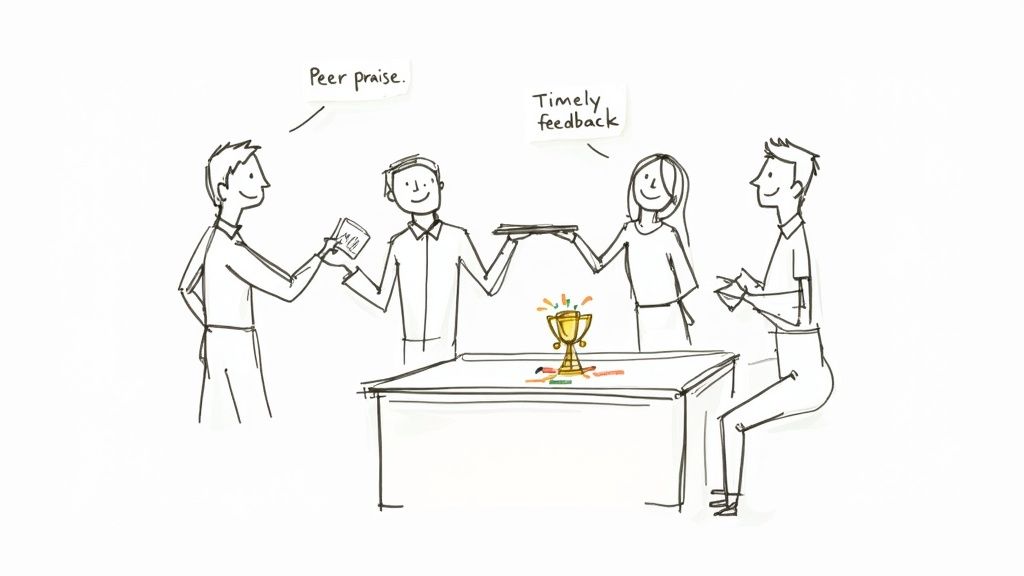
Spontaneous praise is great, but a structured system makes sure no one falls through the cracks. If you rely solely on managers to notice every win, inconsistency is guaranteed. The goal is a multi-directional flow of appreciation — manager to employee, employee to manager, and, just as importantly, peer to peer.
This doesn't need an expensive platform. It's about creating predictable channels where giving credit is encouraged.
- Peer-to-peer recognition channels. A dedicated space for people to publicly thank each other — a team-chat channel like
#kudosor#winsworks perfectly. It takes pressure off managers and lets everyone acknowledge the work happening around them. - Manager-led shout-outs. Make recognition a standing agenda item. Five minutes for a "wins of the week" segment is enough.
A common trap is recognising only the final, polished outcome. Real recognition acknowledges the process — the late nights, the clever problem-solving, the collaboration that got you there. Highlighting the effort makes the praise land as genuine.
Make Feedback Specific and Timely
The impact of recognition comes down to specificity and timing. A vague "great work on the project" delivered a month late barely registers. To land, praise has to be immediate and detailed.
Instead of "you did a good job in that presentation," try:
"The way you handled that tough question from the client today was excellent. Your calm, data-backed answer built real trust in the room."
That level of detail proves you were paying attention and clarifies exactly which behaviours you want to see more of. Gallup's research on recognition reinforces the point: the most effective recognition is authentic, individualised, and frequent — roughly weekly — and it's most memorable when it comes directly from an employee's manager.
Celebrate Milestones and Team Wins
Morale isn't only about individual performance; it's also about shared successes and personal milestones. Celebrating them builds a genuine sense of community.
- Project completion rituals. When a big project wraps, hold a brief retro. Cover the lessons, but also mark the win — order lunch, or give the team a half-day to recharge.
- Work anniversaries and birthdays. Acknowledge them publicly. A shout-out in a team channel or a card signed by colleagues helps people feel seen as individuals.
- Quarterly peer awards. A simple, non-monetary, peer-nominated award — "Collaboration Champion," say — adds a lighthearted way for people to be recognised for their distinct strengths.
Building a culture of recognition is ultimately about consistency: simple, accessible systems that make giving and receiving appreciation a natural part of the workday.
Turn Managers Into Morale-Building Coaches
If you want to know how a team is really doing, look at its manager. Managers are the single biggest influence on day-to-day morale — they set the tone, manage expectations, and shape the environment where people either thrive or just get by. Gallup's research is blunt on this: managers account for roughly 70% of the variance in team engagement.
The most powerful way to build a resilient, high-morale team is to shift managers from taskmasters to genuine coaches. That transformation pivots on one idea: psychological safety — the shared belief that it's safe to take a risk on the team, to speak up with an idea, a question, a concern, or a mistake, without being punished or shamed for it.
Model Vulnerability and Treat Mistakes as Data
Psychological safety starts at the top. When a manager can say "I don't have the answer," admit a mistake, or ask the team for help, it signals that it's okay to be human here. That's not weakness — it's authentic leadership.
Forget a culture where errors get swept under the rug. Reframe them as learning:
- When a deadline is missed, ask "What did we learn?" not "Whose fault was this?"
- Encourage new ideas: "I'd rather we try this and learn something than not try at all."
- Share your own professional stumbles — a project that went sideways, and what you took from it.
Psychological safety isn't about being nice. It's about giving candid feedback, openly admitting mistakes, and learning from each other to reach high performance.
This kind of openness is also crucial for wellbeing. By normalising conversations about challenges, you can better understand what your team needs. Our guide on promoting mental health at work digs deeper into that connection.
Run Inclusive Meetings Where Everyone Is Heard
Meetings are where psychological safety is often won or lost. A manager's job isn't to hold the mic — it's to facilitate, deliberately drawing out perspectives, not just from the loudest or most senior people in the room.
- Share agendas in advance. This gives introverts and deep thinkers space to process and prepare.
- Use a round-robin. Go around the room — virtual or physical — and explicitly ask each person for their view. It guarantees everyone gets a turn.
- Amplify quiet voices. If a good point gets overlooked, bring it back: "I want to return to what Sarah said earlier — I think that was important."
- Set the rules for disagreement. Make clear that challenging ideas is welcome and expected, as long as it's respectful and aimed at the idea, not the person.
These small adjustments turn a meeting from a monologue into a genuinely collaborative session.
Develop Real Coaching and Feedback Skills
Investing in a manager's coaching skills is a direct investment in your team's morale — and managers benefit too. Gallup reports that coaching-focused manager development can lift a manager's own performance metrics by 20–28%, with effects persisting up to 18 months after training; their teams saw up to 18% higher engagement. A manager who is steadier and better supported has more capacity to support the team.
Turning a manager into a coach-style leader comes down to a few core skills:
| Skill | Actionable Technique | Why It Matters |
|---|---|---|
| Active listening | Don't wait for your turn to talk — listen to understand. Paraphrase back: "So if I'm hearing you right, the main obstacle is..." | It shows you value their perspective, which builds trust and encourages openness. |
| Asking open-ended questions | Ditch yes/no questions. Ask "What are your thoughts on how we approach this?" or "What support do you need to succeed?" | It empowers people to own their solutions rather than wait to be told what to do. |
| Giving developmental feedback | Frame feedback around future growth, not past mistakes: "To prepare you for the next level, let's focus on your presentation skills." | It positions you as an ally in their career, making constructive feedback feel supportive. |
Managers who master these skills become the engine of a positive, high-morale workplace — a space where people feel safe, heard, and ready to do their best work.
Fostering Connection in Modern Work Environments
In a world of flexible schedules and distributed teams, the old team-building playbook doesn't cut it. Happy hours and trust falls feel out of place, and forcing connection over a video call is often just awkward.
The secret to lifting morale isn't another one-off event. It's creating genuine, organic opportunities for people to connect — weaving connection into the fabric of daily work rather than staging it. When teams feel a real sense of belonging, psychological safety follows.
Creating Virtual Water Coolers
One of the biggest casualties of remote work is the casual "water cooler" chat — those spontaneous conversations where relationships form and ideas spark. You can't replicate it perfectly, but you can build modern alternatives that serve the same purpose: low-pressure, non-work interaction.
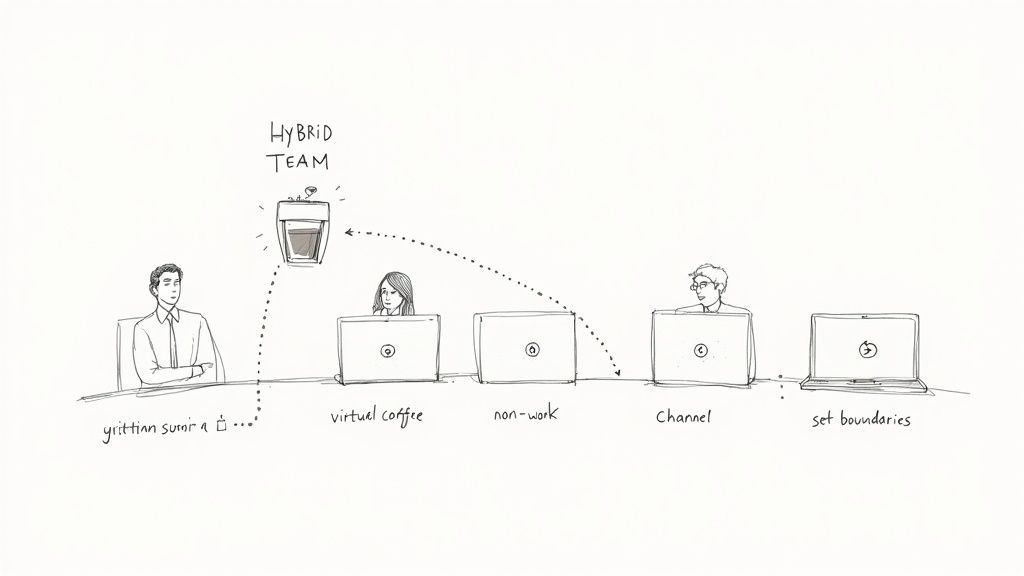
- Virtual coffee pairings. A simple chat app can randomly pair team members from different departments for a 15-minute coffee each week. It's a great way to break down silos and connect people who'd otherwise never meet.
- Structured non-work channels. Dedicated channels for shared interests —
#gardening,#book-club,#pet-photos— give people an outlet to connect personally without cluttering work-focused channels.
Don't underestimate these small, consistent touchpoints. A strong sense of connection is built through hundreds of tiny interactions over time, not a single expensive offsite.
For more on this, see our guide to effectively managing distributed teams, with practical tips on communication and culture for remote-first companies.
Proactively Preventing Burnout
A connected team is a resilient team — but connection alone won't stop burnout. You can't have high morale when people are running on empty. Promoting wellbeing isn't a perk; it's a core operational strategy — and reducing employee burnout is central to it. Leaders have to actively model and enforce the boundaries that protect everyone's time and energy.
The structural side of this matters more than the perks. MIT Sloan researchers studying 76 large companies found that introducing meeting-free days had a clear, measurable effect: cutting meetings by about 40% — roughly two no-meeting days a week — was associated with 71% higher productivity and significantly lower stress, as employees felt more autonomous and less micromanaged.
| Strategy | Actionable Example | Why It Works |
|---|---|---|
| Set communication boundaries | Protect "no-meeting Wednesdays" or recurring focus-time blocks where internal meetings are off-limits. | Predictable, uninterrupted time for deep work cuts stress and lifts output. |
| Encourage PTO usage | Have managers check team vacation balances and actively nudge people to book time off. | It normalises taking breaks and dismantles the "unused leave as a badge of honour" culture. |
| Offer meaningful resources | Provide real access to mental health support — therapy sessions, or quality wellness app subscriptions. | It shows you support the whole person, building loyalty and reducing stress-related turnover. |
Fostering connection and preventing burnout are two sides of the same coin. When people feel socially connected and professionally supported, you build a foundation for morale that can handle the pressures of modern work.
Measuring Your Impact and Proving ROI
Improving team morale isn't a "feel-good" initiative — it's a strategic investment that pays real dividends. To win buy-in and justify the resources, you have to connect your actions to business outcomes. That means moving past anecdotes and tracking hard numbers.
When you measure your efforts, you create a feedback loop: you can see which initiatives are landing, which need a rethink, and prove to leadership that a more engaged team is a more productive one.
Key Metrics for Tracking Morale
To get the full story, track both leading and lagging indicators. Leading indicators, like sentiment, are forward-looking; lagging indicators, like turnover, show the results of past actions.
- Employee Net Promoter Score (eNPS). A simple but powerful metric you can pull from pulse surveys, built on one question: "On a scale of 0–10, how likely are you to recommend us as a place to work?"
- Voluntary turnover rate. A classic lagging indicator. A meaningful drop in people choosing to leave is a strong signal your efforts are working.
- Productivity benchmarks. This looks different for every team — sales figures, project completion rates, customer satisfaction scores. The trick is to link them to the periods when you rolled out new morale initiatives.
The goal is a narrative supported by data. "After we launched peer recognition, our eNPS rose 15 points and voluntary turnover in that department dropped" is an undeniable business case.
Connecting Initiatives to Business KPIs
The final step is drawing a clear line from action to result — showing cause and effect, which makes successes easy to report and future investment easy to justify. The body of research linking employee sentiment to business performance is substantial; our roundup of workplace statistics and trends gathers more of it. Measuring that sentiment consistently is covered in our guide on how to measure employee engagement.
| Morale Initiative | Primary Metric to Track | Business KPI Impact |
|---|---|---|
| New peer recognition programme | eNPS and survey feedback | Lower voluntary turnover |
| Flexible work schedule trial | Absenteeism rates | Improved productivity metrics |
| Manager coaching on feedback | Pulse survey sentiment scores | Higher employee engagement scores |
A structure like this helps everyone — your team and the C-suite — see exactly how investing in people moves the bottom line. It turns morale from a fuzzy concept into a measurable business driver.
Common Questions About Team Morale
Even with a solid plan, you'll hit tricky situations when you try to turn morale around. Here are the questions managers ask most.
How Quickly Will We See a Difference?
The answer has two speeds. You can get a surprisingly fast lift from a few quick wins — rolling out a consistent public recognition system, or finally clearing a nagging communication bottleneck, can make people feel heard almost immediately. Expect a noticeable bump in your next pulse survey, sometimes within weeks.
But for the deeper issues — a lack of psychological safety, or full-blown burnout — you need to play the long game. Rebuilding trust and shifting ingrained habits isn't an overnight fix. For those, expect a three-to-six-month timeline before you see a sustainable shift in lagging metrics like retention or eNPS.
What if the Real Problem Is Pay?
It's tempting to throw your hands up when feedback points to compensation — but don't sidestep it. If pay is a recurring theme, acknowledge it head-on. Don't pretend it isn't a factor.
You may not control the budget, but you do control other parts of the employee experience. This is the moment to pivot the conversation to the tangible, non-monetary value you can offer:
- Real career growth. Don't just talk about it — map out clear advancement pathways and show people how to develop new skills on the company's dime.
- Giving time back. Introduce genuinely flexible schedules or enforce hard stops to the workday. Protecting personal time is a powerful motivator.
- Fixing the day-to-day grind. Make sure the work itself is meaningful, and actively remove the frustrating roadblocks and clunky processes that wear people down.
These aren't fluffy perks — they're proven engagement levers that move retention even when salary increases are off the table.
Should We Just Book a Big, Expensive Team Offsite?
A fancy offsite feels like a solution — it's fun, it gets people out of the office, it creates a buzz. But "temporary" is the key word. Think of it as a sugar rush: great for a moment, no lasting energy.
The ROI on one-off, expensive events is almost always lower than investing in consistent, daily cultural improvements.
Your budget is far better spent on the foundations: coaching for new managers, better tools for feedback, resources that support genuine wellbeing. Those pay dividends long after the memory of a pricey dinner has faded.
Get the day-to-day experience right first. Consistent recognition, psychological safety, and clear communication are the bedrock of a team that actually wants to be there — and one of the clearest signals you can send is respecting the rest of someone's life. A genuinely flexible schedule, whether that's remote-first working or a four-day work week, tells your team their time matters as much as their output. For employers thinking about this shift, see our guide to improving workplace productivity in a four-day week. That belief, reinforced daily, is what high morale is really built on.
Hiring for a 4-day week?
List your roles on 4dayweek.io and reach candidates who want a better balance.
Get started free