
When someone resigns, the first number most leaders reach for is the recruiter fee or the cost of a job ad. That number is real, but it is also the smallest part of the bill. The Society for Human Resource Management estimates that replacing an employee costs somewhere between 50% and 200% of their annual salary once you account for hiring, onboarding, and the productivity gap a vacant role leaves behind.
Run that against a real salary and the scale becomes uncomfortable. A team member earning $60,000 a year can cost anywhere from $30,000 to $120,000 to replace. For a senior hire, the figure is larger still. It is a recurring, often-invisible drain — and the good news is that most of it is preventable.
This guide is for managers, founders, and people leaders who want to put a credible number on their turnover problem, then build the case for fixing it at the source.
Why Turnover Is Your Business's Leaky Bucket

Picture your company's talent as water in a bucket. Every resignation punches another hole in the side. The leak is not a one-off expense — it is a steady drain on money, morale, and momentum.
This is not just an HR line item. It is an operational vulnerability. Projects stall while a seat sits empty. The people who stay absorb the extra load and edge closer to burnout. And the institutional knowledge the leaver built up over years — the undocumented process, the key client relationship, the hard-won judgement — walks out with them.
A Strategic Mindset Shift
The first step to patching the holes is being honest about the true financial damage. Once you can put a defensible number on turnover, the business case for investing in retention writes itself.
The conversation has to move from "How much does it cost to hire someone?" to "What is the return on keeping our best people?" That single reframe turns a budget headache into a competitive advantage.
Building a More Resilient Team
You do not have to live with a leaky bucket. The proven ways to slow the drain almost always come back to taking your team's well-being seriously:
- Improve work-life balance. Burnout is one of the most common reasons strong employees leave. Policies that give people their time back are not soft perks — they are direct investments in long-term commitment.
- Offer benefits that matter. Today's talent expects more than a paycheck. Our guide to what benefits employees value most breaks down where to focus a limited budget.
- Build a culture people defend. An environment where people feel heard and respected is what keeps them in their seat when a recruiter calls.




Hiring for a 4-day week?
List your roles on 4dayweek.io and reach candidates who want a better balance.
Get started freeAddress the root causes of why people leave and you stop paying for an endless cycle of backfills.
Unpacking the Visible and Hidden Costs of Turnover
The true cost of replacing an employee behaves like an iceberg. The trackable, line-item expenses are the tip. The real damage sits below the waterline, in costs that quietly drain momentum and rarely land cleanly on a budget.
Focus only on the obvious expenses and you will badly underestimate the problem. To get an honest figure, you have to look at both the easy-to-measure costs and the harder-to-quantify ones.
The Tip of the Iceberg: Visible Costs
Visible costs are the tangible expenses your finance team can pull straight from a budget. They are real, but they tell only a small part of the story:
- Recruitment and advertising fees. Job board postings, sponsored ads, and the commission paid to external recruiters — which routinely runs to 20% or more of the new hire's first-year salary.
- Administrative hours. Every hour HR spends screening résumés, scheduling interviews, and processing paperwork is an hour not spent on development or strategy.
- Interviewing time. Add up the hourly cost of every manager and senior colleague pulled into a multi-stage process. It compounds quickly.
- Screening and setup. Background checks, skills assessments, and equipping a new hire with a laptop, software licences, and access.
These costs are significant. But the truly expensive ones never appear on an invoice.
The Hidden Costs Sinking Your Budget
Hidden costs are the indirect, mostly unmeasured consequences of a departure. They are more damaging than the visible expenses because they ripple outward across the whole organisation.
The most dangerous costs are the ones nobody tracks. Lost productivity, declining morale, and squandered knowledge are quiet killers of profitability — and they all trace back to unchecked turnover.
This is where the real drain happens:
- Lost productivity from a vacant role. When a desk is empty, work either stalls or lands on already-stretched colleagues. Deadlines slip and customer service suffers, hitting revenue and client relationships directly.
- Declining morale and engagement. The people who stay absorb the slack, which breeds stress and resentment. One key departure can trigger a domino effect as others start questioning their own roles.
- Loss of institutional knowledge. A long-tenured employee carries deep customer insight, undocumented process, and internal relationships. That intellectual capital is almost impossible to hand over in a two-week notice period.
- The ramp-up gap. A new hire is not productive on day one. Depending on the role, reaching full productivity takes anywhere from a few months to roughly a year — and you pay a full salary throughout.
Picture a marketing agency losing an account manager earning £70,000. The replacement cost is not a few thousand pounds in recruitment fees. Factor in hiring, onboarding, and the productivity gap, and the realistic range is 50% to 200% of salary — roughly £35,000 to £140,000 for one departure. Turnover at that scale is not a rounding error; it is a strategic problem.
How to Calculate Your Company's Turnover Cost
Abstract percentages are easy to wave away. A concrete dollar figure for your business is what makes the case for change impossible to ignore.
You do not need a finance background. A simple, adaptable model breaks the total expense into four buckets, so you capture the obvious cash drains alongside the hidden ones.
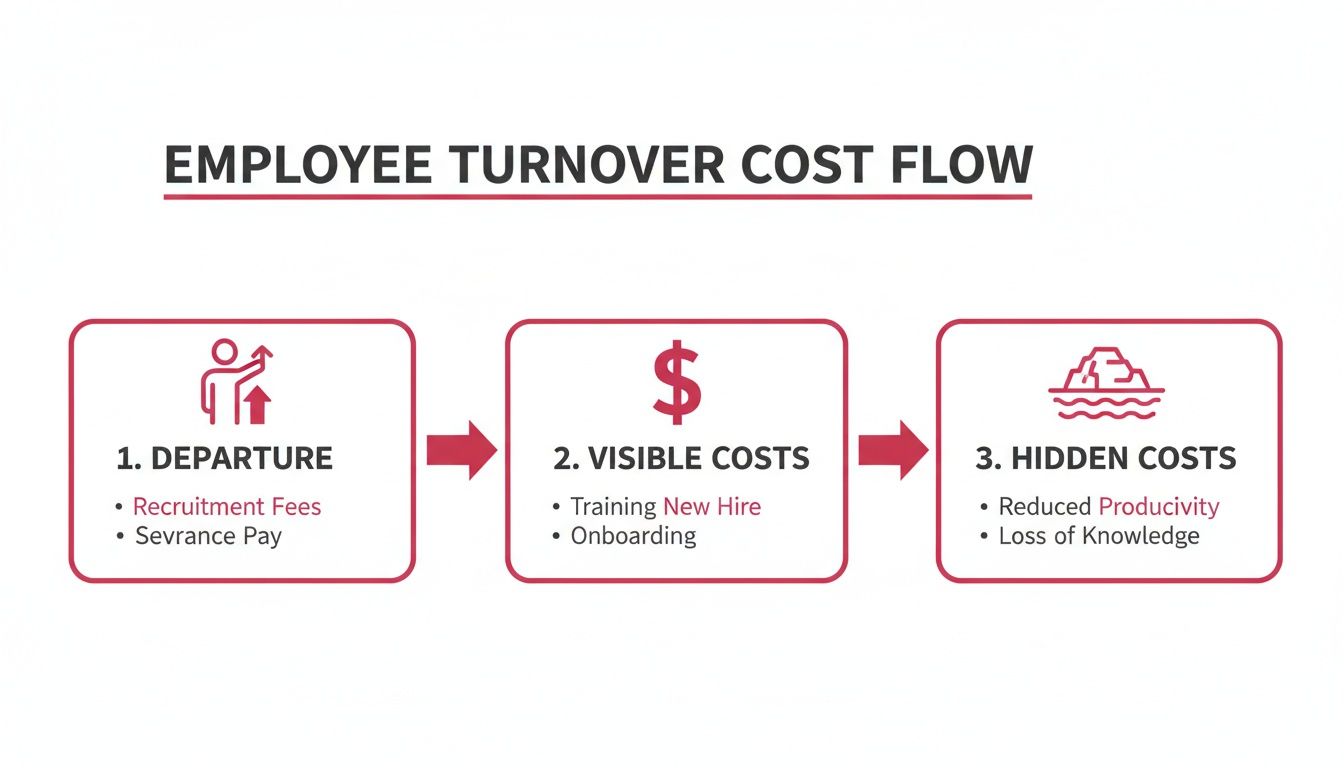
The pattern the diagram makes clear: the heaviest damage usually sits below the surface, in lost productivity.
Step 1: Separation Costs
The meter starts running the moment an employee hands in notice. Separation costs cover the immediate expenses of their departure:
- Exit interview time — the hourly cost of the HR staff and manager running the final conversation.
- Administrative tasks — HR and IT hours spent on final payroll, account deactivation, and benefits paperwork.
- Severance pay — a direct and often significant cost where it applies.
- Temporary coverage — overtime for existing staff or a contractor to hold the role, hitting your labour budget straight away.
Step 2: Recruitment Costs
Next come the most visible expenses: recruitment costs. This is the active hunt for a replacement, and it is where many leaders wrongly assume the bulk of the spend lives.
Say a software engineer earning $120,000 a year resigns. The bill to replace them is far more than a job ad. Within SHRM's 50%–200% range, a senior technical role lands toward the upper end — comfortably $90,000 or more once you include recruiter fees, interview time, and the productivity drag while the seat is empty.
This phase has several clear line items:
- Advertising spend — fees for posting on job boards and niche industry sites.
- Recruiter fees — an external agency typically charges 20–30% of the new hire's first-year salary.
- Interviewing time — the hourly cost of every person across every round. With several managers and team members involved, this climbs fast.
- Screening and assessments — background checks, skills tests, and other pre-employment services.
Step 3: Onboarding and Training Costs
Once you have hired, the spending continues. A new employee is an investment long before they are a contributor.
Onboarding is paying a full salary for partial output. For the first few months, a new hire absorbs far more than they produce. That is a period of pure investment, not return.
Key expenses to track:
- Formal training — courses, materials, and any certifications the role requires.
- Manager and team time — existing staff sink dozens of hours into training, pulling them off their own work.
- Full salary during ramp-up — you pay the new hire's salary and benefits in full while their output is still climbing, often for three to six months or longer.
Step 4: Lost Productivity Costs
Finally, the big one — and the most frequently overlooked: lost productivity. This is the value of work that simply is not getting done, or is getting done poorly.
It breaks into three parts:
- The vacancy period. From the day the employee leaves until a replacement starts, the role is empty. Critical tasks are delayed or dumped onto others, dragging timelines.
- The new-hire ramp-up. The gap between a new hire's early output and a seasoned employee's full output is a direct, measurable loss.
- Team disruption. A new person slows the whole team, not just themselves. Colleagues pause their own work to answer questions and get them up to speed.
Understanding Employee Turnover Industry Benchmarks
Knowing your own turnover cost is a strong first step, but a number with no context is hard to act on. Benchmarking against your industry is what turns internal data into a strategic signal — it tells you whether your churn is a company problem or a sector-wide pressure.
Different industries face different pressures. A tech engineer may be lured away by a competitor's stock package; a customer support agent may leave because the role itself burns people out. The cause shapes the cure.
A Look Across Key Sectors
Turnover is not a one-size-fits-all problem. Drawing on the U.S. Bureau of Labor Statistics' Job Openings and Labor Turnover Survey, the contrast between sectors is stark:
- Technology. Intense competition for specialised skills means engineers and product managers are constantly courted. Voluntary turnover tends to be driven by better pay and faster career growth elsewhere.
- Hospitality and retail. Among the highest separation rates of any sector. Roles are demanding, pay scales are often lower, and churn is a persistent operational cost.
- Finance and insurance. Turnover is comparatively lower, but each departure can be expensive — leavers take sensitive client relationships and complex domain knowledge with them.
- Healthcare. Sustained staffing pressure and burnout keep separation rates elevated, with replacement costs amplified by licensing and credentialing requirements.
What the Numbers Actually Say
Rather than trust a tidy table of precise percentages — the kind that often turns out to be invented — anchor on two reliable reference points.
First, separation rates by sector. The BLS JOLTS data consistently shows leisure and hospitality with the highest quits rates, professional and business services in the middle, and government and finance among the lowest. Pull the figure for your own sector directly from that source rather than a secondhand benchmark.
Second, replacement cost as a share of salary. The Center for American Progress, reviewing 30 case studies across 11 research papers, found replacement costs of around 20% of annual salary for lower-paid roles, rising to as much as 213% for senior, highly skilled positions. Most professional roles sit somewhere in between.
Benchmarking moves you from measuring a problem to diagnosing it. If your churn runs well above your sector's quits rate, the issue is internal — culture, management, pay — and that is squarely within your control.
The economic weight of this churn is enormous. Gallup estimates that the global slide in employee engagement during 2024 cost the world economy around $438 billion in lost productivity, with falling manager engagement a major driver. Disengagement and turnover are two ends of the same problem — and both respond to the same fixes. For the wider picture, see our work-life balance statistics.
Using the Four-Day Week to Cut Replacement Costs

Once the scale of turnover costs is clear, the case for getting ahead of them is obvious. Constantly hiring, training, and losing people is a drain — and the four-day workweek has emerged as a data-backed way to slow it.
This is not a trendy perk. It is a structural decision with a measurable return. A shorter week targets the root causes of voluntary turnover directly: it reduces burnout, improves work-life balance, and delivers the flexibility that strong candidates increasingly treat as a baseline rather than a bonus.
The Direct Link Between a Shorter Week and Lower Turnover
The logic is straightforward. Give people a genuine extra day to rest and handle life admin, and they return more focused and engaged — which cuts the burnout that sends good employees job hunting in the first place. Think of it as preventative maintenance for your team.
The evidence backs the logic. The largest study to date is the UK's six-month pilot, run from June to December 2022 by 4 Day Week Global with the think tank Autonomy and researchers at Boston College and the University of Cambridge. It involved 61 companies and around 2,900 employees on a "100-80-100" model — full pay, 80% of the hours, in exchange for maintaining output.
The retention result was striking: across participating companies, the number of staff leaving fell by 57% over the trial period, while sick days dropped by 65% and revenue held broadly steady. The model also proved durable — when researchers followed up a year later, 54 of the 61 companies were still running the four-day week, with 31 having made it permanent.
A four-day week is not a cost centre. By preserving the institutional knowledge and productivity you have already paid to build, it offsets the far larger cost of churn.
A Worked Example: Modelling the Return
The business case becomes concrete when you model it. Take a finance startup that loses a data specialist earning $90,000. Within the 50%–200% replacement range, the cost of that one departure lands somewhere between $45,000 and $180,000.
Now suppose the company introduces a four-day week and cuts voluntary turnover by 30% — a deliberately conservative figure against the pilot's 57%. If it had been losing five specialists like this each year, that improvement prevents one or two departures. The saved replacement cost alone covers the implementation effort and delivers a positive return in year one.
The model surfaces three financial benefits:
- Lower direct costs — fewer departures mean less spend on recruitment fees, ads, and screening.
- Preserved productivity — keeping experienced people eliminates the vacancy gap and the long ramp-up for replacements.
- A stronger employer brand — companies with a four-day week attract candidates more easily, cutting the cost and time-to-hire when a role does open. You can see who already offers it across our four-day-week companies.
A shorter week is far more than a calendar change. It is a deliberate move to build a more loyal, resilient workforce. If you are weighing it, our guide on how to implement a four-day week walks through doing it without sacrificing output.
Common Questions About Employee Replacement Costs
How Does Replacing Remote vs. In-Office Staff Differ?
It is a myth that replacing a remote employee is always cheaper. It is more of a trade-off. You may save on physical overhead like desk space, but other costs creep up.
Hiring remotely often means competing in a far larger talent pool, which can mean more spend on sophisticated sourcing and advertising to stand out. Sourcing across regions also adds complexity around salary benchmarking and compliance.
Getting a remote hire fully up to speed also demands a more deliberate approach:
- Technology setup — not just a laptop, but potentially a full ergonomic kit and the right collaboration software so the new hire feels connected from day one.
- Structured onboarding — effective remote onboarding needs engaging, self-paced material and dedicated manager time for virtual check-ins.
- Cultural integration — weaving a remote employee into the team takes conscious effort; get it wrong and the ramp-up stretches out, costing you more.
Some direct costs drop, but the indirect costs of onboarding and integration can absorb the savings if you are not deliberate about it.
What Is the Single Biggest Hidden Cost?
The hit to the remaining team's productivity and morale. It is the cost that never appears on a spreadsheet but can hobble a department for months.
When someone leaves, their work does not vanish — it lands on colleagues who are usually already stretched. That spike in workload is a direct route to stress and burnout. As people watch others walk out while their own to-do list grows, they start questioning their own future, which can trigger a fresh cycle of departures that is hard and expensive to stop.
How Soon Do Retention Initiatives Show a Return?
The soft signals shift almost immediately — people notice when a company starts investing in their well-being, and morale lifts. The hard financial return typically becomes visible within 6 to 12 months.
A rough timeline:
- Months 1–3. The soft stuff improves first: people feel more valued, communication gets better, the overall mood lifts. This is the foundation.
- Months 4–9. The data starts to move. Voluntary turnover begins to dip as fewer people actively look elsewhere.
- Months 10–12+. The financial payback becomes clear. You can draw a straight line from a lower turnover rate to real savings in recruitment, onboarding, and lost productivity.
For more on the four-day week and its impact, see our frequently asked questions.
Replacing people is one of the most expensive things a business does, and most of the cost is hidden in plain sight — lost productivity, drained morale, and knowledge that cannot be handed over. Put a credible number on it for your own organisation and the priority becomes obvious: keeping your best people is almost always cheaper than replacing them, and a schedule that respects their time is one of the most direct ways to make them want to stay.
Hiring for a 4-day week?
List your roles on 4dayweek.io and reach candidates who want a better balance.
Get started free