
Cutting your turnover rate isn't damage control for when someone resigns. It's a deliberate investment in the people who already work for you: competitive pay, visible career paths, capable managers, and a schedule that respects life outside work. Get those right and your best people stop scanning job boards, because leaving would mean giving something up.
This guide is written for managers and people leaders who own the retention problem and want a practical, evidence-based plan to fix it.
Why High Turnover Is Costing You More Than You Think

When someone hands in their notice, the first cost most leaders reach for is recruitment: job ad fees, agency commissions, the interview hours. That's the visible tip. The real expense sits below the waterline and never lands cleanly on a balance sheet.
Estimates of the full cost of replacing one employee vary widely by role, but they are consistently large. The Center for American Progress, reviewing 30 case studies across 11 research papers, found replacement costs ranging from around 20% of salary for the lowest-paid roles up to 213% of annual salary for highly skilled executive positions. For most mid-level and professional roles, the figure lands somewhere in the middle — a real, recurring drain on productivity, team morale, and customer relationships.
The Hidden Financial Drain
Direct costs are easy to track. The hidden ones do the real damage, starting with the productivity vacuum. A new hire rarely performs at the level of the person they replaced on day one; depending on role complexity, reaching full productivity can take anywhere from a few months to roughly two years.
While the new person ramps up, someone covers the gap — usually your existing team. That extra load is a fast track to burnout and disengagement, which are themselves two of the biggest drivers of more turnover. One departure can quietly trigger several.
Whenever someone leaves, the people who stay start asking why. That ripple poisons morale, disrupts handovers, and makes your best performers quietly reassess their own loyalty.
It's About More Than Just Money
Set the financial hit aside for a moment. High turnover erodes assets you can't easily rebuild. Everyone who walks out takes a slice of your institutional knowledge with them: the undocumented process, the key client relationship, the nuanced judgement that never made it into a handbook.
The often-ignored costs:
- Lost productivity. A triple hit: the role sits vacant, the new hire needs time to learn, and current team members pause their own work to train them.
- Declining morale. Frequent departures leave the people who stay feeling insecure, overstretched, and undervalued — which directly dents their engagement.
- Erosion of institutional knowledge. Long-tenured employees are walking reference libraries. When they go, you lose shortcuts and context that were a quiet competitive edge.
- A damaged employer brand. A reputation as a revolving-door company makes every future hire harder, slower, and more expensive.




Hiring for a 4-day week?
List your roles on 4dayweek.io and reach candidates who want a better balance.
Get started freeNaming these costs is the first step. Reframe retention as a high-return investment rather than a nagging expense and you can build a genuine business case for the workplace changes that follow. For more on what employees actually want from an employer, see our roundup of four-day workweek statistics.
Find the Real Reasons Your Employees Are Leaving
Before you fix anything, you have to diagnose it. It's tempting to guess — blame the market, assume it's all about money — but guesses are expensive. To fix what's actually broken, you need the real, often unspoken, reasons your best people are leaving.
Skip the diagnosis and you'll spend money on symptoms. It happens constantly: a company rolls out an across-the-board pay rise, then watches turnover stay flat because the real problem was a difficult manager, not the paycheck.
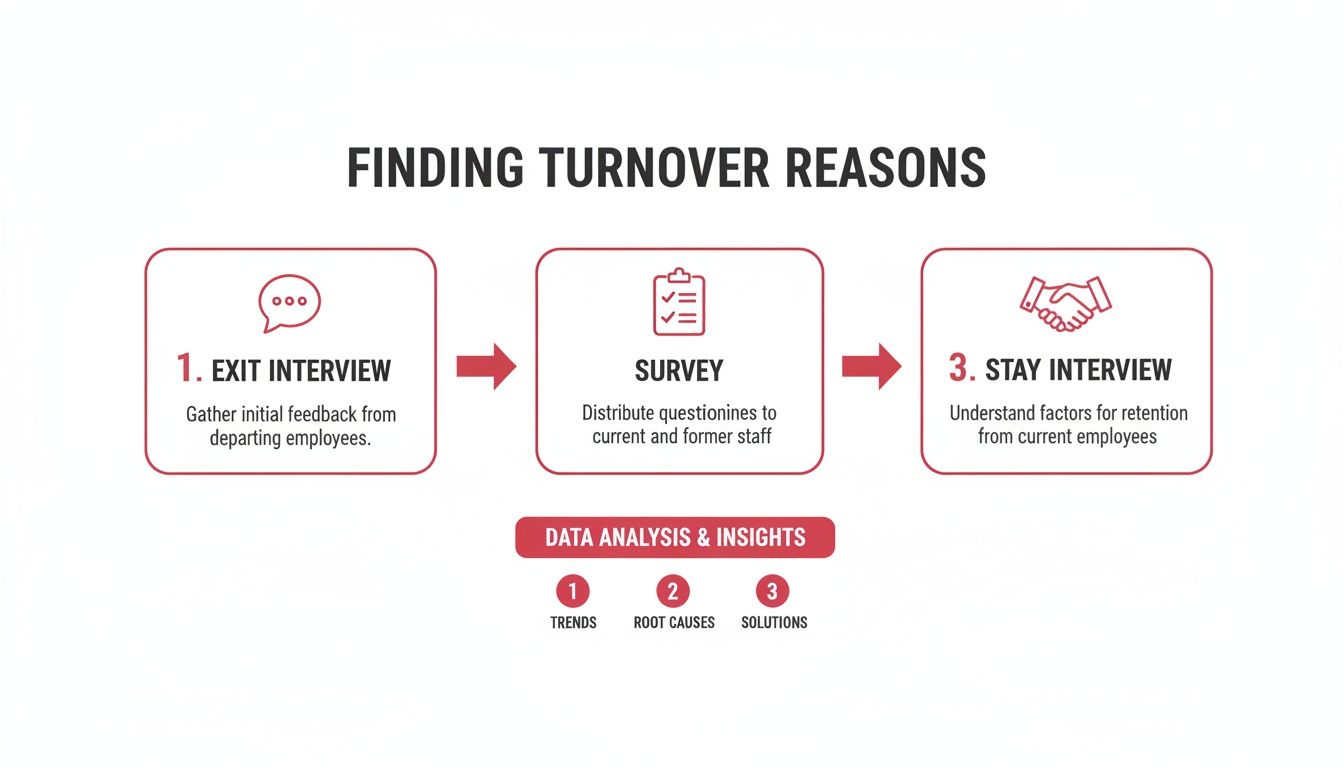
Master the Exit Interview
The exit interview is your most direct line of sight into the problem, and it's routinely wasted. Most departing employees offer up something polite and vague — "seeking a new challenge" — because they don't want to burn a bridge. Your job is to make it safe enough to hear the truth.
To get feedback you can use:
- Use a neutral interviewer. People clam up when their direct manager asks the questions. Have HR or a third party run the conversation to remove the fear of backlash.
- Ask open-ended questions. "Were you satisfied with your manager?" invites a one-word answer. "What could your manager have done differently to support you better?" invites specifics.
- Guarantee anonymity in reporting. Make clear that feedback is aggregated and anonymised before it reaches leadership. That single promise sharply increases candour.
Frame your questions around the future — what could have been better, what advice would you give us — and you shift the tone from blame to construction. That's where the usable insight hides.
Uncover Systemic Issues with Anonymous Surveys
Exit interviews tell you individual stories. Anonymous surveys reveal the patterns. They give a voice to current employees — the ones who may be unhappy but haven't started packing a box yet — and act as your early-warning system.
Go beyond surface questions. Probe the real drivers of retention: management quality, career development, work-life balance, and culture. Mix rating scales with open text so you capture both the hard signal and the human context behind it.
The table below helps translate what people say into what may actually be going on.
Decoding Common Reasons for Leaving
| Common Departure Reason | What It Might Really Mean | How to Investigate Further |
|---|---|---|
| "Seeking a new challenge" | "I'm bored and not growing. My skills are stagnating." | Review career pathing, L&D budgets, and internal mobility rates. |
| "Found a better opportunity" | "The pay, benefits, or flexibility elsewhere is more compelling." | Run a compensation analysis and survey staff on benefits satisfaction. |
| "It wasn't a good fit" | "The culture is misaligned with my values, or my manager was difficult." | Analyse survey data on manager effectiveness and cultural sentiment. |
| "Personal reasons" | "I'm burned out, or the workload is unsustainable." | Look at overtime hours, PTO usage, and survey questions on workload. |
This isn't about calling people liars. It's about understanding the professional code that keeps them polite on the way out.
Implement Proactive Stay Interviews
Why wait until someone has one foot out the door to learn what would have kept them? Stay interviews are short, informal conversations with your current high performers, and the goal is simple: understand what they value and what might tempt them away.
These chats are quietly powerful for building trust and catching problems early. Managers can open with a few direct questions:
- What do you look forward to when you start work each day?
- What are you learning here — and what do you want to learn?
- What would make your job more engaging?
- If a recruiter called tomorrow, what might make you listen?
The feedback is a blueprint for improving the whole employee experience. For more on keeping a team engaged, see these practical employee motivation techniques.
Combine all three — exit interviews, surveys, and stay interviews — and you can stop guessing and start building a retention strategy grounded in evidence.
Building a Retention Strategy That Actually Works
Once you've diagnosed why people leave, you can stop throwing darts in the dark. A strong retention strategy isn't a single initiative; it's a set of moves that show your team you're invested in their financial security, their growth, and their well-being.
The foundation is making sure your pay and benefits aren't just competitive but genuinely compelling. If you keep losing good people to "better opportunities," that's where to look first.
Nail Your Compensation and Benefits
Matching the market average no longer cuts it in a competitive field. You need to know exactly where you sit, then make a deliberate call on where you want to lead.
Start with a thorough compensation analysis: benchmark your salary ranges against fresh data for your industry, location, and specific roles, and look past base pay to bonuses, equity, and other financial perks. With that data, define a compensation philosophy. Will you pay at the top of the market for critical roles? Will you differentiate on benefits instead? There's no single right answer — but there must be a strategy.
Beyond the paycheck, benefits are a major retention lever — and employees increasingly want benefits that support their whole life, not just their health plan:
- Flexibility. No longer a perk; a baseline expectation. Remote work, hybrid schedules, or a four-day week can be decisive.
- Wellness support. Think past basic health cover — stipends for gym memberships, mental health app subscriptions, or financial planning services.
- Family-friendly policies. Strong parental leave, childcare support, and flexible hours for caregivers signal that you back your team through every life stage.
The aim is a package that genuinely resonates with your people. For more ideas, see our guide on what benefits employees value most.
Design Motivating Career Paths
One of the top reasons strong people leave is that they can't see a future where they are. Hit a perceived ceiling and they'll look for the next rung elsewhere — naturally.
Clear career paths are non-negotiable if you want to cut turnover, and this is about growth, not just promotions. Build career frameworks that spell out exactly which skills move someone to the next level. Include parallel tracks for individual contributors and managers so your technical experts can grow without being pushed into leadership roles they don't want.
Back those frameworks with a real learning and development budget: online courses, paid certifications, mentorship pairing junior staff with senior leaders. Investing in someone's skills sends an unmistakable message — we are investing in your future here.
Train Managers to Be Retention Catalysts
You've heard "people don't leave companies, they leave managers." It's an overstatement — workload, pay, and resources matter too — but the manager effect is real and large. DDI's research found 57% of employees have left a job because of their manager, and a SHRM survey found 84% of US workers say poorly trained managers create unnecessary work and stress.
Gallup's analysis goes further: managers account for roughly 70% of the variance in team engagement, and business units with highly engaged teams see meaningfully lower turnover than those with disengaged teams. A manager is the single biggest factor in an employee's day-to-day experience.
The catch is that most people are promoted into management because they were good at their last job, not because they were trained to lead. To close that gap, invest in management training that builds the skills that actually retain people:
- Communication and feedback. How to handle difficult conversations, give praise that lands, and build psychological safety.
- Coaching for performance. Helping team members set meaningful goals, work through obstacles, and grow.
- Spotting and preventing burnout. Recognising the early signs of overwork — and being empowered to protect a team's work-life balance.
Build your strategy on these three pillars — competitive rewards, visible growth, and capable management — and you create a real defence against turnover. The conversation shifts from filling empty seats to building a place where your best people want to stay.
How a Four-Day Week Can Cut Your Turnover Rate
Beyond competitive pay and capable managers, one of the most powerful retention levers is a structural change to how work gets done. The four-day workweek has moved from radical experiment to a data-backed tool for employers serious about turnover.
It isn't just an extra day off. It's a redesign of the work model that targets the root of burnout and disengagement. Give people back their most valuable resource — time — and you build a kind of loyalty that traditional perks struggle to match.
The Data Behind the Shorter Week
The largest evidence base comes from the UK's six-month four-day-week pilot, which ran from June to December 2022. Organised by 4 Day Week Global with the think tank Autonomy and researchers at Boston College and the University of Cambridge, it involved 61 companies and around 2,900 employees on a "100-80-100" model: 100% of pay for 80% of the hours, in exchange for maintaining 100% of output.
The retention result was striking. Across participating companies, the number of staff leaving fell by 57% over the trial period, while 71% of employees reported reduced burnout and revenue held broadly steady. The model also proved durable: when researchers followed up a year later, 56 of the 61 companies had kept the four-day week, with 18 making it permanent.
A four-day week isn't about working less. It's about working better — forcing both the company and its people to cut the noise and focus on what actually moves the business.
The link is clear: when people feel trusted to deliver in less time, and feel their life outside work is respected, they're far less likely to look elsewhere.
From Trial to Permanent: The Buffer Example
Buffer, the social media management company, offers a well-documented worked example. It introduced a four-day week as a pandemic-era well-being trial, saw the results hold, and made the policy permanent in 2021. Two years in, 91% of teammates reported being happier and more productive, and the company found weekly output largely unchanged despite the shorter week.
Buffer's transition was not just a calendar change. It depended on operational discipline that any team can borrow:
- Fewer meetings. Non-essential meetings were cut and protected focus time defended.
- Deep-work blocks. Calendars were structured around long, uninterrupted stretches for focused work.
- Asynchronous communication. Heavier reliance on written updates and project tools reduced the need for constant real-time check-ins.
If you're weighing this path, it pays to learn how to implement a four-day week before committing, so the transition is structured rather than improvised.
Rethinking Flexibility: It's More Than Just a Shorter Week
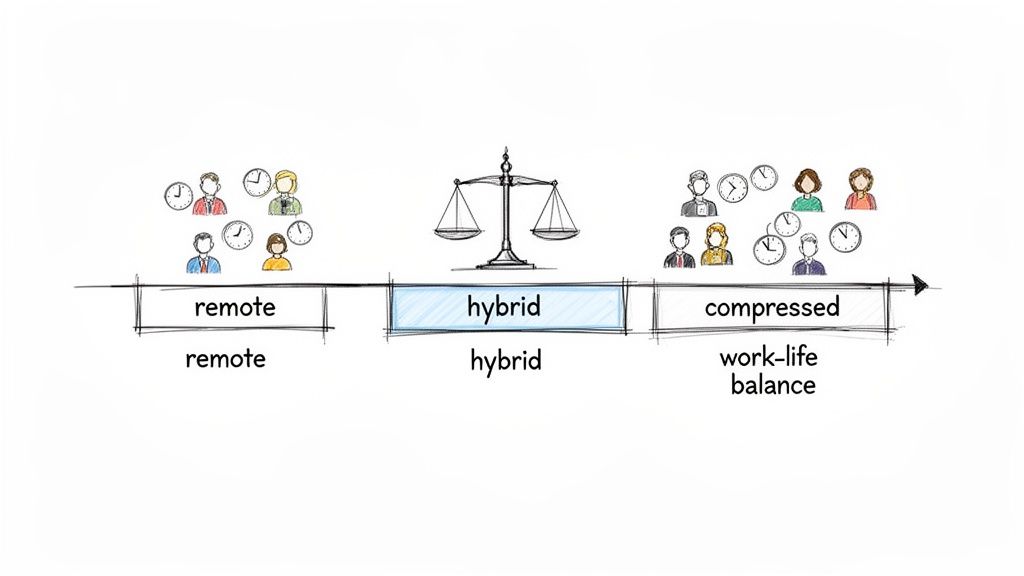
A four-day week is a powerful retention magnet, but it isn't the only way to offer meaningful flexibility. If shifting your whole company to a 32-hour week isn't realistic right now, you can still make a real dent in turnover with other flexible models.
The underlying lever is autonomy: giving employees more control over their schedules. That act of trust improves work-life balance, reduces burnout, and builds the kind of loyalty that stops people opening other offers. The goal is the sweet spot between what your team wants and what your operations need.
High-Impact Flexibility Models to Explore
Moving past the standard 9-to-5 doesn't have to be all-or-nothing. Think of it as a spectrum you can tailor to your structure and culture:
- Compressed workweeks. The team still works a full week — typically four 10-hour days — for a three-day weekend with no cut to total hours. It suits roles where longer focused shifts work well and daily handovers are straightforward.
- Nine-day fortnights. Also called a 9/80 schedule: 80 hours across nine days instead of ten, producing a three-day weekend every other week. It's popular in engineering because it gives a predictable, regular long weekend people can plan around.
- Hybrid and remote-first models. The freedom to work from home, whether full-time or a few days a week, remains one of the most sought-after arrangements. It removes the commute, lets people shape their own workspace, and signals real trust.
The best flexibility policies aren't rigid mandates. They're frameworks that let teams find a rhythm that works. Trust and clear communication are the bedrock of any of them.
Flexible scheduling isn't just a nice-to-have. In the UK four-day-week pilot, the same redesign that cut turnover by 57% also drove a 65% fall in absenteeism, with employees pointing to better work-life balance as the reason. For a practical starting point, see our template for requesting flexible working hours.
Managing Flexibility for Lasting Success
Rolling out any of these models takes more than updating the calendar. It requires a shift in how you manage performance: from hours clocked to results delivered.
Set clear communication protocols and outcome-based performance metrics. Train managers to lead teams that may be remote or working asynchronously, focusing on results rather than monitoring keystrokes. Done well, this keeps everyone on a level playing field and prevents a two-tier culture where in-office staff are assumed to be more productive.
Half-day Fridays are a lighter-touch example of the same principle: a team can cluster client-facing work earlier in the week and reserve Friday afternoons for focused, independent work — protecting service levels while giving everyone a genuine head start on the weekend.
Measuring What Matters: Turning Retention Into a Strategy
You've rolled out new benefits and invested in manager training. That feels like progress — but if you aren't measuring the impact, you're flying blind.
To genuinely cut turnover, stop making hopeful guesses and start tracking the right data. That's what turns retention from a vague intention into a measurable strategy, lets you prove the return on your efforts, and helps you refine your approach over time.
Key Retention Metrics to Track
You only need a handful of high-impact metrics. Treat these numbers as the storytellers of your organisation's health. Before you roll anything new out, establish a baseline for each:
- Overall turnover rate. Your headline number: employees who left in a period divided by your average headcount. Track it monthly and annually for the big-picture trend.
- Regrettable attrition rate. Not all turnover is equal. This zeroes in on departures of your strongest performers — the people you can least afford to lose. A high rate here is a serious red flag.
- Employee Net Promoter Score (eNPS). One question — "On a scale of 0-10, how likely are you to recommend us as a place to work?" — but a powerful gauge of loyalty and satisfaction.
Treat these metrics as your dashboard. A falling eNPS is the check-engine light: it warns you of trouble well before resignations start landing.
Turning Data Into Action
Once you have a baseline, the work becomes continuous improvement. Set realistic, incremental goals — for example, reducing regrettable attrition over the next two quarters — then check progress regularly and connect the trend back to specific initiatives.
Did turnover drop after you introduced a flexibility policy? Did eNPS rise a month after manager training? Analyse those cause-and-effect relationships, double down on what works, and drop what doesn't. That cycle of measuring, analysing, and refining is what separates companies that are perpetually fighting turnover from those that have actually mastered retention.
Common Questions About Reducing Turnover
Even with a solid plan, practical questions come up once you start digging into retention. Here are the ones leaders ask most.
What Is a Good Employee Turnover Rate to Aim For?
There's no universal magic number — it depends heavily on your industry. Gallup describes annual turnover below 10% as broadly healthy, and LinkedIn's analysis put the global all-industry average at around 11%. Sectors vary widely: technology, retail, and media consistently sit among the highest, while stable fields tend to run lower.
Rather than fixating on a benchmark, focus on your own trend. The real win is consistently lowering your company's specific rate — and paying close attention to regrettable attrition, the departures of your top performers.
How Much Does Employee Turnover Really Cost?
More than most leaders expect. Direct costs — recruitment fees, job ads — are easy to spot; the hidden costs sting. The Center for American Progress found the total cost of replacing one employee ranges from around 20% of salary for lower-paid roles to over 200% for senior, highly skilled positions, once you factor in lost productivity while the role is vacant, ramp-up time for the new hire, and the strain on the team covering the gap.
What Is the Single Most Effective Way to Reduce Turnover?
If you can only fix one thing, fix your managers. The evidence is consistent: a poor manager is one of the strongest predictors of voluntary exits, and managers account for roughly 70% of the variance in team engagement.
Training managers to be better coaches, communicators, and advocates is the highest-leverage move available. A manager who builds psychological safety, gives regular feedback, and genuinely champions their team's growth creates an environment people are reluctant to leave.
How Can Small Businesses Compete With Large Corporations on Benefits?
You may not match an enterprise's salary bands or sprawling benefits — but you can win on flexibility and culture, where large organisations are often slow and rigid:
- Real flexibility. Your strongest card. Offer a four-day week, genuinely remote roles, or compressed schedules.
- Visible impact. In a smaller company it's far easier for someone to see how their work moves the needle. Make that connection explicit and celebrate it.
- A close-knit culture. Build a genuine sense of community where people feel known and valued rather than like a cog in a machine.
These are high-impact, low-cost differentiators — and they can lift retention without straining your budget.
Reducing turnover is rarely about one dramatic gesture. It's the compound effect of fair pay, clear growth, capable managers, and a schedule that respects the rest of someone's life — and a four-day week is one of the most direct ways to deliver that last piece.
Hiring for a 4-day week?
List your roles on 4dayweek.io and reach candidates who want a better balance.
Get started free