
Trying to improve company culture without first understanding what is really going on is like navigating without a map. You might end up somewhere, but probably not where you intended. Real change starts with an honest look at your current reality — a clear baseline you can build from. This guide walks through that full cycle: diagnosing where you stand, designing a practical blueprint, rolling it out, sustaining connection in a flexible workplace, and measuring whether any of it is working.
Diagnosing Your Current Company Culture

Before you can build a better culture, you need an honest read on where you are right now. Many leaders operate with a skewed view — they see the culture they want, not the one their employees experience every day.
The goal of a cultural audit is to surface the unwritten rules, the hidden friction points, and the genuine strengths that define how work actually gets done. This is not another once-a-year survey that produces predictable, sanitised answers. It is about creating a safe channel for honesty and gathering real qualitative feedback.
Moving Beyond the Annual Survey
Surveys have their place, but they rarely capture the whole story. People often answer what they think you want to hear, or click through to be done with it. To get to the heart of what is happening, go deeper:
- One-on-one conversations. Treat these as stay interviews. Sit down with a mix of people — brand-new hires through to your longest-tenured staff — and listen. Ask open-ended questions about what energises them and what drains their motivation.
- Small focus groups. Get diverse groups of five to seven people together to discuss specific themes like communication, recognition or work-life balance. With a good facilitator, you will hear candid insights that never surface in a larger setting.
- Continuous feedback channels. A regular, anonymous pulse mechanism gives employees a low-friction way to raise concerns and gives you a live signal rather than a once-a-year snapshot.
These conversations expose the gap between your company's stated values and your team's lived experience. They are the only reliable way to learn what actually drives your people — a question we explore further in our guide to effective employee motivation techniques.
What to Look For in Your Audit
As you gather feedback, you are not just collecting comments — you are hunting for patterns. Look for the positive themes you can build on and the negative ones you need to tackle directly.
Getting this right matters because culture shows up in hard business numbers. Gallup's meta-analysis of employee engagement found that business units in the top quartile of engagement outperform the bottom quartile by 23% in profitability and 18% in productivity, with markedly lower absenteeism and turnover. Culture is not a soft extra; it is a measurable driver of performance.
To make your audit count, focus on a few critical dimensions.
Key Areas for Your Cultural Audit




Hiring for a 4-day week?
List your roles on 4dayweek.io and reach candidates who want a better balance.
Get started freeThis table breaks down the core dimensions worth investigating — a working sheet for getting to how your company actually operates day to day.
| Cultural Dimension | What to Look For | Sample Questions to Ask |
|---|---|---|
| Communication | How information flows, levels of transparency, psychological safety. | "How do you usually find out about important company changes?" "Do you feel comfortable disagreeing with your manager?" |
| Recognition | How effort and results are acknowledged and rewarded. | "When did you last feel genuinely recognised for your work?" "What kind of recognition feels most meaningful here?" |
| Leadership | Manager effectiveness, trust in leadership, how decisions are made. | "Does your manager support your professional growth?" "Do leadership's actions match their words?" |
| Work-Life Balance | Expectations around hours, flexibility, support for wellbeing. | "Do you feel able to disconnect after work hours?" "What could the company do to better support your wellbeing?" |
By focusing on these areas, you build a clear, evidence-based picture of your culture — the good, the bad, and everything between.
By the end of this diagnostic phase, you should have a clear, evidence-based picture of your culture. This baseline is not a judgement; it is your starting point for building something better.
Designing Your Culture Blueprint
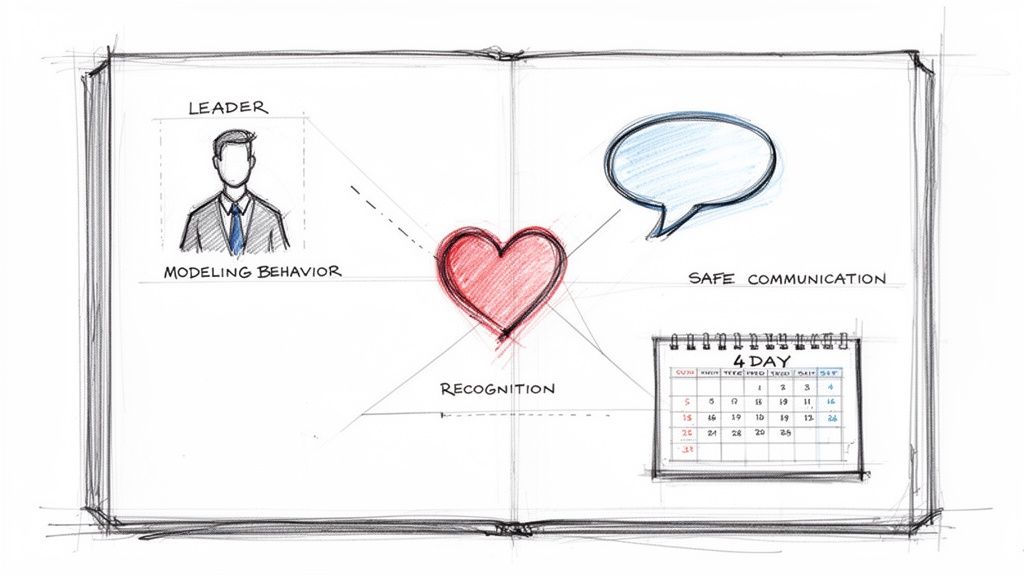
With an honest read on your current culture, it is time to move from analysis to action. This is not about drafting a lofty mission statement for the office wall. It is about building a practical, living blueprint for how your team will actually work, communicate and succeed — closing the gap between the culture you have and the one you need.
Leadership Must Model the Change
Culture change does not happen through a company-wide email. It starts at the top. Leaders have to live the change they want to see.
If you want a culture of transparency, leaders must be transparent. If you are championing work-life balance, they need to be the first to log off and take their holiday. People notice the disconnect immediately when a manager preaches one thing and does another.
The payoff for getting this right is significant. Great Place to Work's research finds that when employees see their managers as honest and ethical, they are five times more likely to want to stay long-term. Active modelling is not a nice-to-have; it is the foundation of trust that any real change depends on.
Foster Psychologically Safe Communication
A strong culture is built on open, honest dialogue — an environment where people feel safe to share ideas, voice concerns and disagree without fearing they will be penalised or humiliated. That is psychological safety, and it does not appear by accident.
A few practical ways to build it:
- Host regular "Ask Me Anything" sessions with leadership where no question is off-limits. This sends a clear signal about transparency.
- Train managers to actively seek input during meetings, so quieter voices are heard before big decisions are made.
- Build a clear process for acting on feedback. Nothing kills morale faster than feedback vanishing into a black hole. When people see their suggestions produce real change, they contribute again.
Involving employees in shaping the change is not just good manners — it materially improves the odds. McKinsey's research on organisational transformations found that when frontline employees help drive the change, success rates reach 71%, far above top-down efforts.
Redesign Recognition and Rewards
What gets celebrated gets repeated. If your recognition system only rewards individual sales heroes, do not be surprised when a collaborative culture fails to emerge. Your blueprint has to align rewards with the behaviours you actually want.
Look hard at who gets promoted, who gets bonuses, and who gets public praise. Are you rewarding the teammate who lifts everyone up, or only the lone wolf who hits their numbers?
A few ways to broaden it:
- Peer-to-peer recognition. A dedicated channel where anyone can give a colleague a public shout-out for living a core value.
- Value-based awards. Awards tied directly to your company values — a "Most Collaborative Teammate" or "Innovation Champion."
- Team-based incentives. Bonuses structured around collective wins, to build a real sense of shared purpose.
Embed Culture Into Your Operations
Culture is not cemented by posters or perks. It is baked into the systems and policies that dictate how work gets done. This is where operational changes have outsized impact.
Take the four-day workweek. It is far more than a benefit. It forces a company to get ruthlessly efficient, prioritise what truly matters, and trust its people to deliver results in less time — embedding autonomy and trust directly into how the organisation runs. Flexible work policies do the same: they signal respect for employees as whole people with lives outside work. When you are ready to make systemic changes like these, exploring what benefits employees value most gives you a clear roadmap for where to focus.
Putting Your Plan Into Action
You have diagnosed the issues and designed a blueprint. Now the hard part. Even the most insightful plan gathers dust without a smart execution strategy — and this is where many culture initiatives stumble, because the rollout feels like another top-down mandate rather than a shared evolution.
The goal is not just to implement change. It is to build genuine momentum and buy-in along the way. A successful launch is transparent, iterative and focused on empowering people, not merely informing them.
Communicate the Why Before the What
Before you announce anything, connect it directly back to the feedback your team gave you. Do not just launch a new recognition programme — explain why, and frame it as a direct response to what you heard in your audit.
For example: "In our focus groups, many of you said you wanted more timely, specific appreciation. Based on that, we are rolling out a peer-to-peer recognition tool to make that easier."
That framing does two things. It proves you were listening and took the feedback seriously, and it turns a corporate decision into a collaborative solution. When employees see their own words reflected in the change, resistance drops and shared ownership grows.
Empower Your Managers to Be Champions
Your managers are the most critical link in the chain. They translate a high-level cultural vision into daily reality for their teams. If they are not equipped and bought in, the plan is dead on arrival. Forwarding them an email with the new plan will not cut it — you have to invest in them first.
Leaders must model the change, but managers must coach it. They need the tools, training and autonomy to lead their teams through the transition with confidence.
To set them up properly, give them:
- Dedicated training. Workshops on handling conversations about new cultural values, or on using a new feedback system well.
- Clear talking points. A simple guide to the questions their teams will inevitably ask.
- A safe forum. A space for managers to share challenges and wins with each other as they navigate the rollout.
When managers feel supported, they become advocates who can address concerns on the ground and reinforce new behaviours in a way that feels authentic rather than forced.
Start Small With Pilot Programs
Jumping straight to a company-wide launch for a major operational change is risky. Testing on a smaller scale first lets you gather real data, work out the kinks, and build an internal case study before rolling out to everyone.
If you are considering a more flexible work schedule, run a pilot with one or two departments for a quarter rather than flipping the switch everywhere at once. This gives you several advantages:
- Lower risk. You can spot unforeseen problems in a controlled environment without disrupting the whole company.
- Data-driven decisions. At the end of the pilot you have hard data on productivity, engagement and satisfaction to guide your next move.
- Built-in proof. A successful pilot creates internal champions and gives you a compelling story that makes the wider rollout far smoother.
This iterative approach builds trust and shows a commitment to getting things right. If you are exploring options, our guide on implementing flexible working hours offers practical templates to start from. By testing, refining and then expanding, you make change feel like a thoughtful progression rather than a sudden disruption — and that is what makes a new culture stick.
Nurturing Connection in a Flexible Workplace
As work models shift, the office is no longer the automatic hub for company culture. In a world of remote and hybrid teams, connection and wellbeing are not happy accidents — they have to be deliberately designed. Improving culture today means weaving belonging into the fabric of a distributed workplace.
This goes well beyond another virtual happy hour or a generic wellness app. It means building a genuine support system that acknowledges the real challenges of flexible work — isolation, blurred boundaries — while leaning into its strengths of autonomy and balance.
Prioritising Genuine Well-Being
Surface-level perks are easy to spot and easy to dismiss. What people want are substantive benefits that address their mental, physical and financial health. A culture of wellbeing is built on real support, not amenities.
Flexible work itself helps here when it is designed well. Office for National Statistics data found that 78% of people who worked from home said it improved their work-life balance — but isolation and blurred boundaries remain real risks, particularly for younger workers, that culture has to actively counter.
A few practical ways to build a more supportive environment:
- Offer a mental health stipend. Let employees use it for therapy, meditation apps, or whatever works for them — it shows you trust them to manage their own wellbeing.
- Institute no-meeting days. Give everyone dedicated time for deep, uninterrupted work, reducing screen fatigue and calendar clutter.
- Normalise taking time off. When leaders openly share that they are disconnecting, it sends a clear message that rest is encouraged, not merely tolerated.
Engineering Deliberate Connection
When you cannot rely on spontaneous chats by the coffee machine, you have to build new rituals for connection. Those small, informal interactions create the trust and camaraderie that fuel good collaboration. Without them, a team starts to feel more like a collection of freelancers than a cohesive unit.
The trick is to make these moments feel natural, not forced — less mandatory fun, more accessible, low-pressure space for people to just be people.
In a remote setting, you have to be deliberate about creating the casual collisions that used to happen on their own. Culture is built in those small, human moments of connection.
A few places to start:
- Rethink onboarding. Make the first week about relationships, not just paperwork. Assign a dedicated onboarding buddy and schedule introductory one-on-ones with key people across departments.
- Create themed channels. Set up non-work channels for shared interests — pets, cooking, books. It is a low-stakes way for people to find common ground.
- Pair people for virtual coffees. Randomly match colleagues for a short, informal video chat. It is a simple way to break down silos and spark new conversations.
Initiatives for Well-Being and Connection
| Goal | Example Initiative | Primary Impact |
|---|---|---|
| Reduce burnout | Company-wide "recharge" days (e.g. first Friday of the month off) | Gives everyone a collective break, removing the guilt of being the only one offline. |
| Combat isolation | Virtual co-working sessions (cameras on, mics off) | Creates a sense of shared presence without the pressure of constant interaction. |
| Encourage recognition | A dedicated wins or kudos channel | Makes peer-to-peer appreciation visible and celebrates small victories that often go unnoticed. |
| Support physical health | Stipend for ergonomic home-office setups | Prevents physical strain and shows the company cares about long-term health. |
| Break down silos | Cross-departmental lunch-and-learns | Encourages knowledge sharing and helps people understand what other teams are working on. |
Each of these small, deliberate actions helps build a stronger, more connected culture. Putting them into practice is a core challenge of managing distributed teams effectively, but the payoff in engagement and retention is substantial.
Measuring Progress and Keeping the Momentum
Improving company culture is not a one-and-done project with a clear finish line. It is more like tending a garden — it needs constant attention. Launching a new initiative brings a burst of energy, but the real work is figuring out what is actually working, adapting your approach, and making that cycle part of how the company operates. Without a way to track progress, even the best plans lose steam and fade.
Nailing Down Your Key Culture Metrics
You cannot fix what you do not measure. Culture can feel intangible, but its effects show up clearly in business metrics. Tracking a few consistently gives you a dashboard for organisational health.
Start with three vital signs:
- Employee Net Promoter Score (eNPS). A simple question — "How likely are you to recommend our company as a place to work?" — that gives a quick read on how your team feels and how loyal they are.
- Retention and turnover rates. Do not stop at the headline number. Dig into regrettable turnover — losing high performers you wanted to keep. Exit interviews are valuable here; they point to the exact cultural friction causing people to leave.
- Absenteeism rates. A sudden spike in unplanned absences is often an early warning sign of burnout or disengagement.
These numbers tell you what is happening. To understand why, pair them with qualitative data — regular pulse surveys with specific questions about psychological safety, recognition or leadership uncover the story behind the trend.
Get Into a Rhythm of Review and Action
Data is useless if it sits on a dashboard gathering dust. Momentum depends on a consistent loop: gather feedback, review it, act on it. That transparency builds trust and shows your team their voice leads to real change.
A great culture is not about getting everything perfect on the first try. It is about building a system where you can listen, learn and iterate quickly.
Put a predictable schedule in place — a quarterly review cycle is a good starting point. In those reviews, leaders should openly share the latest culture data with the whole company: the good, the bad and the uncomfortable. This is also where you connect the dots. If one department's eNPS dips, cross-reference it with recent one-on-ones and pulse surveys to work out what is really going on. When this becomes part of your operational rhythm, culture never gets pushed to the back burner.
Build Feedback Loops That Actually Work
A healthy culture depends on open channels for continuous, honest feedback — not just the annual survey, but feedback woven into daily operations. A few practical ways to do it:
- Manager-led conversations. Train managers to make culture a regular topic in one-on-ones. A simple "What is one thing we could do to make this a better place to work?" can uncover real insight.
- Anonymous channels. You need a way for people to raise concerns without fear of repercussion. This is how you hear about the hard issues people will not discuss openly.
- Action-oriented follow-up. The most important part. When you act on feedback, close the loop and tell people. A simple "you said, we did" message shows everyone that speaking up makes a difference.
This continuous dialogue is the foundation of a strong culture. When giving and receiving feedback becomes as routine as a standard performance review, it stops feeling like a special event and becomes a normal part of doing business — and that constant adaptation is what makes a culture resilient.
Common Questions About Shifting Your Company Culture
When you start talking about transforming company culture, practical questions surface. Leaders want to know what they are really signing up for, where the landmines are, and how to make an impact without a bottomless budget.
How Long Does This Really Take?
While you can often feel small, encouraging shifts in team morale within a few months, deep and lasting cultural change is a marathon, not a sprint. Plan for a realistic timeline of 18 to 24 months.
Think of it in phases. The first six months are diagnosis and design — gathering honest feedback, digging into the root causes of friction, and building a clear blueprint. The following year or so is the real work of implementation and reinforcement. You will see early wins along the way, like better feedback scores or a drop in regrettable turnover, but for new behaviours to become the default takes consistent effort over the long haul. Rushing it is a reliable way to end up with superficial changes that do not stick.
What Is the Biggest Mistake to Avoid?
The single biggest mistake is confusing perks with culture. A new ping-pong table or free snacks will not fix a foundation of burnout, mistrust or poor communication. Those things are pleasant, but they are not culture.
A great culture is built on the daily interactions between people — how they are treated, how decisions are made, and whether they feel psychologically safe. Lasting change comes from fixing systemic issues, not applying cosmetic ones.
The stakes are real. SHRM's research found that turnover driven by poor workplace culture cost US businesses an estimated $223 billion over five years, with most departing employees pointing to their manager. Real improvement comes from addressing fundamentals: training managers to be better coaches, building transparent communication, and making recognition fair and meaningful. A team that feels respected and supported will always outperform one that is merely well-fed.
Can We Improve Our Culture on a Tight Budget?
Yes. Some of the most powerful culture-building initiatives are free — they need an investment of time and intention, not money. A limited budget can even be a blessing, forcing you to focus on the behavioural changes that genuinely matter.
A few high-impact, low-cost places to start:
- Make recognition a ritual. Sincere, specific, timely praise costs nothing. A peer-to-peer shout-out channel, or recognition as a standing item in team meetings, lifts morale noticeably.
- Default to transparency. Regular all-hands meetings where leaders share business updates and take unfiltered questions build trust faster than almost anything else.
- Invest in your managers. They have the biggest day-to-day impact on the employee experience. Training them to give constructive feedback, support growth and lead with empathy is one of the highest-leverage moves you can make.
- Bring clarity to chaos. Confusion is a culture killer. Make sure every team and individual has clear goals and understands how their work connects to the bigger picture.
Ultimately, building a culture that lasts is about changing behaviours, not buying things. Trust, respect and clear communication are the bedrock — and the work of strengthening them never quite finishes, because a culture is only ever as strong as the daily interactions that renew it.
Hiring for a 4-day week?
List your roles on 4dayweek.io and reach candidates who want a better balance.
Get started free