
Did you know that nearly 27% of U.S. employees now work remotely full-time or on a hybrid basis? While this shift has opened doors to talent and flexibility, it has also introduced new layers of legal complexities for employers and HR teams.
Each state in the US has a unique set of labor laws, tax requirements, and compliance quirks. This article summarises these laws and equips you with strategic insight and actionable tips to stay compliant across state lines.
P.S. If you're just beginning your remote journey, make sure your application stands out with these resume tips for remote jobs.
Do Remote Workers Have the Same Legal Protections as In-Office Employees?
Yes, remote workers generally have the same core employment protections as in-office employees. Federal laws guarantee that remote employees receive equal treatment regarding wages, safety, anti-discrimination measures, and leave entitlements.
However, working remotely also introduces important differences based on location, expenses, and privacy considerations.
Here’s how it breaks down:
-
Wage and Hour Protections: Remote employees must be paid at least minimum wage and overtime (if non-exempt), just like office-based employees, under the Fair Labor Standards Act (FLSA).
-
Family and Medical Leave Act (FMLA): It applies to remote workers who meet eligibility (12 months worked, 1,250 hours).
-
Anti-Discrimination Laws: Laws such as Title VII, the Americans with Disabilities Act (ADA), and the Age Discrimination in Employment Act (ADEA) fully protect remote workers against discrimination.
-
Workplace Safety: While OSHA does not inspect home offices, employers are still responsible for ensuring that remote work environments are safe and healthy.
State and Local Laws Depend on Employee Location
-
Employment laws from the state and city where the remote employee physically works generally apply, not necessarily the state where the company is based.
-
States may have their own higher minimum wage standards, stricter overtime rules, family leave laws, or business expense reimbursement requirements.
-
Some cities have additional local laws, such as specific paid sick leave requirements, that remote employers must follow.
Special Considerations for Remote Work
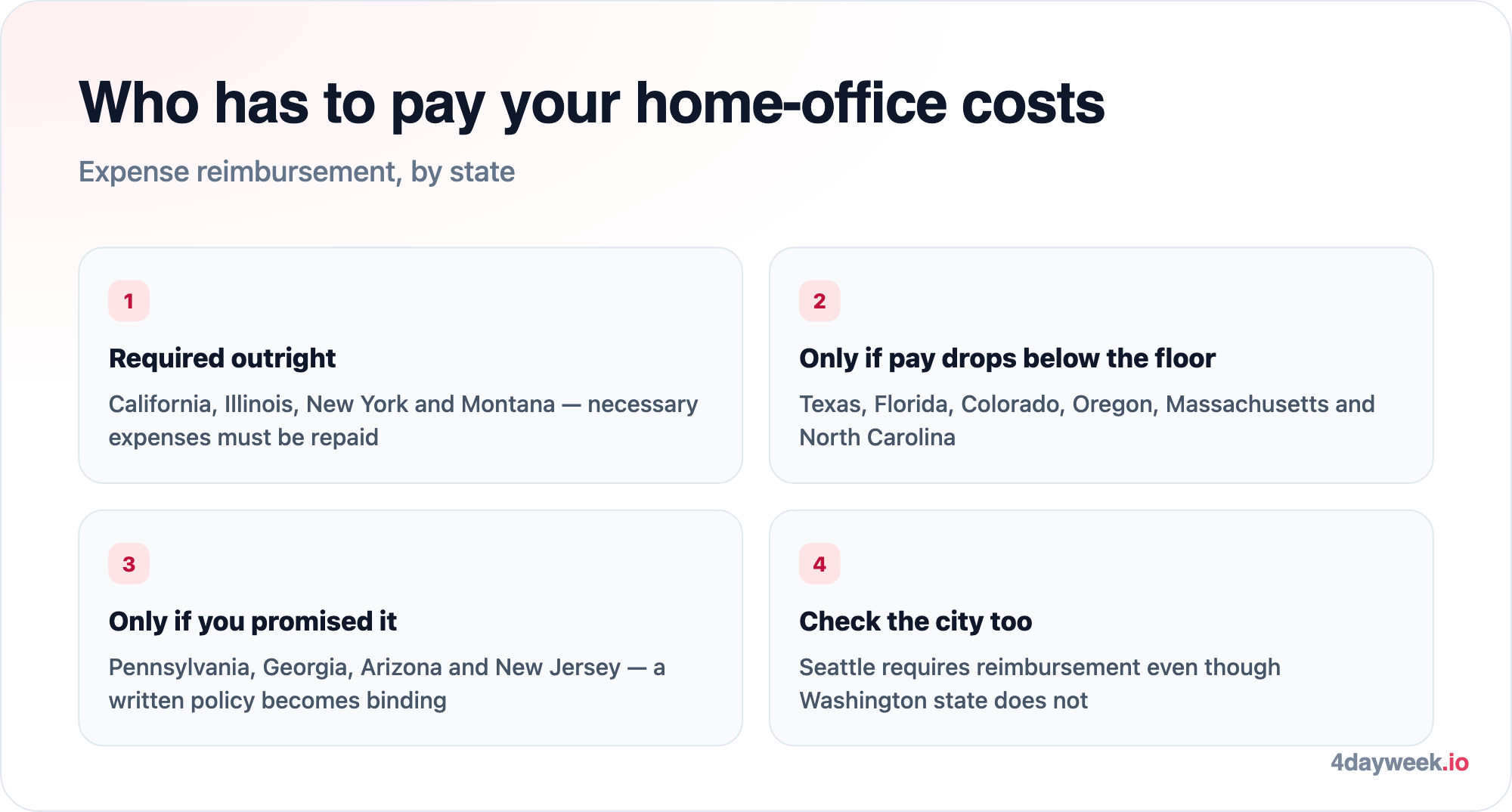
- Expense reimbursements: Remote workers may incur work-related expenses like internet costs, phone bills, and office supplies. Some states require employers to reimburse these necessary expenses.
- Tax implications: State income tax obligations usually depend on where the employee physically performs the work, not where the employer is located. This can create complex situations for cross-state remote work.
Read Next: 10 Essential Skills for Successful Remote Work
State-by-State Analysis of Remote Work Laws
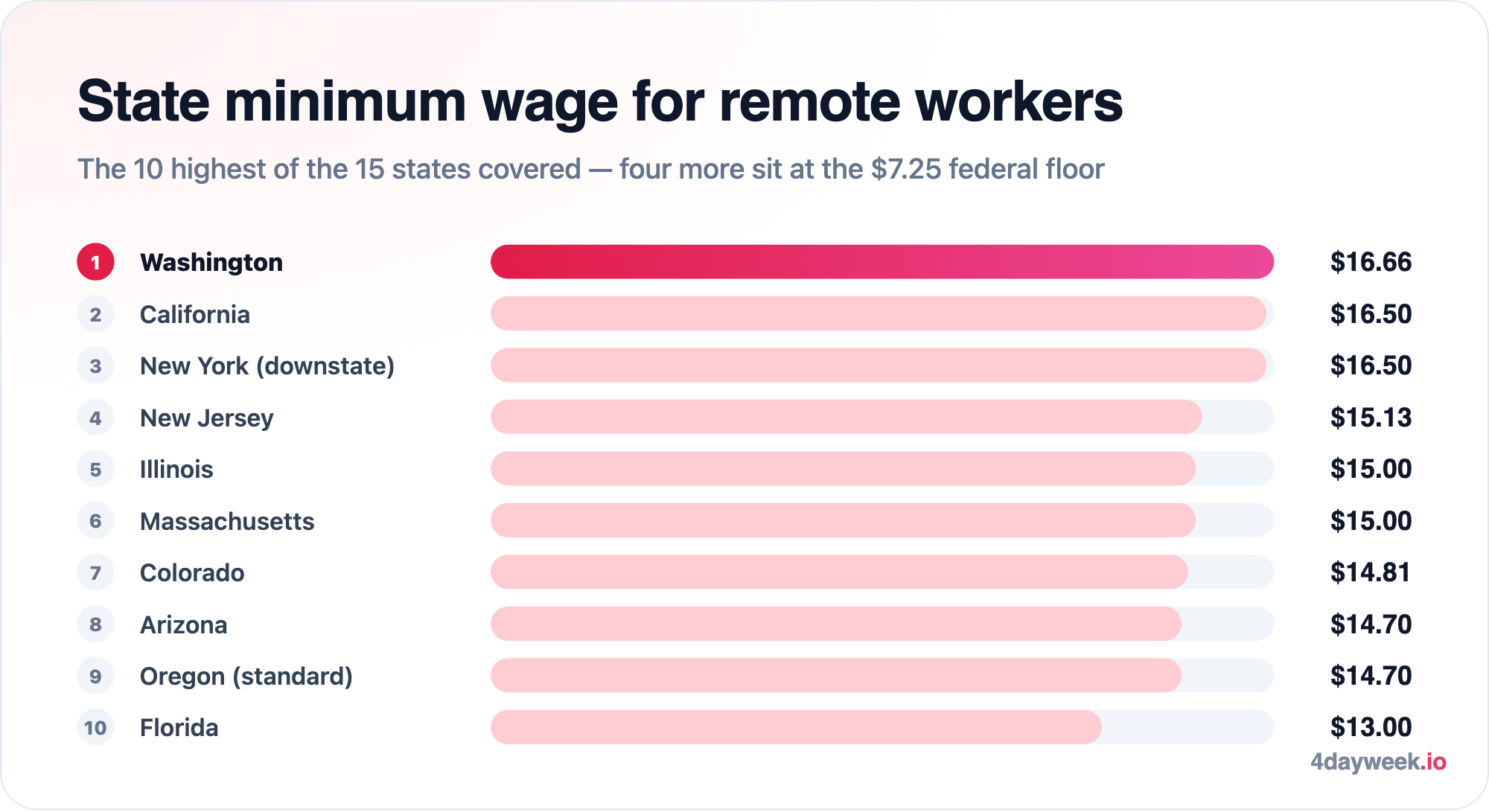
Remote workers might log in from anywhere, but USA state laws decide how you pay, protect, and tax them.
Let’s break down what changes across state lines.
1. California
In California, specific rules regarding reimbursement, taxes, and employee rights apply outside traditional office settings.
-
Minimum wage requirements: California mandates a statewide minimum wage of $16.50 per hour for all employers. However, certain cities, such as Los Angeles, have higher local minimum wage rates, around $17.28/hour.
-
Remote work reimbursement: California Labor Code 2802 requires employers to cover necessary remote work expenses. This includes office supplies, phone bills, and other relevant costs.
-
Meal and rest breaks: Nonexempt employees must receive a 30-minute unpaid meal break after five hours and 10-minute paid rest breaks every four hours.
-
Tax obligations: Remote workers living in California are subject to state income tax. If a tax nexus is created, out-of-state employers may need to register, withhold taxes, and meet business tax obligations.
-
Paid leave: Remote workers must be provided with at least 1 hour of paid sick leave per 30 hours worked, with up to 40 hours usable annually. They also have access to Paid Family Leave for bonding or caregiving, and if they’re eligible under Family and Medical Leave Act (FMLA), they can take up to 12 weeks off.
2. Texas
Texas keeps things relatively straightforward for remote employees, but there are still important rules around wages, taxes, and compliance that you can't ignore.
-
Minimum wage requirements: Texas follows the federal minimum wage of $7.25 per hour. Employers must ensure that remote employees receive at least this amount, and any work-related expenses do not reduce their earnings below this.
-
Remote work reimbursement: Texas does not mandate reimbursement for remote work expenses. However, if unreimbursed expenses cause an employee's pay to fall below the minimum wage, it can lead to legal issues under the Fair Labor Standards Act.
-
Meal and rest breaks: Texas law doesn’t require meal or rest breaks for remote employees. But if breaks under 20 minutes are given, they must be paid. Meal periods over 30 minutes can go unpaid.
-
Tax obligations: Having remote employees in Texas can establish a tax nexus, which obligates the employer to register for state taxes and comply with business tax requirements. This includes collecting and remitting sales tax if the company's revenue exceeds certain thresholds.
-
Paid leave: For remote employees in Texas, no state law requires paid sick or family leave. While some cities like Dallas and San Antonio have local ordinances, these are not currently enforced. Remote workers may still be eligible for up to 12 weeks of unpaid leave under the FMLA, provided they meet the standard criteria.
3. New York
In New York, the state can tax remote employees even if they live and work somewhere else, as long as their employer is based there.
-
Minimum wage requirements: Remote employees in NYC, Nassau, Suffolk, and Westchester must be paid at least $16.50/hour. The rest of New York State follows a $15.50/hour rate.
-
Remote work reimbursement: Employers can’t make unauthorized wage deductions, such as pushing equipment costs onto employees. Remote workers must be reimbursed for essentials like computers, internet, and phone use if needed.
-
Meal and rest breaks: Non-factory remote employees working 6+ hour shifts over 11 AM–2 PM must get a 30-minute unpaid meal break. Shifts starting between 1 and 6 AM require a 45-minute break. Rest breaks aren’t needed, but those under 20 minutes must be paid.
-
Tax obligations: New York's "Convenience of the Employer" rule says that nonresident remote employees working for New York-based employers may be subject to state income tax if their remote work is for their own convenience rather than the employer's necessity.
-
Paid leave: Remote workers in New York earn paid sick leave, up to 56 hours per year if the employer has 100+ employees, and 40 hours for smaller companies. They also get up to 12 weeks of Paid Family Leave with partial wage replacement, and NYC-based workers are covered by the city’s Paid Safe and Sick Leave Law.
4. Florida
Florida doesn’t have a state income tax, but that doesn’t mean it’s hands-off when it comes to remote work. You still need to navigate wage laws, federal labor rules, and tax obligations when hiring remote employees.
-
Minimum wage requirements: Florida’s current minimum wage is $13.00 per hour. It will increase to $14.00 in September 2025, as part of the state’s yearly raise toward a $15.00 minimum by 2026.
-
Remote work reimbursement: Florida doesn’t require expense reimbursement, unless unpaid costs push a remote employee’s pay below minimum wage.
-
Meal and rest breaks: The law in Florida does not require employers to provide meal or rest breaks to employees. However, if you give short breaks (lasting about 5 to 20 minutes), federal law considers them as compensable work hours.
-
Tax obligations: Florida does not impose a state income tax on remote workers. However, if a business has remote employees working from the state, it may still need to register there and follow Florida’s business tax rules.
-
Paid leave: Florida’s remote workers aren’t guaranteed paid sick or family leave under state law. But if they meet FMLA eligibility, based on hours worked and length of employment, they can take up to 12 weeks of unpaid, job-protected leave.
5. Illinois
When working with remote staff in Illinois, you need to pay attention to wages and strict rules around expense reimbursement and tax withholding for out-of-state hires.
-
Minimum wage requirements: Remote employees in Illinois must be paid at least $15.00 per hour.
-
Remote work reimbursement: You are required to reimburse remote employees for all necessary expenses incurred within the scope of employment. This includes costs for internet and phone services used for work purposes.
-
Meal and rest breaks: Employees working 7.5 continuous hours or more must receive a 20-minute unpaid meal break, provided within the first 5 hours of the shift.
-
Tax obligations: If a nonresident remote employee works in Illinois for over 30 days a year, you must withhold Illinois income tax on their earnings for those days.
-
Paid leave: For remote employees, Illinois state requires one hour of paid leave for every 40 hours worked, usable for any reason, up to 40 hours per year. Chicago and Cook County require separate sick and paid leave policies with accrual starting from day one.
6. Pennsylvania
With strict tax rules and a basic minimum wage that has remained unchanged for years, Pennsylvania’s remote work laws heavily rely on federal standards, except for income tax.
-
Minimum wage requirements: Remote employees in Pennsylvania must be paid at least $7.25 per hour. It has not changed since 2009.
-
Remote work reimbursement: You aren’t required to cover remote work expenses unless it’s written into a company policy or agreement.
-
Meal and rest breaks: Breaks aren’t required for workers 18 or older, but if short breaks are provided, anything under 20 minutes must be paid.
-
Tax obligations: Pennsylvania’s “Convenience of the Employer” rule means out-of-state remote employees could still owe PA income tax if their role could be done in the state.
-
Paid leave: The state doesn’t offer paid sick or family leave, but cities like Philadelphia and Pittsburgh do:
-
Philadelphia: Employers with 10+ employees must provide 1 hour of paid sick leave per 40 hours worked for up to 40 hours a year.
-
Pittsburgh: Those with 15+ employees must provide up to 40 hours of paid sick leave per year; those with fewer employees must offer up to 24 hours.
-
7. Georgia
Georgia may look relaxed on paper. However, remote workers here face some of the lowest legal protections in the country.
-
Minimum wage requirements: Georgia’s state minimum is $5.15, but most remote employees are covered under federal law, so they must be paid at least $7.25/hour.
-
Remote work reimbursement: There’s no law forcing employers to cover remote work expenses unless it’s promised in a company policy.
-
Meal and rest breaks: No state law requires breaks. But if you do give one under 20 minutes, it must be paid under federal rules.
-
Tax obligations: Nonresidents working remotely from Georgia must file state income taxes if they earn more than $5,000 or 5% of their total income, whichever is less.
-
Paid leave: No paid leave laws for private sector remote employees. State workers, however, earn sick leave monthly. For others, it all depends on the employer’s internal policy.
8. Massachusetts
Massachusetts stands out for its employee-first approach. Remote workers here benefit from strong wage laws, structured leave policies, and clear tax rules.
-
Minimum wage requirements: Remote employees must be paid at least $15.00 per hour, one of the highest state minimum wages in the U.S.
-
Remote work reimbursement: Employers must ensure that work-related expenses do not reduce an employee's earnings below the state minimum wage. Moreover, the Massachusetts Attorney General recommends reimbursing necessary expenses incurred during remote employment.
-
Meal and rest breaks: Employees working more than six hours are entitled to a 30-minute unpaid meal break, during which they must be free from all duties.
-
Tax obligations: Nonresident remote employees working for Massachusetts-based employers may be subject to state income tax if their remote work is for the employer's convenience.
-
Paid leave: Remote workers are covered under Paid Family and Medical Leave if they’ve earned at least $5,700 in the past year. Benefits can last up to 26 weeks, depending on the reason for leave.
Remote Jobs with a Great Work-Life Balance
Save one to come back to it — it's free.



9. Montana
Montana may not make headlines often, but when it comes to remote work, it quietly delivers.
-
Minimum wage requirements: The minimum wage in Montana is $10.55 per hour. This applies to all employees, including those working remotely.
-
Remote work reimbursement: Remote employees must be paid back for necessary work-related expenses, like internet or phone costs, if those are required to do their job.
-
Meal and rest breaks: There’s no state rule requiring breaks for adult workers, but if short breaks under 20 minutes are offered, they must be paid.
-
Tax obligations: Remote employees who live and work in Montana are subject to Montana state income tax, regardless of where their employer is located. Employers may need to withhold and remit taxes accordingly.
-
Paid leave: There’s no paid leave law, but if an employer offers it, they’re legally required to follow their policy. Everything depends on what’s written in the agreement.
10. New Jersey
New Jersey has taken a strict approach to out-of-state remote workers. Combined with solid wage laws and limits on wage deductions, it’s a state that expects employers to stay on top of legal compliance.
-
Minimum wage requirements: The minimum wage for most employees is $15.13 per hour. Seasonal workers and employees of small businesses (with five or fewer employees) have a lower rate of $14.53 per hour.
-
Remote work reimbursement: While New Jersey law doesn't explicitly mention reimbursement for remote work expenses, employers are prohibited from making unauthorized wage deductions. This shows that shifting necessary equipment costs onto employees without consent is not allowed.
-
Meal and rest breaks: New Jersey does not require employers to provide meal or rest breaks to employees aged 18 or older. However, if one does provide rest breaks, those under 20 minutes must be paid.
-
Tax obligations: New Jersey doesn’t care where you’re working from. If your employer is based there and you’re remote just for your own convenience, the state still wants a cut of your paycheck.
-
Paid leave: Remote workers earn 1 hour of paid sick leave for every 30 hours worked, capped at 40 hours yearly. They also have access to 12 weeks of paid family leave through the state’s insurance program.
11. Colorado
Colorado takes remote work seriously by backing it with tracked job data, local wage rules, and clear break laws.
-
Minimum wage requirements: The statewide minimum is $14.81/hour, but cities like Denver ($18.81) and Edgewater ($16.52) enforce higher local rates that apply to remote workers too.
-
Remote work reimbursement: If a remote employee’s work expenses (like internet or phone use) push their pay below the minimum wage, the employer must cover those costs. That’s not optional.
-
Meal and rest breaks: Remote workers are entitled to a 30-minute unpaid meal break after 5 hours and a paid 10-minute rest break for every 4 hours worked.
-
Tax obligations: Only income earned while physically working in Colorado is taxed by the state. If the work is done from outside, no income tax applies, luckily.
-
Paid leave: Remote workers earn 1 hour of paid sick leave per 30 hours worked, up to 48 hours a year. They’re also eligible for up to 12 weeks of paid leave under the state’s FAMLI program.
12. Oregon
From region-based wages to clear rules around remote taxation, Oregon takes a structured approach to remote work.
-
Minimum wage requirements: Oregon’s minimum wage depends on location. Remote employees in Portland earn $15.95/hour, while standard counties pay $14.70 and nonurban areas $13.70. The rate is tied to where you’re physically located.
-
Remote work reimbursement: If you’re required to use your own internet, phone, or other tools for work, and those costs dip your pay below minimum wage, your employer is responsible for covering the difference.
-
Meal and rest breaks: Remote or not, Oregon law gives you a 30-minute unpaid meal break if you work 6+ hours. You also get a paid 10-minute break for every 4 hours worked.
-
Tax obligations: The state only taxes income earned inside Oregon. So if you’re working remotely from a different state, Oregon’s income tax doesn’t apply to your wages.
-
Paid leave: Oregon’s Paid Leave Oregon (PLO) covers remote workers if their job is based in the state, even if they live somewhere else. The program offers up to 12 weeks of paid leave for family, medical, or safety reasons.
13. North Carolina
North Carolina keeps things light on regulation, but remote workers still need to watch for key compliance issues around pay and taxes.
-
Minimum wage requirements: The state follows the federal minimum wage of $7.25/hour. Employers must also ensure remote employees aren't earning below this after any work-related deductions.
-
Remote work reimbursement: There's no state law that requires reimbursement for remote work expenses. But if an employer has a written policy that covers it, they have to honor it.
-
Meal and rest breaks: No law necessitates breaks for adult employees. If employers do offer short breaks under 20 minutes, they must be paid under federal rules.
-
Tax obligations: If you are physically located in NC, your wages are subject to NC income tax, even if your employer is in another state.
-
Paid leave: North Carolina doesn’t enforce paid leave. Remote employees can take up to 12 weeks of unpaid FMLA leave, and use paid leave with it if their employer’s policy allows.
14. Arizona
Arizona keeps remote work rules simple but offers strong sick leave protections through state law, something most states leave to employers.
-
Minimum wage requirements: Remote employees must be paid at least $14.70/hour. Flagstaff sets its own higher rate per hour ($17.85 or $16.85 for tipped workers).
-
Remote work reimbursement: Arizona doesn’t legally require expense reimbursement for remote workers unless it’s promised in a contract or company policy.
-
Meal and rest breaks: There’s no law mandating breaks for adults as well. But if employers provide short breaks under 20 minutes, they must be paid, just like the federal law.
-
Tax obligations: Arizona taxes all income earned by residents, including remote work done for out-of-state employers. Nonresidents working from Arizona for an AZ-based company are also subject to state income tax.
-
Paid leave: Remote workers earn 1 hour of paid leave for every 30 hours worked, up to 40 hours annually (more if the employer allows).
15. Washington
Not all remote jobs are treated equally, but in Washington, the law makes sure yours doesn’t get overlooked.
-
Minimum wage requirements: The minimum wage in Washington is $16.66/hour. However, several cities enforce higher rates. For example, Seattle has $20.76/hour, and Tukwila goes up to $21.10/hour, depending on employer size.
-
Remote work reimbursement: While Washington state doesn't implement expense reimbursement, Seattle requires employers to cover necessary business expenses, including those incurred by remote workers.
-
Meal and rest breaks: Employees must receive a paid 10-minute rest break for every 4 hours worked and a 30-minute unpaid meal break for shifts over 5 hours. Rest breaks cannot be removed, but meal breaks can be if both parties agree.
-
Tax obligations: Washington has no state income tax. However, employers with remote workers in Washington must register with the state and comply with business tax obligations, such as sales tax collection if applicable.
-
Paid leave: Under the Paid Family and Medical Leave (PFML) program, remote employees can access up to 12 weeks of paid leave for family or medical reasons. In addition, all employees accrue at least 1 hour of paid sick leave for every 40 hours worked.
Wrapping Up
As remote work becomes a permanent fixture of the modern workplace, understanding the state-specific laws is more important than ever. From pay and leave entitlements to tax and reimbursement rules, your rights often depend on where you live, not just who you work for. Staying informed about your state’s laws empowers you to advocate for fair treatment and ensure you're protected, no matter where your desk is.
If you're looking to explore flexible job opportunities that align with today’s evolving work culture, check out our job board. It features many remote and 4-day workweek roles that prioritize work-life balance, flexibility, and modern employment values.




Get 4-day week jobs in your inbox
Create a free account to receive curated opportunities weekly.
Sign up for freeFree forever. No spam, unsubscribe anytime.