
Landing a software engineering job at Tinder means working on real-time systems that millions use daily. But before you get there, you’ve got to make it through a multi-step interview process that tests your coding skills, design thinking, and how well you collaborate under pressure.
And yep, interviews these days are no joke. On average, candidates are prepping 150–200 coding problems just to stay competitive for junior and mid-level roles; that’s how high the bar’s gotten.
This guide walks you through every stage of the Tinder software engineer interview. You’ll get real questions, timelines, and prep tips based on actual candidate experiences, so you know exactly what to expect and how to stand out.
Tinder Software Engineer Interview Process Overview
To begin your journey as a software engineer at Tinder, you’ll go through a structured hiring process designed to evaluate both technical ability and team fit.
Here’s how it starts:
-
Visit the official Tinder Careers page and browse open roles.
-
Use filters to narrow by location, departments, job types, and work type.
-
Choose a role aligned with your experience in backend systems, mobile development, or cloud architecture.
-
Submit your application with a resume that highlights your engineering strengths and collaboration experience.
-
If your profile matches the team’s needs, a recruiter will contact you to schedule an initial phone call.
Here’s What Tinder Software Engineer Interviews Say:
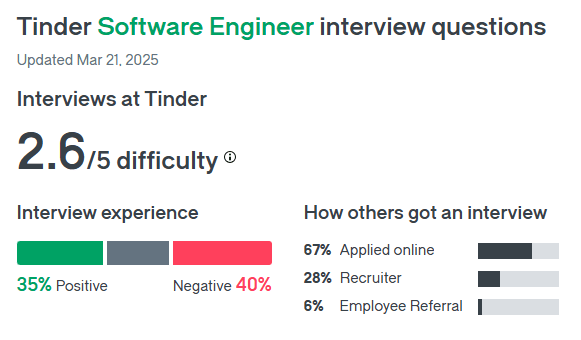
According to recent Glassdoor data, the average interview difficulty is 2.6 out of 5. About 35% of candidates report a positive experience, while 40% had a negative one. Most interviews start through online applications (67%), followed by recruiter contact (28%), and employee referrals (6%).
While not considered extremely difficult, the interview process is highly technical and time-sensitive, especially during coding and design rounds.
Pro tip: Want to stand out during the resume screening stage? Use AI-powered resume builders to tailor your resume to Tinder’s job description. A well-optimized resume can increase your chances of passing the initial filter.
Tinder Software Engineer Interview Process Timeline
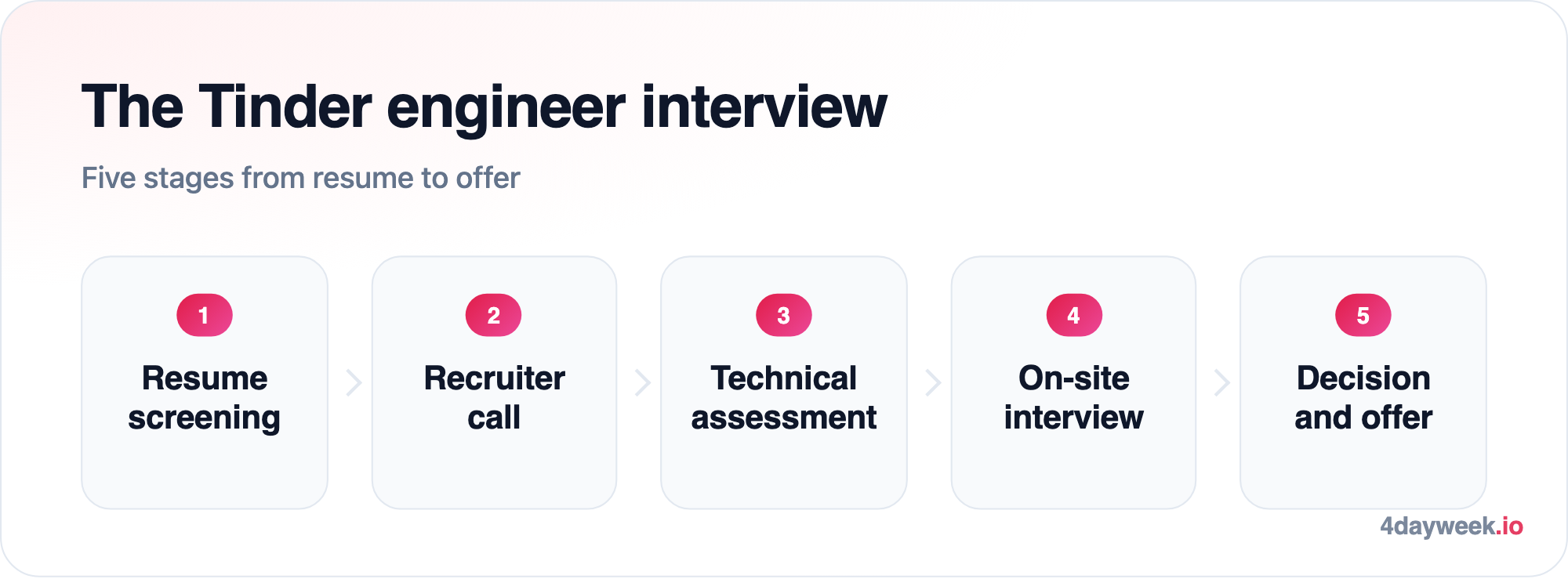
The Tinder software engineer hiring process typically lasts around 3 to 4 weeks, with most technical and cultural assessments wrapped up efficiently.
Here’s a clearer breakdown:
-
Application review & recruiter screen (Week 1–2): Recruiters often take 1 to 2 weeks after your application to reach out.
-
Technical assessment & interview scheduling (Week 2–3): After the initial phone screen, most candidates complete a coding assessment and a remote technical interview within the next 1–2 weeks.
-
Onsite or virtual onsite interviews (Week 3–4): The final round, featuring system design, behavioral, and culture-fit interviews, typically occurs shortly after the technical screening, often within the third or fourth week.
-
Final decision & offer (Week 4): Once all interviews are complete, Tinder usually wraps up the process with an offer or rejection within a few days to a week.
Tinder Software Engineer Interview Process - Key Phases
Before Tinder makes an offer, candidates go through several structured interview stages, each one designed to test a specific skill set.
Below, we break down each stage so you know exactly what to expect and how to stand out at every step.
1. Resume Screening
The first phase in Tinder’s hiring process is the resume screen, where recruiters look for alignment between your technical background and the core demands of the role. Most candidates who pass this stage clearly demonstrate relevant backend or mobile engineering experience and show a history of building scalable systems.
Here’s what Tinder looks for in software engineer applications:
-
Strong backend expertise: Experience in Java, .NET Core, or Python is highly preferred.
-
Cloud proficiency: Familiarity with AWS services like EC2, Lambda, and RDS is often highlighted.
-
Mobile experience: Roles involving mobile development favor engineers with iOS or Android app contributions.
-
API development: A history of designing and maintaining RESTful APIs is considered a plus.
-
Scalability and performance: Projects that involve high-traffic systems or performance optimization tend to stand out.
-
Collaborative experience: Evidence of working with cross-functional teams, mentoring others, or leading feature rollouts strengthens your profile.
To improve your chances of advancing:
-
Tailor your resume to reflect Tinder’s stack and product scale.
-
Highlight specific outcomes, such as reduced latency, improved reliability, or user growth.
-
Avoid vague job titles or general descriptions, be precise about what you built and how it helped
Tinder uses both manual review and ATS (Applicant Tracking Systems), so formatting and keyword relevance matter. Make sure your resume is clear, easy to scan, and includes terminology aligned with the job description.
2. Initial Recruiter Call
If your resume is shortlisted, a Tinder recruiter will schedule a 30-minute introductory call. This isn’t a technical round, but it plays a key role in moving forward. Expect questions about your background, past projects, and why you're interested in Tinder. The recruiter will also explain the role, hiring stages, and team structure.
What they're looking for: clear communication, alignment with Tinder’s mission, and a good fit for the team culture. To prepare, review the job description, know your resume inside out, and show that you understand Tinder’s product and values. Ask thoughtful questions to show genuine interest in the role and company.
3. Technical Assessment
After the recruiter screen, you’ll receive a technical assessment, typically conducted via a live online coding platform such as CoderPad or CodeSignal. In some cases, Tinder may assign a short take-home challenge instead.
Most real-time assessments last between 45 to 60 minutes and must be completed in one sitting. If you’re given a take-home project, you’ll usually have 48–72 hours to complete and submit your solution.
These assessments are designed to test your coding fundamentals, problem-solving skills, and ability to work under time constraints. Most questions focus on:
-
Data structures and algorithms: Think arrays, trees, hash maps, and graph traversal
-
Backend problem-solving: REST API design, real-time service logic, or handling high-concurrency systems
-
Mobile logic or UI state handling: If you're applying for a mobile-focused role, expect logic-based challenges relevant to in-app features
Tinder evaluates your ability to write clean, structured code while solving problems in real time. Interviewers pay close attention to how you approach each challenge, how clearly you explain your reasoning, and whether your code is easy to follow.
Trade-offs in logic, performance, or implementation style may also come up in discussion, so be prepared to justify your choices.
4. On-Site Interview
Candidates who pass the technical assessment move on to the final stage: the onsite or virtual onsite interview. This round typically includes 3 to 5 interviews, conducted over half or a full day, depending on the role and level.
Let’s see what to expect:
-
Coding interviews: You’ll solve problems involving algorithms, data structures, and real-world scenarios. These are time-boxed, typically 45–60 minutes per session.
-
System design or architecture: Mid- and senior-level roles usually include one or two rounds focused on designing scalable backend systems or app features (e.g., real-time matching, push notifications, or traffic scaling during high usage).
-
Behavioral interviews: These assess collaboration, ownership, adaptability, and past experience working on cross-functional teams.
-
Team fit discussions: You may meet with future teammates or a hiring manager to discuss how you approach product development, communication, and decision-making.
The onsite round is technical and structured. Interviewers focus on depth of knowledge, clarity of thought, and your ability to communicate decisions under pressure. Most candidates hear back within a week of completing this stage.
5. Final Decision & Offer
Once you complete the onsite interviews, Tinder’s hiring panel reviews all feedback and makes a decision within a few business days to one week. If you pass, a recruiter will contact you with a formal offer.
Compensation typically includes a base salary, annual bonus, and equity, with final numbers based on role level, experience, and location. You may also be matched with a specific team during this stage, especially for mid- or senior-level roles.
If the offer terms don’t align with your expectations, there’s usually room to discuss base pay, equity, or team placement. Once accepted, onboarding begins quickly, with access to internal systems and orientation support.
Common Questions to Expect in the Tinder Software Engineer Interview
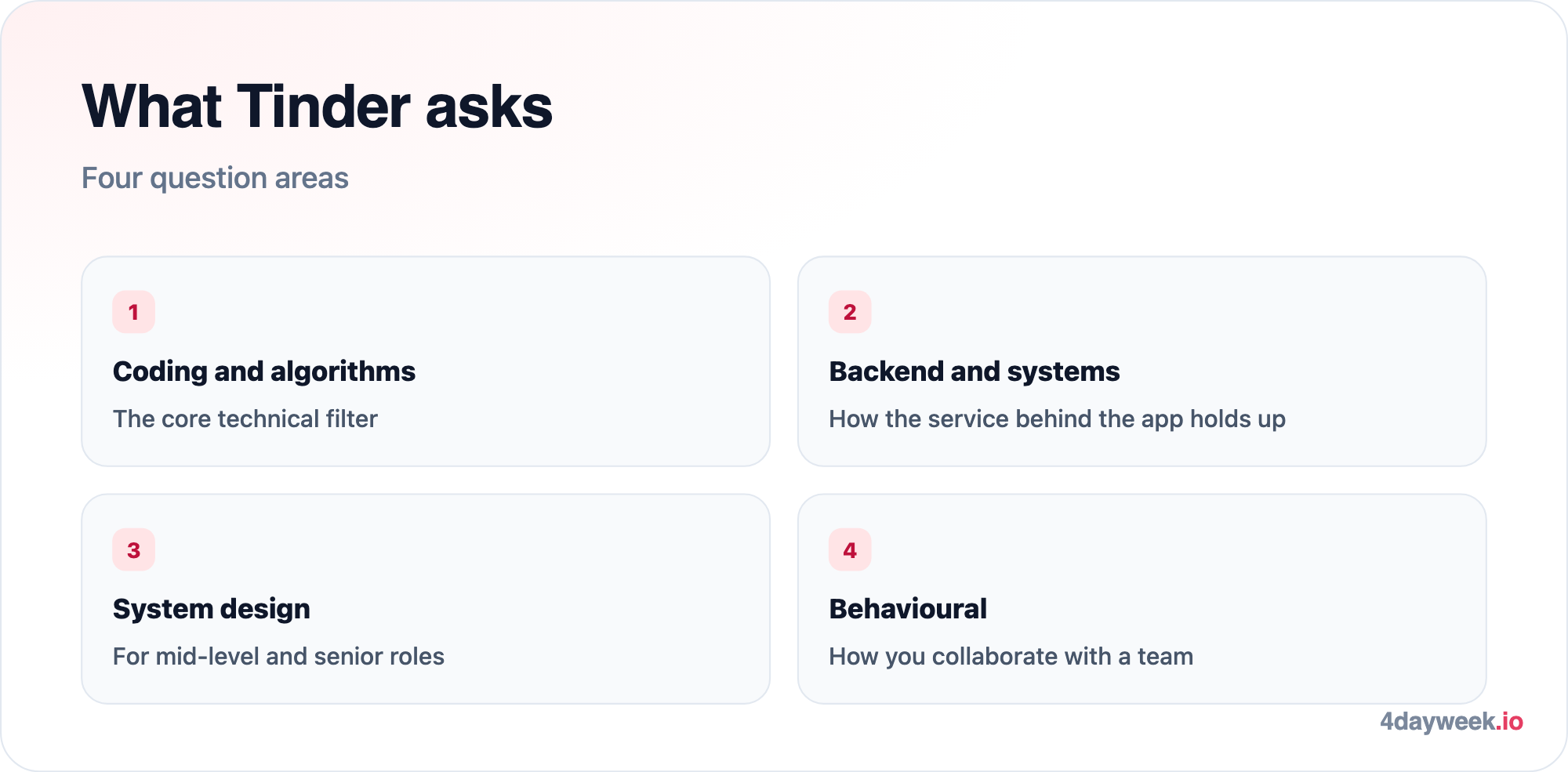
Tinder’s interview questions focus on evaluating core software engineering skills, practical experience, and your ability to collaborate in a fast-paced environment. Some common types of questions software engineers report across different rounds are:
Coding and Algorithm Questions
-
Write a function to check if a string is a palindrome.
-
Implement a sorting algorithm and explain its time and space complexity.
-
Explain the difference between a stack and a queue.
-
Solve a real-time messaging logic problem for high-concurrency use cases.
Work-Life Balance Jobs with Genuinely Reduced Hours
Save one to come back to it — it's free.


Backend and Systems
-
How would you design a RESTful API for a new feature?
-
What are the differences between SQL and NoSQL databases?
-
How do you approach debugging a critical issue in production?
-
Explain how you would handle user sessions across multiple devices.
System Design (for mid-level and senior roles)
-
How would you design push notifications for millions of users?
-
What architecture would you use to handle a traffic spike during a major event?
-
How would you build and scale a matchmaking algorithm?
Behavioral and Collaboration
-
Describe a time you dealt with a difficult teammate.
-
How do you prioritize tasks when handling multiple projects?
-
How do you approach feedback, especially under tight deadlines?
-
Why do you want to work at Tinder?
These questions assess both technical decision-making and how well you fit into Tinder’s engineering culture. Expect follow-ups on trade-offs, edge cases, and system reliability.
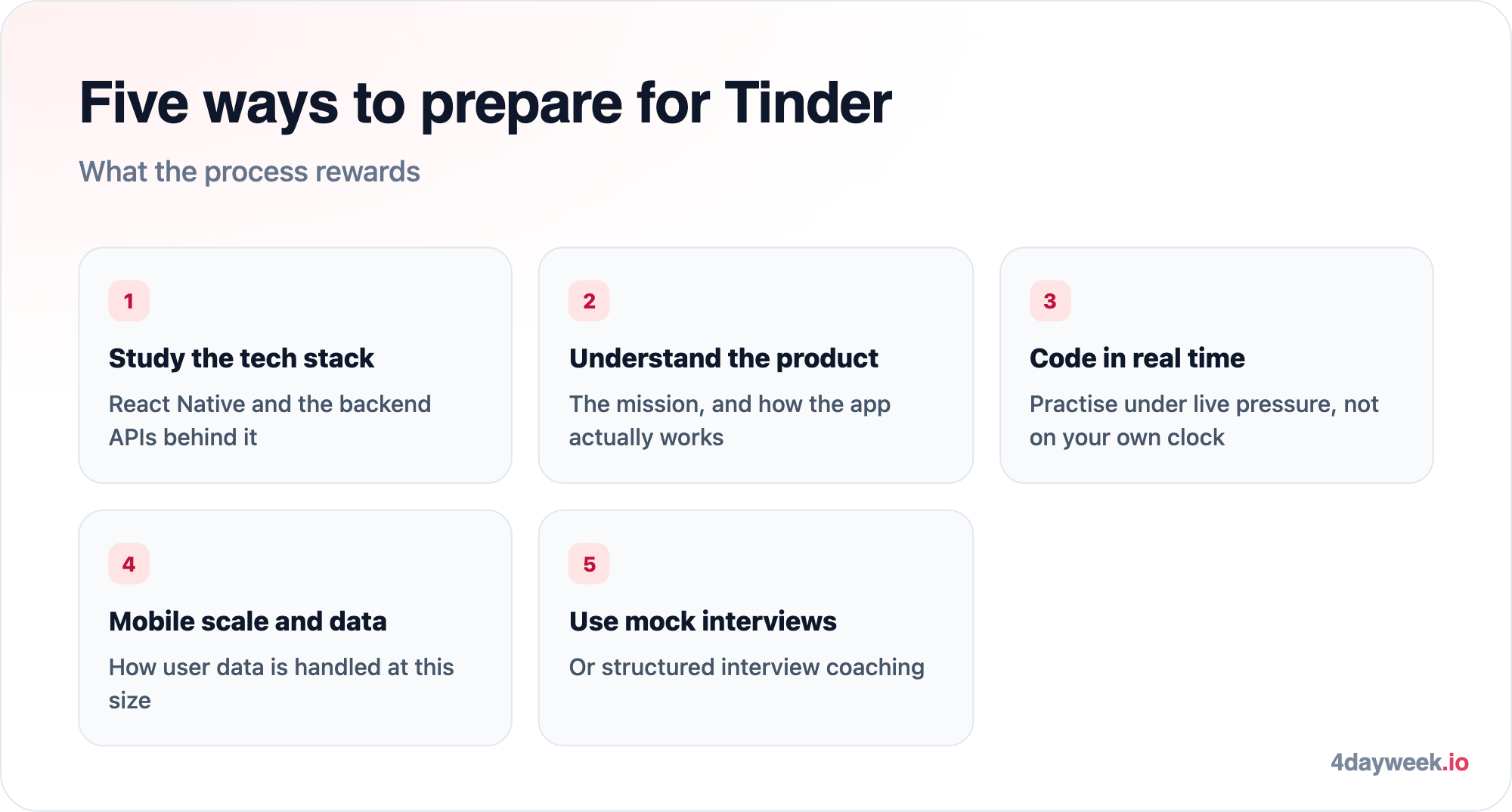
5 Preparation Tips to Ace the Tinder Interview
Before you enter the interview loop, it’s important to align your preparation with the specific technical and team expectations at Tinder. These tips are based on feedback from real candidates and recent hiring patterns.
1. Study Tinder’s tech stack (React Native, backend APIs, etc.)
Tinder’s engineering teams operate across mobile, backend, and infrastructure domains. On the mobile side, they use React Native to deliver consistent experiences across both iOS and Android.
Backend services are built using Java, .NET Core, and Python, with a strong focus on scalability, performance, and uptime. You’re expected to understand RESTful API design, how to work with asynchronous UI states, and how to handle real-time features like messaging or notifications.
AWS is a core part of their infrastructure, so being comfortable with services like EC2, Lambda, and RDS is a plus.
2. Understand Tinder’s Mission and Product
Tinder’s mission is to build meaningful human connections through technology. The app relies on real-time matching, location-based discovery, and a swipe-based interface designed for simplicity and speed.
Understanding how these features interact at scale, and how trust, safety, and responsiveness are prioritized, can help you answer product-driven or system design questions with more relevance during your interview.
3. Practice Real-Time Coding Under Pressure
Most technical interviews at Tinder involve timed, live coding sessions using platforms like CoderPad or CodeSignal. You’ll need to solve algorithmic problems while explaining your approach clearly.
Focus on writing clean, efficient code within a 45–60 minute window. Practice common data structure challenges and simulate interview conditions to improve speed, accuracy, and communication under time constraints.
4. Understand Mobile Scaling and User Data Considerations
Tinder serves millions of users globally, so scalability and data reliability are key. Be prepared to discuss how you'd handle growing user bases, high traffic during peak times, and data synchronization across devices.
Topics like caching strategies, offline data handling, and efficient API usage often come up, especially for roles touching mobile performance or backend systems supporting real-time interactions.
5. Use Mock Interviews and Interview Coaching
Mock interviews help you get comfortable with Tinder’s time-limited format and technical depth. Practicing under realistic conditions improves clarity and response speed. Coaching sessions can also refine your system design and behavioral answers, making your prep more aligned with what hiring teams actually evaluate.
Pro Tip: Looking for expert guidance before the big day? Check out our list of the 10 best interview coaching services to find platforms that offer personalized feedback, mock sessions, and role-specific prep for tech interviews.
Wrapping Up
The Tinder software engineer interview process is structured, technical, and selective but entirely manageable with focused preparation. Understanding the stages, knowing what to expect, and practicing under realistic conditions can significantly increase your chances of moving forward.
If you're exploring more flexible opportunities, check out our curated job board featuring software engineering roles with flexible schedules, including remote and 4-day workweeks at top tech companies.
It’s a smart way to find high-quality roles that match both your skills and how you want to work.
FAQ’s
How much do software engineers make at Tinder?
According to Interview Query, the average base salary for a Tinder software engineer is $177,933, with total compensation, including equity and bonuses, averaging $251,047. For more senior roles, particularly in the Bay Area, total compensation can reach $28K+, according to Levels.fyi
How many rounds of interviews are normal for a software engineer?
Most software engineer candidates at Tinder go through four to five rounds, typically including a recruiter screen, technical assessment, technical interview, and one or more onsite or virtual onsite rounds. The exact number can vary slightly based on role level.
How long is the software engineer interview process?
Tinder’s software engineer interview process typically lasts three to four weeks from application to final decision. Some candidates may experience longer timelines depending on scheduling or team availability, but most report hearing back within 25 to 30 days.
How to prepare for an interview as a software engineer?
Focus on mastering coding fundamentals, system design, and behavioral communication. Practice real-time coding under timed conditions using platforms like LeetCode or CoderPad. Study Tinder’s tech stack, product features, and engineering culture. Mock interviews and coaching can also help refine your responses and improve clarity under pressure.




Get 4-day week jobs in your inbox
Create a free account to receive curated opportunities weekly.
Sign up for freeFree forever. No spam, unsubscribe anytime.