
Improving workplace productivity isn't about squeezing more hours out of the day. It's about getting more high-value work done in less time. For any company even thinking about a four-day week or reduced hours, that distinction is the whole game — success hinges on working smarter, not longer.
This guide is written for managers, founders, and people leaders who want to lift output without lengthening anyone's week. The principles apply whether you're piloting a 32-hour week or simply trying to claw back focus time inside a standard one.
Redefining Productivity Beyond Hours Worked

The old assumption that long hours equal high value is broken. Real productivity is about meaningful results delivered inside a sustainable workload — creating systems that let people do their best work without burning out. That is the exact principle a four-day week depends on.
To get there, you have to stop measuring time at a desk and start focusing on what actually drives impact: sharp team workflows, protected individual focus, and technology used as an accelerator rather than another source of noise.
The True Cost of Disengagement
One of the biggest drags on output isn't laziness — it's disengagement. When people feel disconnected from their work, motivation drops and so does what they produce.
The scale of the problem is hard to ignore. Gallup's 2024 State of the Global Workplace report found that only 21% of employees worldwide are engaged at work, and that global engagement actually fell that year — only the second decline in over a decade. Gallup estimates that low engagement costs the world economy around US$8.9 trillion annually, the equivalent of 9% of global GDP.
A disengaged team isn't a personnel problem to be managed quietly — it's a productivity problem hiding in plain sight. The flip side is the opportunity: re-engaging people is one of the highest-return moves available to a leader.
A shorter or more flexible week is not a magic fix for engagement, but it directly targets two of its biggest enemies: burnout and the sense that an employer doesn't respect life outside work.
The Path to Smarter Work
Getting to a higher standard of productivity isn't about a single silver bullet. It's a deliberate effort to rethink how work gets done, and it comes down to a few components:




Hiring for a 4-day week?
List your roles on 4dayweek.io and reach candidates who want a better balance.
Get started free- Optimising team collaboration. Cutting unnecessary meetings and building clear, genuinely used documentation.
- Protecting individual focus. Equipping people with techniques to manage distraction and defend deep-work time.
- Leveraging smart tools. Automating repetitive work and streamlining communication so brainpower goes to what matters.
Focus on these and you can unlock the same — or better — performance in fewer, more focused hours.
Re-Architecting Team Workflows for a Shorter Week
Switching to a shorter week isn't about cramming five frantic days into four. That's a fast route to burnout. The real win comes from changing how the team collaborates. You cannot simply speed up broken processes and expect a good outcome.
The goal is to root out collaborative drag — the endless meetings, repetitive questions, and tangled communication loops that quietly drain everyone's time. That starts by challenging the default of synchronous work.
Embrace Asynchronous Communication
An async-first approach doesn't mean you never speak in real time again. It means you make real-time meetings the exception rather than the reflex. Instead of booking a 30-minute call to ask one question, you move that conversation somewhere people can answer when they're ready.
This model respects deep, focused work, which is the cornerstone of a compressed week. It cuts interruptions and lets people engage with information when they can give it real attention.
A few practical ways to start the shift:
- Make a project tool the single source of truth. A shared project board should carry every project's current status. When it does, the constant "just checking in" messages disappear.
- Write detailed memos for complex updates. For a new proposal or a thorny decision, a well-structured document gives colleagues space to digest the detail and respond with far better feedback than they could off the cuff.
- Use video messaging. A short recorded screen-share is often faster than a long email and far clearer than a messy thread.
Rethink your communication culture and you reclaim hours previously lost to low-value, synchronous interruptions. For a structured approach to the wider transition, see our guide on how to implement a 4-day week.
Build a Centralised Knowledge Hub
Consider how much time a team wastes asking and re-answering the same questions. A centralised knowledge base, or internal wiki, is one of the most powerful productivity tools you can build. It becomes the team's collective memory, accessible to anyone at any time.
This is not a messy folder of random documents. A genuinely useful knowledge hub is organised, searchable, and — most importantly — consistently kept current.
Every question answered publicly in your knowledge base prevents a dozen future interruptions. It is a small investment of time with a large compounding return on team focus.
Get started by documenting the things people actually ask about:
- Standard operating procedures for common tasks.
- Answers to the questions new hires reliably have.
- Project briefs, goals, and key decisions.
- Guides for the software and tools your team uses.
Then set one simple rule: when someone has a question, the knowledge hub is the first stop. If the answer isn't there, whoever eventually finds it is responsible for adding it. That habit creates a self-sustaining system that steadily reduces friction.
Cultivating High-Impact Habits for Individual Focus
Sharpening team workflows is a major step, but making a shorter week stick comes down to what each person does minute by minute. The best systems in the world can't rescue habits that invite distraction and reward shallow work. To genuinely benefit from a compressed schedule, every person needs to become good at protecting their own focus.
This isn't about working faster. It's about working deeper.
The modern office is a minefield of interruptions, and the cognitive cost is steep. Research by Gloria Mark at UC Irvine found that after an interruption it takes, on average, 23 minutes and 15 seconds to fully return to the original task. A few innocent pings can quietly erase an hour of productive work.
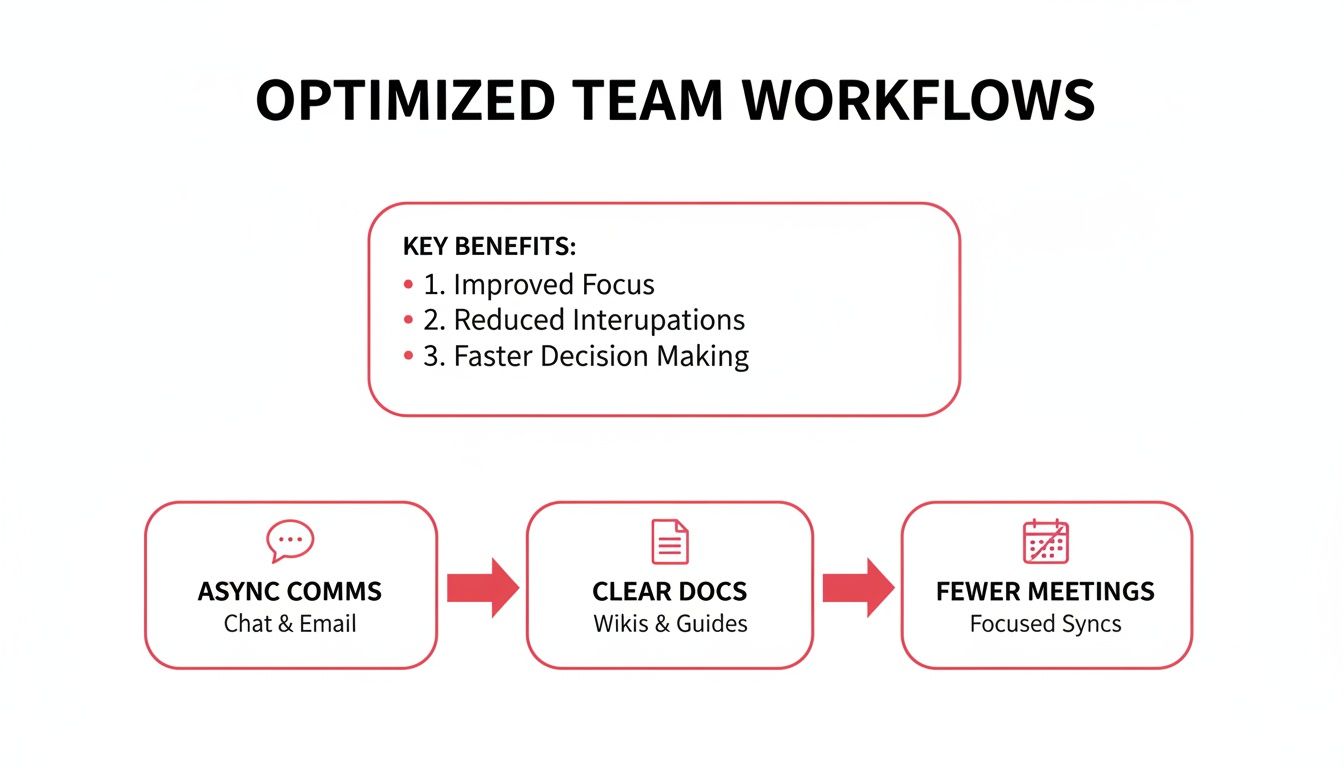
This is exactly why async communication, clear documentation, and fewer meetings matter so much — they exist to protect that focus time.
Master the Calendar with Time Blocking
One of the most effective ways to protect focus is time blocking. Forget the open-ended to-do list. Time blocking means assigning every meaningful task a specific slot on the calendar, turning a vague intention into a concrete plan for the day.
When someone blocks a two-hour window for "Draft project proposal," they're making a commitment. It builds a psychological wall against interruptions and stops lower-priority work from creeping in and derailing the important stuff.
Use Micro-Bursts of Focused Work
No one sustains deep concentration for eight hours straight. That's where methods like the Pomodoro Technique help — a simple system that breaks work into focused 25-minute sprints separated by short breaks. The cycle keeps people sharp and guards against fatigue.
During each sprint, the rule is one task and one task only, with everything else silenced. Knowing a break is minutes away makes it far easier to resist checking email or the phone.
The real value of a technique like Pomodoro isn't only the work interval — it's the disciplined break. Stepping away briefly lets the brain reset so the next session is as productive as the last.
Tame Digital Distractions
Digital tools are essential, but their constant notifications are a leading productivity killer. The fix is firm boundaries and batched communication.
- Schedule inbox and message checks. Instead of reacting to every ping, set specific times to check messages — say late morning and mid-afternoon. That puts the individual back in control of their attention.
- Silence non-urgent notifications. Go through phone and desktop settings and disable alerts for anything that isn't genuinely time-critical. A quiet badge is usually enough.
- Use the two-minute rule. If a task surfaces that takes two minutes or less, do it immediately. This idea, from David Allen's Getting Things Done, stops tiny to-dos from piling into mental clutter.
Manage these inputs deliberately and technology shifts from a source of distraction into a tool that serves focus.
High-Impact vs. Low-Impact Productivity Habits
Not all "productive" activity is equal. Many common habits create the illusion of being busy while quietly undermining focused work. It pays to be clear about the difference.
| High-Impact Habit | Description & Benefit | Low-Impact Alternative |
|---|---|---|
| Time blocking | Proactively scheduling deep-work sessions on the calendar. Protects focus and ensures progress on high-priority projects. | Reactively working through a to-do list |
| Single-tasking | Committing to one task for a set period, such as a 25-minute Pomodoro. Produces higher-quality work, faster. | Multitasking across emails, messages, and tasks |
| Scheduled comms | Checking messages at designated times. Prevents constant context-switching and preserves long stretches of focus. | Keeping notifications on and replying instantly |
| Deep work | Engaging in cognitively demanding tasks without distraction. Produces valuable, hard-to-replicate output. | Shallow work such as low-stakes email and optional meetings |
| Proactive planning | Defining the one to three most important tasks each morning. Provides clarity and direction. | Starting the day inside the inbox |
Choosing the habits in the first column is what separates genuinely productive people from those who are merely busy.
Using Technology and AI to Amplify Output
Tools should be a lever, not another layer of noise. When the goal is productivity, the aim isn't to collect the shiniest new apps — it's to weave technology into the workflow so it genuinely speeds things up.
That means moving away from a scattered mess of software toward a coherent system where every tool has a clear purpose. A shared project platform should be the single source of truth for everything project-related; once the whole team commits to that, the endless status pings fall away.
Making AI a Productivity Partner
Generative AI is no longer a far-off concept — it is a practical way to get time back. Its real value at work isn't in massive, complicated projects. It's in automating the small, repetitive tasks that nibble away at focus: summarising a long meeting transcript or dense report, drafting a routine email, or generating the right spreadsheet formula. Those small automations create pockets of deep focus for the strategic work that genuinely needs a human.
The adoption data backs this up. In PwC's 2025 Global Workforce Hopes and Fears Survey of nearly 50,000 workers, 54% said they had used AI in their role in the past year, and around three-quarters of regular users reported that it had improved their productivity and the quality of their work. The pattern is consistent: technology becomes an advantage only when the skills and culture exist to support it.
A sensible caveat: AI is a multiplier, not a substitute for a well-designed process. Layering it onto a broken workflow just produces broken output faster.
From Communication Chaos to Clarity
Instant-messaging tools are powerful, but without ground rules they quickly become the biggest drain on attention. Taming that chaos means setting explicit norms everyone understands. For any team serious about a shorter week, this is non-negotiable.
A few simple, effective rules:
- Give every channel a clear purpose. Dedicated channels for specific topics stop important updates from getting buried in one noisy feed.
- Define "urgent". Spell out what genuinely justifies an all-team notification versus a routine question that can wait. This cuts notification fatigue.
- Encourage threaded replies. Keeping replies to a topic inside a thread keeps conversations tidy and lets people catch up without wading through unrelated messages.
Small tweaks like these turn team chat from a constant interruption into an organised hub for getting things done. For more, see our guide to remote collaboration tools.
Measuring What Matters to Prove Success
To win buy-in for a shift as significant as a four-day week, you have to prove it works. That does not mean invasive surveillance or tracking keystrokes — those tactics destroy trust and morale. Proving success means measuring what actually matters: results.
The most convincing metrics are the ones leadership already watches. Instead of arguing about "hours worked," track tangible business outcomes. That reframes the conversation from time spent to value created, which is a far stronger case.
Focus on Outcome-Based Metrics
To build a solid argument, you need data that tells a clear story. Skip the vanity metrics and focus on concrete indicators that show the team is delivering the same or better results in less time:
- Project completion rates. Is the team hitting deadlines more consistently? A rise in on-time delivery is a strong signal.
- Lead times. How long does a project take from kickoff to delivery? A shorter cycle proves the new processes work.
- Client satisfaction. Are clients happier? A higher satisfaction score, or a clear wave of positive feedback, shows quality hasn't slipped.
- Revenue per employee. A classic measure that ties productivity gains directly to the bottom line.
- Engagement and retention. Are people more engaged and less likely to leave? Watch employee Net Promoter Score and turnover — a more stable team is almost always a more productive one.
These metrics connect productivity efforts directly to the health of the business, which makes the case hard for leadership to dismiss.
The goal isn't to measure activity — it's to measure impact. Showing that a reduction in working hours held output steady, or improved it, is a far more powerful argument than any opinion survey.
Run a Low-Risk Pilot Program
You don't have to flip a switch and change the whole company overnight. The smartest path is a controlled, low-risk pilot. It lets you gather hard data and iron out the wrinkles on a small scale, which makes it a much easier "yes" for stakeholders.
Treat it like an experiment. You're testing a hypothesis — something like, "By introducing meeting-free Wednesdays and async communication, this team can hold its output across four days instead of five."
A workable pilot structure:
- Define a clear scope. Pick one team or department for a two-to-four-week trial. Keep it manageable.
- Establish baseline metrics. Before changing anything, track your key outcome metrics for a few weeks. You need a clear "before" picture.
- Implement the changes. Introduce the new workflows, habits, and tools.
- Gather data throughout. Track quantitative data such as completion rates alongside qualitative feedback. Short weekly surveys on focus, stress, and collaboration add invaluable context.
- Analyse and present results. Compare the new metrics to the baseline. Present the findings honestly — the wins and the genuine challenges.
This data-driven approach takes emotion and guesswork out of the decision and gives leadership the concrete proof that working smarter is a sharp business strategy, not a feel-good gesture.
The four-day week has a substantial evidence base behind it. The UK's 2022 pilot — organised by 4 Day Week Global with the think tank Autonomy and researchers at the University of Cambridge and Boston College, covering 61 organisations and around 2,900 employees — found that 71% of staff reported reduced burnout while company revenue held broadly steady. Buffer made its four-day week permanent after a pandemic-era trial, with the company reporting that the great majority of its team felt happier and at least as productive on the shorter week. A well-run pilot of your own simply turns that external evidence into internal proof.
Answering Common Productivity Questions
Moving to a more efficient way of working — especially a four-day week — always raises practical questions. Here are the ones leaders ask most.
What Is the Biggest Mistake Companies Make?
Throwing tools at the problem without fixing the underlying culture. Plenty of companies buy new software or adopt AI hoping for a quick fix, but never address the deep-rooted habits: the expectation of constant availability, the back-to-back meetings, the pressure for instant replies.
Real gains come from redesigning how work happens so that focus is protected — empowering the team to work asynchronously and trusting them to manage their own time. Layering a new tool onto a broken process just adds noise.
How Can I Convince Leadership to Try This?
Frame it as a small, low-risk pilot rather than a permanent, company-wide policy. Propose a one-month trial for a single team. That shifts the conversation from "perk" to data-driven business experiment.
Come with a plan: outline the specific changes you'll make, such as cutting internal meetings and adopting clear async rules, and define what success looks like. Naming the metrics — project delivery times, client satisfaction — signals that you are a proactive problem-solver, not someone simply asking for a day off.
Are Some Roles Harder to Adapt?
Yes. Client-facing roles such as sales and support have real challenges, but they are far from impossible. The answer isn't forcing everyone onto an identical schedule — it's smarter scheduling and the right technology.
- Staggered schedules. Have one group work Monday to Thursday and another Tuesday to Friday. That gives full five-day coverage without overloading anyone.
- Technology assists. Use automated chat tools to field the first wave of routine customer questions, and a well-maintained knowledge base to resolve common issues, freeing human agents for the complex ones.
The goal is to rethink how coverage is provided, not simply chop a day off the calendar. Done well, a shorter or more flexible week improves productivity without letting customers down — and it gives a team a powerful reason to stay. If you want to see which employers already operate this way, browse companies offering a four-day week.
Hiring for a 4-day week?
List your roles on 4dayweek.io and reach candidates who want a better balance.
Get started free