
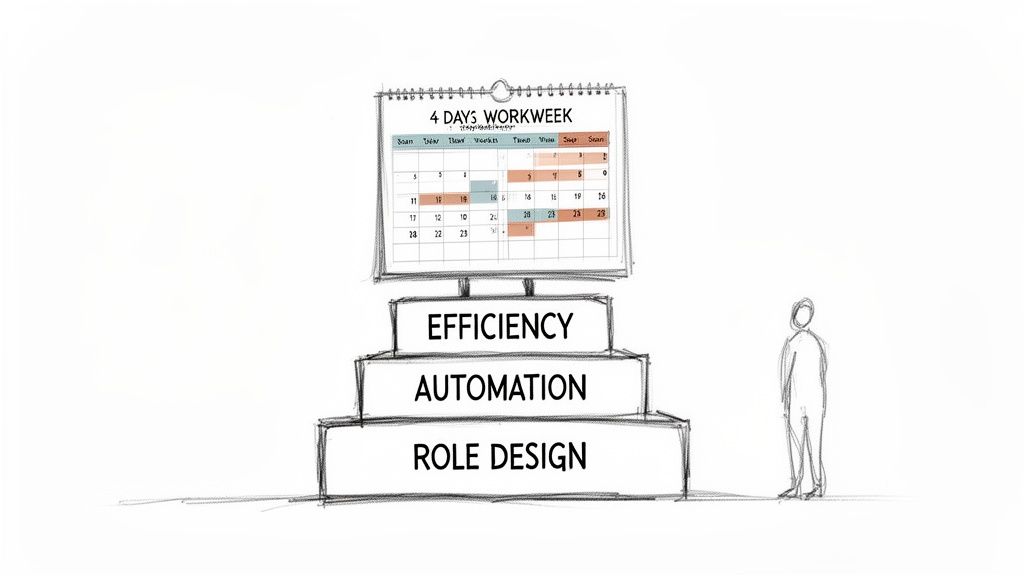
Moving to a four-day workweek is not about asking people to work harder. It is about rethinking how the work gets done. A sustainable reduced-hours model has to stand on a foundation of smarter, more focused work — which makes operational efficiency the prerequisite, not an afterthought.
But the principle holds well beyond the four-day week. Any team carrying redundant tasks, fuzzy priorities, and a bloated meeting calendar is leaving capacity on the table. This guide is a practical playbook for finding that waste and removing it.
The Real Foundation of a Four-Day Workweek
Switching to a four-day schedule forces a useful shift in mindset. Instead of rewarding hours logged at a desk, attention moves to high-impact outcomes. It pushes teams to confront the hidden waste that quietly bloats a five-day week — duplicated tasks, meetings that decide nothing, and priorities nobody has ranked.
This is not about compressing 40 hours of work into 32. It is about redesigning the work itself so the same output — or better — fits into less time.
The whole thing rests on a deliberate, three-part approach: diagnose the waste, automate the repetitive parts, and redesign roles around what actually moves the business.
Diagnose, Automate, and Redesign

Achieving a shorter week starts with pinpointing the real bottlenecks. From there, you apply technology to remove them, then restructure how work is done so the gains hold for the long term.
The goal is a genuine win on both sides: output holds steady or rises, and the team reclaims real time. Treated well, that investment in efficiency pays back in both business resilience and retention.
The wider economic picture supports the idea that focused improvement drives real output growth. The U.S. Bureau of Labor Statistics reported that nonfarm business labour productivity — output per hour — rose 4.7% in the third quarter of 2023, as output grew faster than hours worked. Output per hour, not hours themselves, is the lever that matters.
Framed as a strategic investment rather than a cost-cutting exercise, efficiency becomes a competitive advantage — the foundation of a more engaged, productive, and resilient team.
If you are weighing a reduced-hours model, our guide on how to implement a four-day week covers the rollout in depth. Below are the main levers this playbook pulls.




Hiring for a 4-day week?
List your roles on 4dayweek.io and reach candidates who want a better balance.
Get started freeKey Levers for Boosting Operational Efficiency
| Efficiency Lever | Primary Goal | Impact on a 4-Day Week |
|---|---|---|
| Diagnostic Metrics | Identify and quantify time-wasting activities. | Reveals exactly where the "fifth day" of work is hiding. |
| Process Mapping | Visualise and streamline core business workflows. | Eliminates redundant steps so work fits into fewer hours. |
| Prioritisation Frameworks | Focus team effort on high-impact, value-driven tasks. | Ensures the most critical work gets done in a shorter window. |
| Workflow Automation | Automate repetitive, low-value administrative tasks. | Frees employee time for strategic and creative work. |
| Role & Meeting Redesign | Align roles with core outcomes; run fewer, better meetings. | Maximises focused work time and minimises interruptions. |
| Pilot Testing | Validate efficiency gains with a small-scale trial. | Proves the model works before a company-wide rollout. |
Each lever helps build a system where producing more in less time becomes the norm — which is what makes a four-day week not just possible but profitable.
Finding Where Your Time Really Goes
Before you can fix anything, you need an honest look at where your team's hours are actually going. Most leaders think they know; in practice, the assumption is often well off the mark. This is not about micromanagement — it is about gathering objective data to make better decisions.
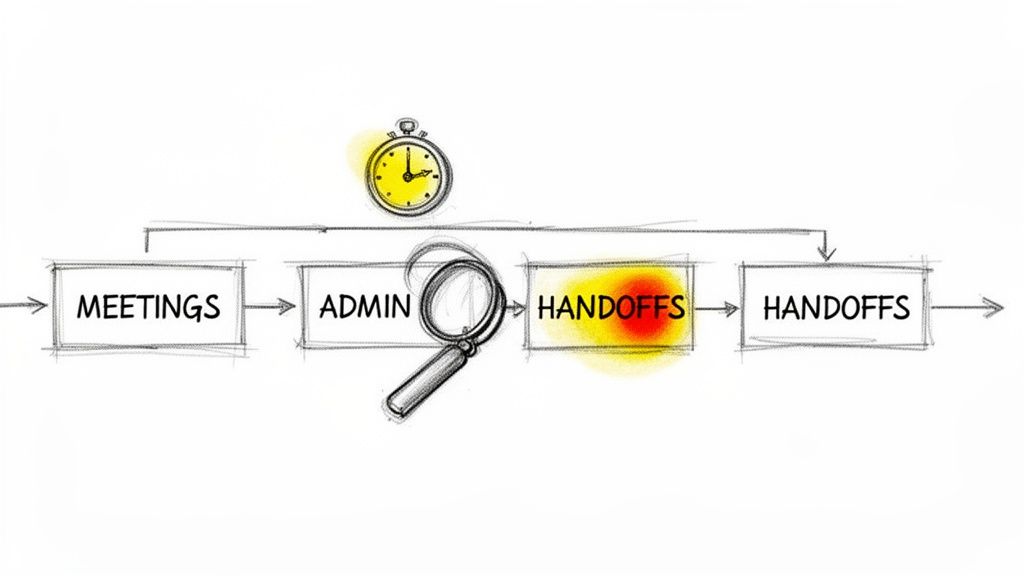
Treat this diagnostic phase as building a heat map of your operations. It highlights the meetings, administrative black holes, and clunky processes that consume the most time for the least valuable output. Without that data, any attempt to improve is guesswork.
Mapping Your Core Processes
Process mapping is the first practical step: visually charting a workflow from start to finish, detailing every action and handoff. It is a blueprint for how work actually gets done.
Try mapping a "new client onboarding" process. Who sends the initial contract? Where does it go for approval? How is the project manager notified once it is signed? Who sets up the kickoff call?
Laid out visually, bottlenecks and duplicated steps become obvious. You might find that three people are manually entering the same client data into three separate systems — a textbook candidate for automation.
Gathering Objective Time Data
Process maps show the intended workflow. Time tracking reveals the actual cost. Asking your team to log their hours for a week or two gives you genuine insight — provided you frame it as a shared effort to find and remove frustrating work, not as surveillance.
Look for patterns in the data:
- Meeting overload. How many hours go into internal meetings versus focused, productive work? Research consistently finds that focused output occupies only a fraction of the working day. One widely cited UK survey of nearly 2,000 office workers found the average employee was genuinely productive for under three hours of an eight-hour day, with low-value meetings and digital distraction the main culprits.
- Administrative drain. Pinpoint the time lost to non-billable, repetitive tasks — manual reporting, data entry, chasing approvals.
- Context switching. Notice how often people jump between apps and tasks. Constant switching is a quiet killer of focus.
Time tracking is for spotting systemic issues, not individual performance. If senior engineers are losing ten hours a week to admin, you do not have a performance problem — you have a process problem.
This turns a vague sense of "we're too busy" into a prioritised, evidence-based list of what to fix first. Modern tools can make the tracking itself painless; our roundup of AI time-tracking tools covers the options.
Automating the Work You Hate
Once your audit has exposed where time leaks out, the next move is to patch those leaks with technology — eliminating the tedious, repetitive tasks nobody enjoys anyway.
Automation does not require a team of developers or a large budget. Today's low-code tools let every department — marketing, HR, operations — build smarter workflows. The aim is to offload the manual grunt work that drains energy and focus, freeing your team for the strategic thinking you actually hired them for.
Building Your First Automated Workflows
Where to start? Look at the most common friction points in your team's day. Where does information get stuck? Which tasks require someone to copy and paste data between systems? Those are your first candidates.
A classic example is connecting your CRM to your project management tool. Instead of a salesperson manually creating a project and assigning tasks after closing a deal, an integration platform like Zapier or Make can do it instantly.
When a deal is marked "Closed-Won" in the CRM, a simple workflow can automatically:
- Create a new project from a standardised template.
- Assign the opening tasks to the project manager and onboarding specialist.
- Post a notification in a dedicated team channel.
That single automation removes data-entry errors, cuts the lag between sales and delivery, and ensures every new project starts the same way every time.
From Manual Reporting to Live Dashboards
Another reliable time sink is compiling weekly or monthly reports. Manually pulling data from different sources into a spreadsheet is dull, error-prone, and out of date the moment you hit send.
A better approach is automated, live dashboards built in tools like Looker Studio or Microsoft Power BI. These connect directly to your data sources — analytics, CRM, ad platforms — and update in real time.
A few hours setting up a dashboard can save a team dozens of hours every month. It shifts the work from gathering data to analysing it, which leads to quicker, better-informed decisions.
The scale of the opportunity is real. McKinsey estimates that currently demonstrated technologies could automate activities accounting for around half of the work people are paid to do today — not as a forecast of job losses, but as a measure of how much routine activity is technically automatable. In well-documented domains such as accounts payable, automated invoice processing routinely cuts processing time by up to 75%. The point is not the headline percentage; it is that a large share of repetitive work can be handed to software.
Automation is not only about large, complex systems. It is about finding small, recurring annoyances and solving them with accessible tools. Start by checking the software you already use — many products have powerful automation features built in. Our guide to remote collaboration tools covers what is possible.
Redesigning Roles and Declaring War on Meetings
Automating grunt work is a real win, but peak efficiency demands a deeper change: rethinking how work is defined and structured.
That means confronting two of the biggest productivity drains in any organisation — fuzzy roles and an out-of-control meeting culture.
Real efficiency arrives when you shift from a task-based mindset to an outcome-based one. Most job descriptions are long lists of duties, which quietly encourages people to look busy rather than create value. Redesign roles around clear, measurable outcomes and you give your team genuine ownership of their work.
From Task-Doer to Outcome-Owner
Go through each role on your team and ask one question: what is the primary result this person is responsible for?
A content marketer's job is not "write blog posts." It is something like "grow organic traffic by 15% this quarter."
That shift is significant. It gives the person freedom to find the best route to the target instead of ticking off a checklist. They might realise that fewer low-impact social posts and a couple of genuinely strong articles is what actually moves the number.
A practical way to start:
- Run an impact audit. Ask each person to track their main activities for a week, then rank those tasks by how much they contribute to their primary goal.
- Cut or delegate the low-value work. Whatever consistently lands at the bottom of the list — can it be automated, handed off, or stopped entirely? A surprising amount of "work" simply disappears.
- Rewrite the job descriptions. Make it official. Update the JDs to reflect the new, outcome-driven responsibilities.
Culling the Calendar Ruthlessly
Now the other monster in the room: meetings. Most professionals lose substantial hours every year to meetings that decide nothing. To boost efficiency, you have to get ruthless with the calendar.
A "default to async" policy is one of the highest-leverage changes a team can make. Before scheduling a call, ask whether the information could be shared in a detailed message, a document, or a short recorded video instead.
From now on, every synchronous meeting needs a clear agenda and a stated goal before it goes on the calendar. If the organiser cannot articulate what a successful outcome looks like, the meeting does not happen.
Three rules worth adopting:
- The 30-minute default. Meetings default to 30 minutes. The constraint forces everyone to get to the point.
- Question every recurring invite. Audit standing meetings quarterly. If a recurring call has lost its purpose, replace it with an update message and end it.
- No agenda, no attendance. Empower people to decline any invite that arrives without a clear purpose and agenda.
Redesign roles around outcomes and claw back hours from pointless meetings, and you create the focused environment a team needs to do its best work. That discipline matters most for distributed teams, where clear ownership and sharp communication are everything — our guide on managing distributed teams goes deeper.
Measuring What Matters and Sustaining the Gains
You have rolled out new processes and automations. The initial productivity bump feels great — but the real test is making it stick. Without attention, teams drift back into old, comfortable habits.
Sustaining a high-efficiency culture means tracking progress and building continuous improvement into how the team operates. The key is monitoring the right indicators. Moving beyond a simple count of "projects completed" gives you a clearer picture of how work actually flows.
Moving Beyond Basic Output Metrics
To understand efficiency, track the metrics that reveal friction and waste:
- Task cycle time. How long does a task take to move from "to do" to "done"? A shorter cycle time is a clear sign your process improvements are landing.
- Rework rate. What share of work gets sent back for edits due to errors or miscommunication? A high number points to unclear briefs or gaps in the process.
- Meeting-to-work ratio. The hours spent in meetings versus focused work. This simple ratio tells you whether you are successfully protecting deep work time.
For more on tracking a flexible or remote team, see our guide on remote monitoring strategies. These data points are not about micromanaging people — they are for spotting flaws in the process so you can fix them.
Creating Effective Feedback Loops
Data is only useful if you act on it. Regular, structured feedback loops give the team a space to discuss what is working and what is not, turning insight into action.
A reliable approach is a recurring team retrospective — say, every two weeks. Set aside time to reflect on recent work with three questions:
- What went well that we should keep doing?
- What did not go as planned?
- What will we try differently next time?
That structure keeps the focus on the process rather than the people, and it gets the whole team solving problems together.
The aim is to shift from a "project launch" mindset to an ongoing practice of refinement. Efficiency is not a destination you reach; it is a discipline you maintain.
That discipline is no longer a niche idea. As McKinsey's research on automation and the future of work makes clear, redesigning how work gets done is becoming a core competitive strategy — and adopting that mindset is essential to thriving on a four-day schedule.
Common Questions on Efficiency and the Four-Day Week
Where Should a Small Team Start with Increasing Operational Efficiency?
When you are a small team, the last thing you need is more complexity. Start small and targeted.
Pick one critical, repetitive workflow — client onboarding, say, or your content publishing process. Get everyone around a whiteboard, physical or virtual, and map every step from start to finish. At each step, ask: is this necessary? Could a tool do it? Where do things always get stuck? That one exercise reliably surfaces the low-hanging fruit.
Another quick win is a calendar audit. Pull up the last two weeks of recurring meetings and put each one on trial. You will be surprised how many can be replaced with a short asynchronous update — hours reclaimed without buying any software.
How Do You Get Team Buy-In for Major Process Changes?
Nobody likes change being forced on them. Lasting improvements are built with a team, not handed down.
Frame the work as a shared goal with a prize everyone wants. For a reduced-hours team, that is the question "how can we work smarter to earn our day back?" Suddenly it is not a corporate target — it is a personal win.
Involve the team directly in finding the problems and designing the solutions. The people doing the work day to day almost always have the most practical ideas.
When a team co-authors a new process, they become its strongest advocates. Their belief in the change will convince sceptics far more effectively than any directive from above.
Then start with a small pilot. Recruit a few willing volunteers to test the new way of working. Their results and genuine enthusiasm create a ripple effect that makes the case for a wider rollout.
Which Automation Tools Offer the Best Return?
The best return rarely comes from the most expensive all-in-one platform. It comes from tools that solve your most frequent, most tedious tasks. Focus on three areas:
- Integration platforms. Tools like Zapier or Make act as connective tissue between your apps — linking CRM, project management, and communication channels to wipe out hours of manual data entry.
- Project management automations. The tools you already use, such as Asana or ClickUp, have automation built in. Set them up to handle routine task assignment, deadline reminders, and status updates.
- Asynchronous communication. A short recorded video in place of a 30-minute call delivers an immediate return — it clears calendars and protects everyone's deep work time.
Operational efficiency is not a one-off project you complete and file away. It is a habit: diagnose where time goes, automate what is repetitive, redesign roles around outcomes, then measure and refine. Build that discipline and producing more in less time stops being an aspiration and becomes how the team simply works — which is exactly the foundation a four-day week needs to succeed.
Hiring for a 4-day week?
List your roles on 4dayweek.io and reach candidates who want a better balance.
Get started free