
Improving employee performance is rarely about enforcing stricter rules. It is about building a smarter, more supportive environment where people can actually succeed — and then getting out of their way.
The most useful framework for this rests on three pillars: clarity, coaching, and culture. Together they move you past the outdated annual review and toward a team where people do not just work but excel. This guide is a practical starting point for getting there.
Start With a Diagnosis, Not a Verdict
Fixing a performance problem can feel like walking through a minefield. Too many managers jump straight to a conclusion — the person lacks skill, or has a bad attitude — when the real cause is more often structural and more fixable than that.
True improvement starts with a clear diagnosis. Are your expectations genuinely understood? Does the employee have the tools and support to do the job well? Is the company culture helping them grow or quietly holding them back? Until you pinpoint the real source of the gap, any strategy you roll out is a guess.
This step is not optional. It stops you spending time and money on solutions that miss entirely. Sending someone on a training course is useless if the actual problem is burnout from an impossible workload.
Diagnosing the real issue
The first job is always to identify the source correctly. Three areas are worth investigating in order — clarity, coaching, and culture — before you take any action.

This kind of decision tree is a quick way to work out whether an issue stems from fuzzy goals, too little guidance, or a work environment that simply is not a fit. The table below turns the same logic into a practical reference.
Performance Gap Diagnostic Framework
| Performance symptom | Likely root cause | First action |
|---|---|---|
| Missed deadlines | Unclear priorities, overloaded schedule, lack of resources | Review the workload and confirm the top priorities in a 1-on-1 |
| Low-quality work | Vague instructions, insufficient training, disengagement | Ask the employee to walk you through their process to spot gaps |
| Poor collaboration | Mismatched communication styles, unclear roles, team conflict | Run a short team meeting to clarify roles and expectations |
| Lack of initiative | Fear of failure, no sense of ownership, burnout | Delegate a small, low-risk project with full autonomy |
Using a framework like this shifts you from assumption to evidence — and solving the right problem is always the fastest path to improvement.




Hiring for a 4-day week?
List your roles on 4dayweek.io and reach candidates who want a better balance.
Get started freeA common mistake is treating every performance issue as a motivation problem. More often it is a structural or communication breakdown. Fix the system, and the performance often fixes itself.
When an employee feels supported and has a crystal-clear sense of their objectives, their own drive to succeed tends to kick in naturally. For more on sparking that drive, see our guide on practical employee motivation techniques.
Your role here is detective, not judge. Uncover the facts, read the situation, and apply a targeted solution that genuinely empowers the person. That approach solves the immediate problem and builds a culture of continuous improvement rather than one of fear.
Pinpoint the Issue and Set Goals That Stick
Before you can fix a performance problem, you have to understand it properly. A candid, non-confrontational conversation is your best tool for uncovering what is really blocking someone. Is it unclear expectations? Missing resources? Plain burnout? You will not know until you ask the right questions in a way that invites honesty.
Will versus skill: a practical diagnostic
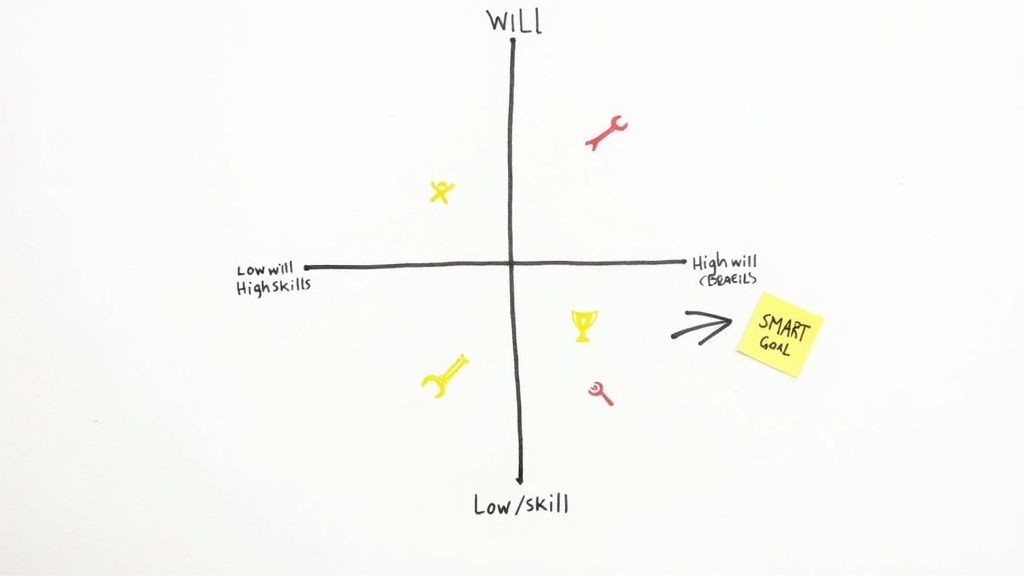
A useful framework for that first diagnosis is the will vs. skill matrix. It distinguishes motivation issues (will) from capability issues (skill) and points you toward the right kind of support.
- High will, low skill. Motivated and eager, but not yet equipped. The fix is straightforward: training and coaching. They want to succeed — show them how.
- High will, high skill. Your strong performer. Keep them engaged with stretch goals and genuine autonomy, and do not let them get bored.
- Low will, high skill. The talent is there but the engagement is not. Dig into the why behind the lost drive — the work is motivation and reconnection.
- Low will, low skill. The hardest quadrant. It calls for a structured improvement plan with direct coaching and clear, documented expectations.
Naming the quadrant stops classic mistakes — like sending a disengaged expert on a basic training course they do not need. It keeps your effort targeted from the start.
The root of many performance issues is not a person but a process. Before you assume the employee is the problem, ask whether your goals, resources, or communication have set them up to fail. Clarity is the foundation of performance.
If you want more on structuring these conversations, our guide to a productive performance review has useful frameworks.
Turning vague objectives into real goals
Once you have identified the core issue, set goals that actually work. Vague objectives — "improve sales," "be more proactive" — are useless. They leave too much room for interpretation and make success impossible to define.
The SMART framework forces that clarity and creates a shared understanding of the finish line:
- Specific. What exactly needs to happen, and who owns it?
- Measurable. How will you track progress and know the goal is met?
- Achievable. Is it realistic given the resources and timeframe?
- Relevant. How does it connect to the team's and company's wider objectives?
- Time-bound. What is the deadline?
Here is the transformation in practice:
| Vague goal | SMART goal |
|---|---|
| "Get better at client communication." | "By the end of Q3, respond to all high-priority client emails within 4 business hours, and schedule monthly check-in calls with our top 10 clients, with the aim of lifting client satisfaction scores." |
The SMART version does more than add detail — it provides a roadmap. The employee knows what to do, how success is measured, and why it matters. That clarity is itself a powerful motivator.
It also pays off at scale. Gallup's long-running research finds that the most engaged teams show roughly 14% higher productivity and 78% lower absenteeism than the least engaged. Organisations that want to close that gap should also look at the broader picture of improving employee satisfaction. Yet Gallup's 2026 State of the Global Workplace report puts global engagement at just 20% — a five-year low. Clear, meaningful goals are one of the most direct levers a manager has to close that gap.
Master Coaching and Continuous Feedback
If you are still relying on annual reviews to drive performance, you are working from an outdated playbook. High-performing teams run on continuous, constructive dialogue. This is the shift from being a manager who assigns tasks to a coach who develops people.
Coaching is a genuine change in approach. Instead of pointing out mistakes, you ask questions that help team members find solutions themselves. That builds ownership and sharpens their judgement — both essential to lasting performance gains.
A framework for coaching conversations
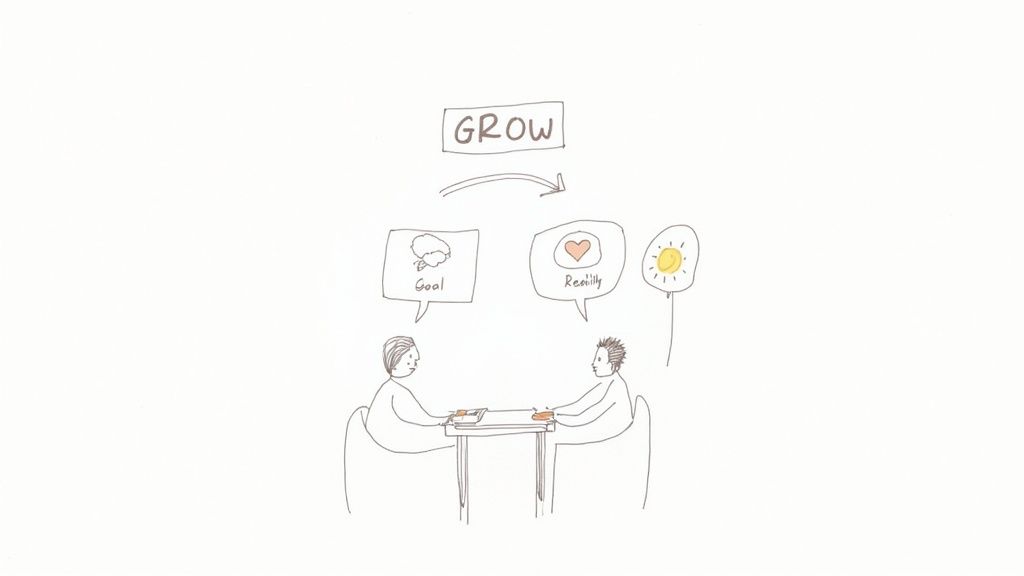
One of the most effective tools for structuring these conversations is the GROW model, developed by Sir John Whitmore and set out in his 1992 book Coaching for Performance. It gives you a simple four-step path from identifying a challenge to committing to a solution — and the point is not to hand over answers but to help people reach their own.
Here is how it works, with questions you can try in your next check-in:
- Goal — what do you want to achieve?
- "What would a successful outcome look like for this project?"
- "What specific skill do you want to build this quarter?"
- Reality — where are you now relative to that goal?
- "Walk me through the steps you've taken so far."
- "What are the biggest things getting in your way right now?"
- Options — what could you do to move forward?
- "Let's brainstorm three actions you could take next."
- "Who could you talk to for advice or support?"
- Will (or way forward) — what will you do?
- "Which of these will you commit to trying this week?"
- "How can I best support you in taking that first step?"
This turns a potentially awkward feedback session into a collaborative, problem-solving meeting, and makes the employee an active driver of their own development.
Delivering tough feedback that inspires change
Delivering criticism is one of the hardest parts of managing. The goal is not to make someone feel bad — it is to change a behaviour. The trick is to focus on specific, observable actions and their direct impact, rather than broad judgements about the person.
Instead of "you're not being a team player," try:
"During yesterday's team meeting, I noticed you were quiet while we were brainstorming the marketing campaign. When your insights aren't shared, the team misses valuable perspectives, and we can overlook real risks. What are your thoughts on that?"
That version is non-accusatory. It states a factual observation, explains the real-world impact, and opens a two-way conversation. The skill matters even more when the team is distributed — you can build on it by learning how to effectively train remote employees through clear communication.
Building psychological safety
Continuous feedback only works in an environment of psychological safety. People need to feel safe enough to admit mistakes, ask for help, or even give feedback to you without fearing blame. When people are afraid to be vulnerable, they hide problems until those problems become crises.
You can build that safety deliberately:
- Lead with your own fallibility. Share your mistakes and what you learned. It signals that being imperfect is fine.
- Respond with curiosity, not anger. When someone brings you a problem, thank them for the transparency before you move to solutions.
- Encourage questions. Frame work as a series of learning opportunities. Ask "What questions do you have?" rather than the more passive "Any questions?"
Finally, do not underestimate positive reinforcement. Addressing weak spots matters, but frequent, specific praise is what fuels motivation. Research from the Achievers Workforce Institute finds that employees who receive recognition at least weekly are markedly more likely to be engaged and performing at their best — and a generic "good work" does not land the way a specific one does. "Great job on that difficult client call — you stayed calm and found a solution fast" reinforces the exact behaviour you want repeated. That is a cornerstone of effective coaching.
Use Technology to Enable Your Team
Technology is no longer just an HR concern; it is a practical part of a manager's toolkit. Used well, performance-management software and AI tools can surface trends you would otherwise miss, flag disengagement risk early, and suggest development paths tailored to a person's skill gaps. That frees you from crunching data so you can focus on coaching and human connection.
Uncovering insights with performance analytics
One real gain from technology is seeing the story behind the numbers. Good performance software tracks more than whether goals were hit — it gives a fuller picture of someone's contributions, challenges, and growth over time. Instead of relying on memory during a review, you can pull up hard data on project milestones, peer feedback, and goal progress, and have a specific, evidence-based conversation. You might notice someone consistently excels at solo work but struggles on collaborative tasks — a clear signal for targeted support.
A caveat worth keeping in mind: employees and managers do not see AI in performance management the same way. In a survey of 3,000 workers by the background-check firm Checkr, 58% of managers said AI use is becoming an unspoken performance requirement, while only 29% of employees agreed. Tools help most when employees see them as fair and transparent — so introduce them openly, explain what the data is used for, and keep a human in every consequential decision.
Automating the administrative burden
Think about the time spent on administrative follow-up — chasing goal updates, gathering feedback from different people, compiling it all. It is low-value work that technology can absorb, handing you back hours for high-impact coaching.
- Automated reminders for check-ins, goal updates, and feedback deadlines.
- Centralised feedback, collected and organised in one place so themes are easy to spot.
- Real-time dashboards that show team progress without chasing individual updates.
This matters especially for flexible and remote teams, where the right systems keep everyone aligned. A solid set of remote collaboration tools makes a real difference to productivity and connection.
The point of technology is not to replace the manager — it is to free up the coach. Automating the administrative side creates space for the conversations that actually drive growth.
Old approach versus new
The contrast between traditional performance management and a tech-enabled approach is stark:
| Feature | Traditional approach | Modern, tech-enabled approach |
|---|---|---|
| Feedback | Annual or bi-annual reviews, often subjective | Continuous, multi-source feedback gathered in real time |
| Goal setting | Set once a year, quickly outdated | Dynamic goals (OKRs) that adapt to shifting priorities |
| Data analysis | Manual review of past performance | Analytics that flag emerging risks and opportunities |
| Development | Generic training recommendations | Learning paths matched to specific skill gaps |
The best tool is the one that fits naturally into your team's workflow and gives you actionable insight, not just more data. Start by naming your single biggest performance-management headache and find a tool that solves that one thing well.
Redesign the Work Itself
Sometimes a performance gap has nothing to do with skill or motivation. The problem is the job itself.
When you focus only on the person and ignore the systems they operate in, you are usually treating a symptom. A genuinely powerful way to lift performance is to redesign the work — to remove friction and unlock the potential that is already there.
A talented developer will always struggle if buried under endless admin meetings and clunky processes. A creative marketer's best ideas wither if every approval takes weeks. The structure of the work directly throttles the result.
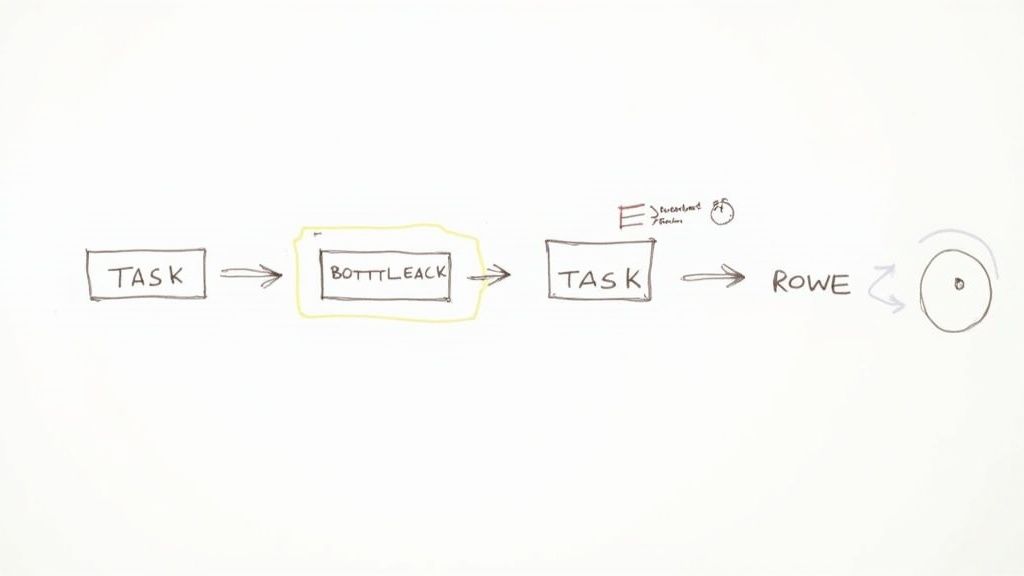
The key shift is from policing hours to measuring outcomes. That is the heart of models like the Results-Only Work Environment (ROWE), where performance is judged on output, not presence — giving people autonomy over how and when they work, as long as they deliver.
Conducting a work-design audit
Before fixing anything, get a clear picture of what is broken. A "work-design audit" is not as formal as it sounds — it is a focused effort to find the bottlenecks, redundant tasks, and hidden causes of burnout holding the team back.
Start with honest questions about day-to-day operations:
- Where do tasks get stuck? Identify where work stalls — usually waiting on an approval or a handoff.
- What adds little value? Be ruthless about the admin and reporting that eats time without moving anything.
- What causes the most frustration? Ask the team. They know exactly which parts of the job feel inefficient.
- Is the workload distributed fairly? Check that your strong performers are not permanently overloaded while others have spare capacity.
These questions expose the "sand in the gears" — systemic issues no amount of individual coaching could fix. You may find that a weekly status report everyone spends hours on is read by nobody. Scrapping it frees real time for real work.
Optimising workflows and workloads
Once you have found the friction, act on it. The goal is workflows smooth enough that the team can pour their energy into what matters.
Simplifying processes is one of the most effective moves. Hunt for steps to cut — can a five-stage approval become two? Can an automated tool take over repetitive data entry? Every simplification removes a potential point of failure.
This obsession with efficiency is a core habit of teams that have successfully moved to a four-day work week: to produce the same quality of work in less time, you have to be merciless about cutting low-value tasks. Our guide on how to work faster has practical advice on streamlining.
A common mistake is trying to cram more work into the existing hours. The real breakthrough is redesigning the work to take less time in the first place. It is about being more effective, not just more efficient.
Finally, keep workloads challenging but balanced. An overloaded employee is a burnt-out one waiting to happen — worth cross-referencing with our guide on improving employee productivity without burnout. An under-challenged one disengages fast. The sweet spot stretches someone's skills without pushing them past their limit — and regular, informal check-ins are how you gauge that balance and adjust.
When you redesign the system, high performance becomes the natural default rather than a constant uphill effort.
Common Performance Hurdles
Even with a solid plan, you will hit tricky moments — from someone who resists feedback to the fine line between supportive coaching and micromanagement. Here is straightforward advice on two of the most common.
These are the moments where theory meets reality. Handling them well does more than solve the immediate problem — it builds a culture of trust and fairness the whole team can feel.
What if an employee pushes back on feedback?
When someone gets defensive, your first instinct should be curiosity, not confrontation. Resistance is usually a shield — it comes from feeling misunderstood or unfairly judged. Push back immediately and you only build the wall higher.
Instead, have a private conversation aimed at understanding their side. Use specific, non-accusatory examples and "I" statements: "I noticed the data section in the client presentation was missing a few key charts," rather than "You forgot the charts." The difference in tone is real.
Then open the door:
- "From your perspective, how did that project go?"
- "What were the biggest roadblocks you ran into?"
- "Could you walk me through your process for putting that together?"
If they still push back after a genuinely supportive approach, it is time to be direct. Clearly connect the behaviour to business outcomes, restate what the role expects, and document the conversation. This is not building a case against them — it is a clear record of your effort to coach, which matters if HR later needs to be involved.
The difference between performance management and micromanagement is trust. Performance management gives the team the what and the why, then trusts them with the how. Micromanagement gets stuck on the how — and becomes the roadblock instead of removing it.
Great managers focus on clear goals and the resources to reach them. Micromanagers dictate every step, which kills autonomy and growth. Real improvement comes from coaching people to find their own best way forward.
How long should you work with an underperformer?
There is no magic number, but a structured approach is essential. If you have tried coaching and consistent feedback without real, sustained improvement, the next step is a formal Performance Improvement Plan (PIP).
A typical PIP runs between 30 and 90 days, with the length matched to the role's complexity and the specific gaps. A focused behavioural issue might need only 30 days; a deeper skill gap can require the full 90.
A well-designed PIP is not a box-ticking exercise before termination — it is a final, focused coaching push. It should include:
- Specific, measurable goals. Define exactly what success looks like, using concrete metrics — for example, "reduce customer ticket response time to under 4 hours for 95% of inquiries."
- A clear timeline. A firm start and end date, with no ambiguity.
- Scheduled check-ins. Weekly or bi-weekly meetings to review progress, offer support, and adjust the approach.
- Clear consequences. Be explicit about what happens if the required improvements are not met and sustained by the end.
Your job throughout is to be a hands-on, genuine coach — providing the training, resources, and support that give the person a real shot at succeeding. If, after that documented effort, there is still no meaningful improvement, parting ways is often the fairest next step, and one always taken in close partnership with HR.
Improving performance, in the end, is less about pressure and more about design. Diagnose the real problem, set goals people can actually act on, coach instead of police, and fix the systems that quietly hold good people back. Get those four things right and high performance stops being something you chase — it becomes the way your team works.
Hiring for a 4-day week?
List your roles on 4dayweek.io and reach candidates who want a better balance.
Get started free