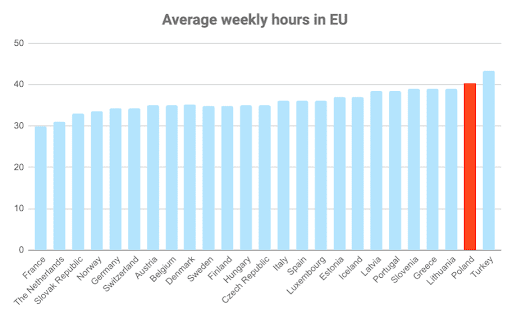
Vacation Policy in Poland
In Poland, regular employees are entitled to a minimum of 20 days of paid vacation annually. Employees with greater seniority, specifically those with 10 or more years of service, are eligible for 26 days of paid leave.
Moreover, employees can take up to 33 days of paid sick leave per year at 80% of their salary, covered by the employer. Beyond this, the Social Security Institute (ZUS) covers up to 182 days per year.
Overtime in Poland
In Poland, the working time should not exceed 8 hours within a 24-hour period. Overtime is limited to 150 hours annually. However, this limit can be adjusted through collective bargaining agreements, employer work regulations, or employment contracts, provided the total working hours do not exceed an average of 48 hours per week in line with EU legislation.
Employees are entitled to additional remuneration for overtime work in Poland. The compensation varies depending on when the overtime is worked.
Employees receive 100% additional pay for overtime work during:
-
Night shifts
-
Sundays and public holidays (if these are not regular workdays)
-
Days off granted in exchange for work on Sundays or public holidays
-
Work exceeding the average 40-hour weekly limit
Employees receive 50% additional pay for overtime work on:
-
Regular workdays, including 'working' Sundays and public holidays (except for night overtime, which is compensated at 100%)
-
Days off resulting from an average five-day workweek
-
Non-working days compensating for daily work exceeding 8 hours in a flexible working time system
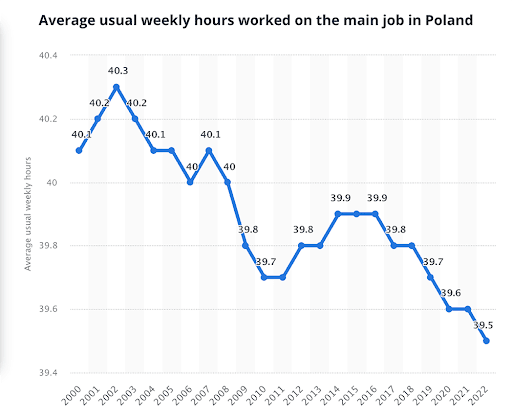
The below graph shows the average usual weekly hours worked on the main job by Polish employees.
Source: Statista
Part-time Working in Poland
Employees in Poland can work either full-time or part-time, as agreed with their employer. However, part-time employment impacts overtime rules and paid vacation leave, with leave calculated proportionally and rounded up to full days.
Moreover, a part-time employee who works more hours than specified in their contract will not be considered to be working overtime as long as the total hours do not exceed the 8-hour daily limit.
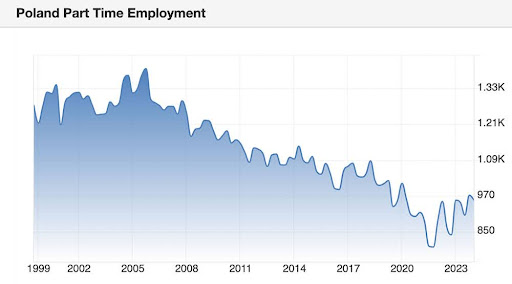
According to the EUROSTAT report, in Q1 2024, part-time employment in Poland dropped to 956.60 thousand from 972.70 thousand in Q4 2023.
Source: Trading Economic
Remote Working in Poland
Polish law defines three types of remote work:
-
Regular Remote Work: This can be agreed upon at the start of employment or during its course and can be full-time or hybrid.
-
Remote Work for Health and Safety (H&S) Reasons: During emergencies or situations compromising H&S, the company can require remote work for up to three months.
-
Ad-Hoc Remote Work: Employees can request up to 24 days per year for remote work, either in paper or electronically,
In 2020, the percentage of employed persons working from home in Poland peaked at 9%, likely due to the COVID-19 pandemic. However, this percentage decreased to 5.4% in 2023, indicating a reduction in remote work as conditions normalized and more people returned to on-site work.
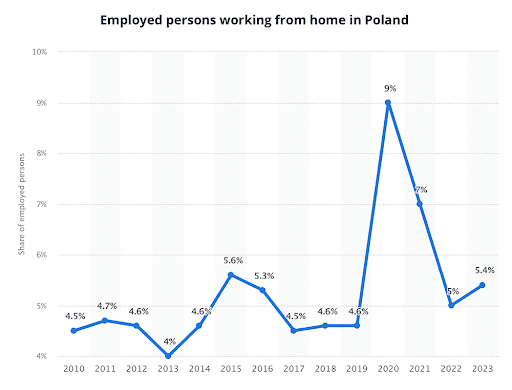
Image Source: Statista
4-day Workweek Companies in Poland
Some Polish companies have already begun experimenting with shorter workweeks. Let’s have a look at them
1. Herbapol Poznań
In 2025, Herbapol Poznań, one of Poland's oldest herbal remedies companies, plans to fully implement a four-day workweek to enhance work-life balance for its 400 employees. This initiative provides an additional paid day off each week without reducing pay and maintaining an eight-hour workday for the remaining four days.
The transition began in January 2024 with one Friday off each month, aiming for all Fridays off by the end of the year.
The CEO, Tomasz Kaczmarek, highlights that this move aims to ensure employees are well-rested, motivated, and valued. The company is running this as a pilot program and monitoring the results closely. The financial stability and the integration of new technologies have made this shift feasible.
2. Senuto
Senuto, a Polish SEO company, has implemented a four-day workweek for its employees. This initiative allows their team to work four days instead of five without any reduction in pay.
The move is part of Senuto's broader effort to enhance work-life balance and increase employee well-being. Senuto’s decision aligns with the growing trend in Poland to adopt flexible working arrangements that prioritize employee health and efficiency.
3. DotLineCode
DotLineCode has adopted a four-day workweek as part of its commitment to enhancing work-life balance for its employees. Staff members work 36 hours a week over four days, receiving 100% of their salary, with every Friday off. The company offers additional benefits, including hybrid remote working opportunities and flexible working hours.
This approach aligns with DotLineCode's mission to create digital products and brand experiences that are simple, aesthetic, and practical while ensuring their team remains motivated and well-rested.