
A work-from-home data analyst role is one of the most in-demand, flexible paths open to professionals right now. It blends genuinely interesting intellectual work with a real shot at work-life balance. The job is, at its core, about turning raw numbers into business strategy — and the shift to remote work has only accelerated demand for the people who can do it.
Companies are no longer limited by geography. They hire the best talent from anywhere, which means there are more opportunities than ever to land a strong remote role.
The Reality of Remote Data Analyst Careers Today
Demand for remote data analysts is not a passing trend — it reflects a structural change in how businesses operate. Data-driven decisions are now treated as essential, and the people who surface those insights can do the work from anywhere. That has created a robust market for analysts who pair technical skill with the self-discipline remote work requires.

Market Demand and Salary Growth
The financial picture is compelling. The U.S. Bureau of Labor Statistics groups data analysts with data scientists, an occupation it projects will grow 34% between 2024 and 2034 — far faster than the average for all occupations — with a May 2024 median wage of $112,590. That growth rate, and the demand behind it, is why analytical skills have become so valuable, especially in a remote setting where results speak louder than hours logged.
Pay for explicitly remote roles tracks closely with the wider market. As of mid-2026, Glassdoor data put the typical remote data analyst pay range between roughly $70,000 and $105,000, with top earners reporting more. And the opportunities are no longer confined to a standard 9-to-5 — the market is increasingly open to flexible setups, including hybrid models and compressed four-day weeks.
The real appeal of a remote data analyst role is the alignment between high-value work and personal freedom. You are judged on the quality of your insights, not the hours you spend at a desk.
Finding Your Ideal Remote Role
Job boards are full of remote analyst listings, which confirms that remote hiring is now a permanent channel for these positions. Your goal is to find a role that matches both your skills and the working style you want.
Many companies actively advertise flexibility as a perk to attract strong candidates. If work-life balance is a priority, a curated list of remote data and analytics jobs — many of which include four-day-week options — is a good way to filter for employers who value output over old-school schedules.
Mastering the Skills for Remote Success
Succeeding as a work-from-home data analyst is less about where your desk sits and more about how you operate. The best remote analysts work with a high degree of autonomy. Core technical skills are the price of admission, but remote work adds another expectation: you need to be a self-sufficient, proactive problem-solver.
It is a shift from executing tasks to owning outcomes end to end.
That changes what a skill like SQL really means. It is no longer just writing queries — in a remote setup it means writing clean, efficient queries to get the data you need without waiting on a colleague in another time zone. It means exploring datasets on your own initiative and anticipating the next question a stakeholder will ask.
The Non-Negotiable Tech Stack
Certain tools are table stakes for any remote analyst role. A hiring manager expects to see them on your CV — and will test you on them through a technical assessment or by digging into your portfolio.
Treat this as your foundational toolkit:
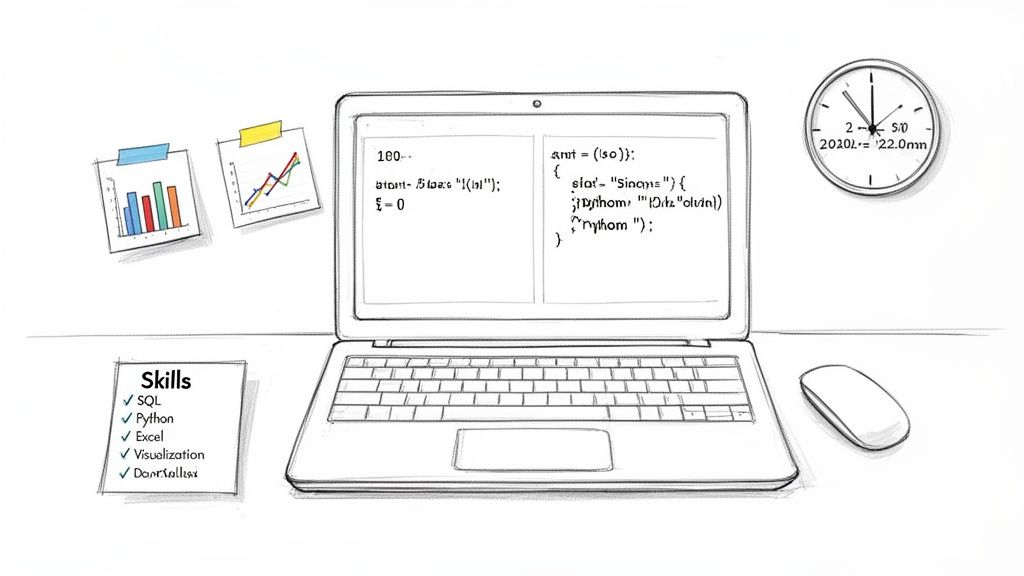
- Advanced SQL. This is the bedrock. You need genuine comfort with complex joins, window functions, and subqueries to pull and shape data independently.
- Python or R. Go beyond basic scripting. Can you use a library like Pandas for data cleaning, or
dplyrin R? That proves you can wrangle messy, real-world data without hand-holding. - Visualisation platforms. Mastery of Tableau or Power BI is non-negotiable. Distributed teams depend on clear, interactive dashboards to communicate findings when you are not in the room.
- Advanced Excel. It is not the flashiest tool, but a deep grasp of pivot tables, VLOOKUP/XLOOKUP, and complex formulas remains a practical must-have for quick, ad-hoc analysis.
The Soft Skills That Signal Remote Readiness
Your tech stack gets your CV noticed; your soft skills land the remote job. Employers have to trust that you can manage your own time, communicate clearly, and solve problems without someone looking over your shoulder.
These are not buzzwords — they are the signals that you can actually thrive in a distributed team.
In a remote environment, your written communication is your office. The clarity of your emails, messages, and documentation directly reflects your professionalism and your ability to collaborate across distances.
Think about how to prove these skills rather than assert them. Instead of calling yourself a "good communicator," point to a project where your documentation was detailed enough that a stakeholder understood the entire analysis without a live presentation. Show, don't tell.
The soft skills hiring managers actually look for:
- Disciplined self-management. Can you structure your own day, prioritise what matters, and hit deadlines without a manager physically present?
- Crystal-clear written communication. Since much of your work will be asynchronous, articulating complex findings in writing is essential.
- Proactive problem-solving. Do you wait to be told what to do, or do you hunt for issues and propose solutions? That mindset is a major differentiator.
Building these abilities is a career-long process. For a deeper dive, our guide on essential remote work skills offers practical strategies to sharpen exactly these competencies.
Building a Portfolio That Proves You're Remote-Ready
Your portfolio is the single most powerful asset you have for landing a strong work-from-home data analyst role. It is more than a collection of projects — it is tangible proof that you can deliver excellent work without supervision.
When hiring for remote roles, managers want more than technical competence. They want to see autonomy, clear communication, and someone who can own a project from start to finish. A portfolio full of textbook tutorials will not do that.
You need a body of work that reads as remote-ready: projects that go beyond clean, tidy datasets and tackle the messy, real-world challenges you would actually face on a distributed team.
This is not a short-lived shift. Remote work grew by 216% between 2005 and 2019 according to Global Workplace Analytics — and that was before the pandemic-era surge. Even after the recent partial return to offices, BLS data shows that around 23% of U.S. workers still telework at least part of the time, a level that strongly favours data-focused roles built around independent, screen-based work.
Choose Projects That Demonstrate Ownership
Hiring managers need to see that you can take a project from a messy concept to a polished, insightful result. Your portfolio has to tell that whole story.
So instead of downloading a perfectly clean CSV, find a messy, real-world dataset that needs serious wrangling. This is your chance to show you can handle the grunt work — which, as any experienced analyst knows, is a large part of the job.
A few project ideas that signal remote competence:
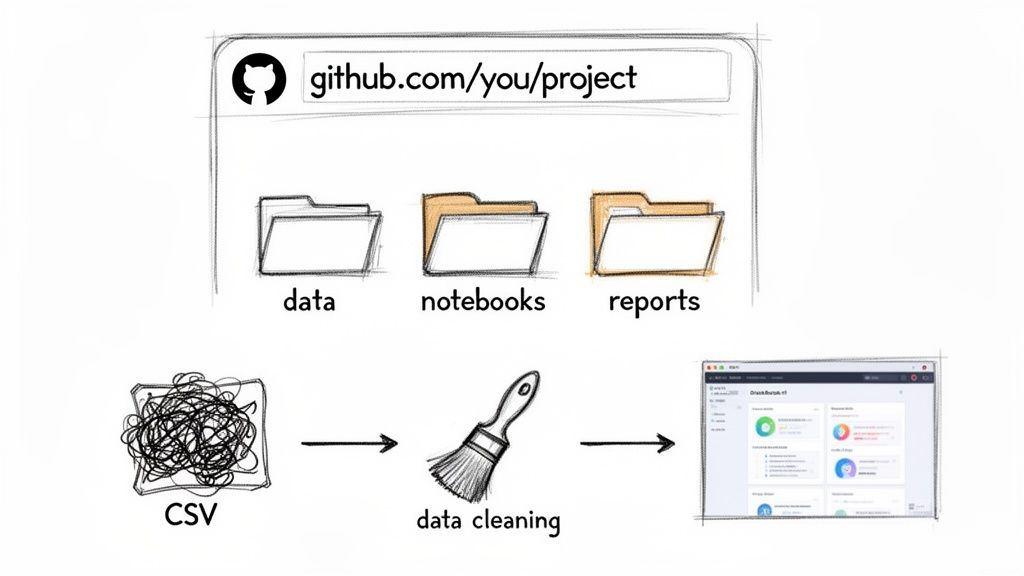
- Public transit analysis. Use open city data to examine public-transport efficiency. Can you spot bottlenecks, suggest better routes, and build a dashboard a hypothetical city planner could use?
- Web scraping for market trends. Scrape e-commerce sites or job boards to track pricing changes or in-demand skills over time. This shows initiative and technical resourcefulness.
- Customer churn prediction. Find a public dataset and build a simple model to predict which customers are likely to cancel. Document your feature engineering and model selection along the way.
Document Everything Meticulously
Your code is only half the story. In a remote world, the ability to document your process matters as much as the analysis itself. A well-documented project on GitHub or a personal blog is your audition as an asynchronous communicator.
For a remote data analyst, your GitHub README is your virtual presentation. It is your chance to walk a hiring manager through your thinking, justify your decisions, and present your findings without being in the room.
Your project documentation should read as a clear narrative that explains:
- The problem. What question were you trying to answer? Start with the "why."
- The process. How did you clean the data? Which tools did you use, and why this analytical method over another?
- The results. What did you find? Present the key insights with clean visuals and short, direct explanations.
That level of detail proves you can work independently and communicate complex findings — two non-negotiable skills for any remote team. For inspiration on presenting finished work, browse the kinds of data dashboard roles top companies are hiring for.
Fine-Tuning Your Resume for Remote Roles
Your CV is your ticket to a strong work-from-home data analyst job. It needs to do more than list technical skills — it has to demonstrate that you can perform in an autonomous, distributed team. To get past both automated screeners (ATS) and human recruiters, frame your experience through the lens of remote work.
That means deliberately using language that shows you are not just capable of remote work but built for it. Move beyond standard bullet points and showcase your independence and communication.
Weave in Remote-Centric Keywords
Recruiters and screening software scan for terms that signal you can thrive without supervision. Work these in naturally across your experience, summary, and skills sections:
- Asynchronous communication. Signals that you can collaborate across time zones without constant real-time meetings.
- Distributed teams. Shows you have worked with colleagues in other offices — potentially other countries.
- Self-directed projects. Highlights autonomy and the ability to own tasks from kickoff to completion.
- Remote collaboration tools. Be specific — name the platforms you use daily, like Slack, Jira, Confluence, or Microsoft Teams.
This is not keyword stuffing. It is describing your experience in the vocabulary remote-first companies actually use.
Reframe Your Achievements to Show Independence
The real skill is transforming accomplishments to spotlight remote-friendly traits — initiative, proactive communication, problem-solving. A quick before-and-after shows the difference.
Before:
Created weekly sales performance reports.
4-Day Week Data Jobs
Save one to come back to it — it's free.


It is a fact, but a passive one. It describes a task and does nothing to sell your remote capability.
After:
Independently designed and automated a weekly sales performance dashboard in Tableau, cutting manual reporting time by 10 hours per month and giving stakeholders on-demand access to key metrics.
This version is far stronger. It shows initiative ("independently designed"), real impact ("cutting manual reporting time"), and clear communication ("on-demand access"). It tells the story of a proactive problem-solver who needs no hand-holding — exactly what a remote manager wants.
Your CV's job is not just to list what you did; it is to build a case for how well you deliver results autonomously. Every bullet point is a chance to provide evidence of self-sufficiency.
Give your LinkedIn profile the same treatment. Your headline and "About" section should mirror this strategy, explicitly stating your skill in working with distributed teams. For more tactics and examples, see our guide on how to prepare your resume for remote work.
Crushing the Remote Interview Process
Treat the remote interview as a live audition. It is not only a check of your technical knowledge — it tests your communication style, your ability to solve problems independently, and whether you are genuinely suited to remote work. Hiring managers want proof that you can explain complex ideas clearly over a screen and keep projects moving without supervision.
From the first video call to the final technical challenge, every interaction is a chance to show the self-discipline and professionalism distributed teams demand. The questions are different by design.
Mastering Remote-Specific Interview Questions
Expect behavioural questions aimed squarely at self-management and communication. Interviewers are not just listening for the "right" answer — they are examining your thought process and how you tell the story. They need evidence you can handle the rhythm of asynchronous work.
Be ready for questions like these:
- "Describe a time you solved a complex problem with minimal guidance." A direct test of initiative. Prove you can take ownership of a problem from beginning to end without constant input.
- "How do you keep stakeholders updated when working across different time zones?" This is about your async communication. Describe your system — meticulous documentation, regular written summaries, or self-service dashboards that keep everyone informed.
- "Walk me through a project where the initial data was messy or incomplete." This tests resourcefulness. A strong answer details how you cleaned the data, the assumptions you made, and — crucially — how you communicated those limitations to the team.
Your ability to articulate your thinking clearly on a video call is a direct proxy for how you will communicate in the role. Structure your answers with a simple framework like STAR — Situation, Task, Action, Result — to keep them concise and impactful.
Conquering the Take-Home Technical Challenge
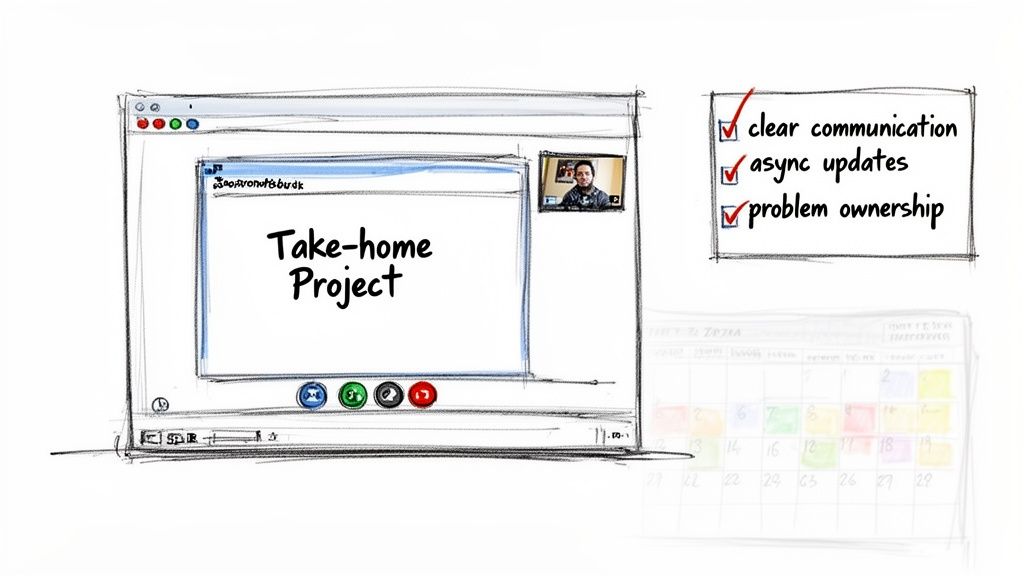
The take-home assignment is where you show you can deliver a polished, professional product. It is not just about your SQL or Python — it is a simulation of a real task, and how you present your findings matters as much as the findings themselves.
Your submission should be the complete package:
- Well-commented code. Clean enough for another analyst to pick it up and run it without frustration.
- A clear summary. A short document or simple slide deck explaining your method, your key insights, and any limitations you ran into.
- Compelling visualisations. Do not just show numbers — use charts to tell the story behind the data and make your conclusions hard to miss.
Putting it together this way shows you have the technical skill, the professionalism, and the commitment to clear communication that top remote employers compete for.
How to Find and Secure a Four-Day Work Week
Landing a remote data analyst role is a real win. Finding one that also respects your life outside work is the bigger prize — and for many people, that means a four-day work week.
This is not a pipe dream. It is achievable if you approach it deliberately.
The trick is knowing where to look and how to frame the conversation. It starts with targeting companies that already understand flexible work.
Where to Find Four-Day Week Roles
Sifting through generic job boards for a condensed schedule is slow going. Start instead with platforms built for it — they attract employers already sold on the four-day model.
- Niche job boards. Sites that specialise in reduced-hours roles cut through the noise and surface jobs that already have a condensed schedule built in.
- Company careers pages. Identify companies known for progressive work cultures and go straight to their careers pages. Many startups and tech firms use work-life balance as a recruiting selling point.
- Professional networks. Use LinkedIn to follow companies and leaders in the four-day-week movement. These roles often appear in those circles before they hit the wider market.
Negotiating a Condensed Schedule
What if you find the perfect job, but it is not advertised as a four-day role? You can still negotiate for it.
The key is to build a business case around productivity and value, not personal preference. The right moment is the final offer stage — after you have impressed them and they want you on the team.
The most successful negotiation for a four-day week is framed as a business case. You are not asking for a favour; you are proposing a more efficient way to deliver exceptional results.
Rather than asking "Can I have Fridays off?", present a concrete plan. Propose a trial period working a compressed schedule and commit to specific, measurable goals. That shifts the conversation from hours logged to outcomes delivered — a language every manager understands. The evidence is on your side: the UK's 2022 four-day-week pilot, the largest trial of its kind, found that 71% of employees reported reduced burnout while company revenue held broadly steady.
Thriving in a Flexible Remote Role
Once you have the schedule you want, sustaining it long-term comes down to discipline and good habits.
A few practices worth treating as non-negotiable:
- Set hard boundaries. When the workday ends, it ends. Turn off notifications and resist checking "just one more thing." This protects your downtime and keeps burnout at bay.
- Master asynchronous communication. Get genuinely good at writing detailed updates and clear documentation. This builds trust and keeps your team informed even when you are offline.
- Focus on high-impact work. With less time, be ruthless about prioritisation. Identify the tasks that move the needle most and do those first.
A remote data analyst career rewards exactly the traits that make a four-day week work: autonomy, clear communication, and a focus on outcomes over hours. Build those deliberately with good remote work productivity habits, and you are not just chasing a flexible job — you are building the kind of working life that flexible job is supposed to deliver.




Get 4-day week jobs in your inbox
Create a free account to receive curated opportunities weekly.
Sign up for freeFree forever. No spam, unsubscribe anytime.