
You hand in your notice. And instead of working out the next three months, your employer says: don't come in. Stay home. We'll keep paying you.
That's garden leave. And despite how it sounds, it isn't a holiday, it's a specific, contractual arrangement with real rules attached.
If you've just been placed on it (or you're negotiating an exit and the term has come up), this guide covers exactly what garden leave means: whether you're paid, what you can and can't do, how long it lasts, and how it differs from being paid off early.
What is garden leave?
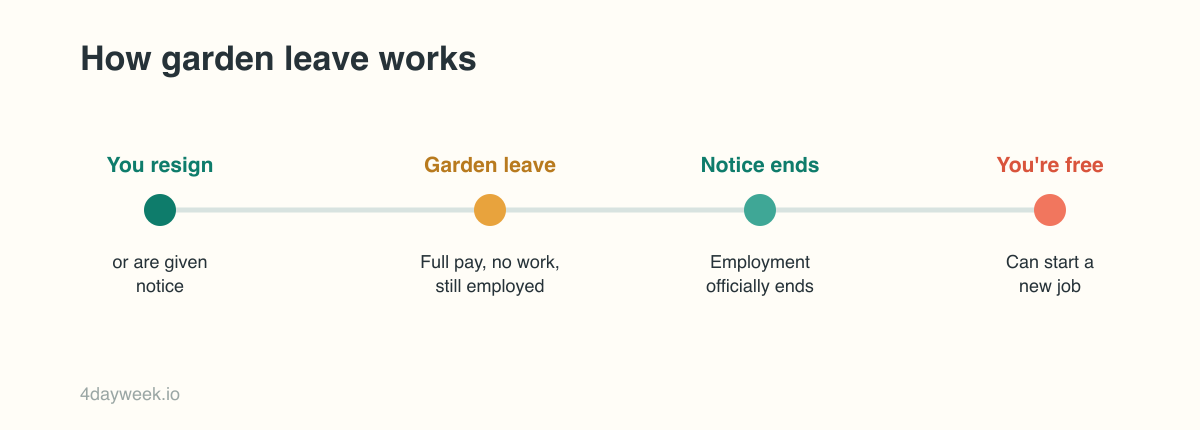
Garden leave is when you serve out your notice period away from the workplace, still employed and still paid in full, but not doing any work.
The name is British and only half a joke: you're at home, free to tend the garden, while your notice runs down.
The key thing to hold onto: you are still an employee. You haven't left yet. Your employment formally ends only when your notice period expires. Until then, you remain on the payroll and remain bound by your contract.
Employers use it when someone has resigned, been made redundant, or been dismissed, and they'd rather that person wasn't in the building, near clients, or across the latest plans during their final weeks.
Do you get paid on garden leave?
Yes. On garden leave you receive your normal full pay and usually your normal benefits, pension contributions, health cover, holiday accrual, for the whole period, exactly as if you were still working.
That's the trade. Your employer gets you out of the office and away from sensitive information; you get paid to stay away.
A few things worth checking:
- Bonuses and commission. How these are treated during garden leave depends on your contract. If a chunk of your pay is variable, read the wording (or ask).
- Holiday. Employers can often require you to use up accrued holiday during garden leave. Again, contract-dependent.
- Benefits. Most continue, but confirm anything you rely on (like private medical cover) is maintained until your leave date.
What can and can't you do on garden leave?
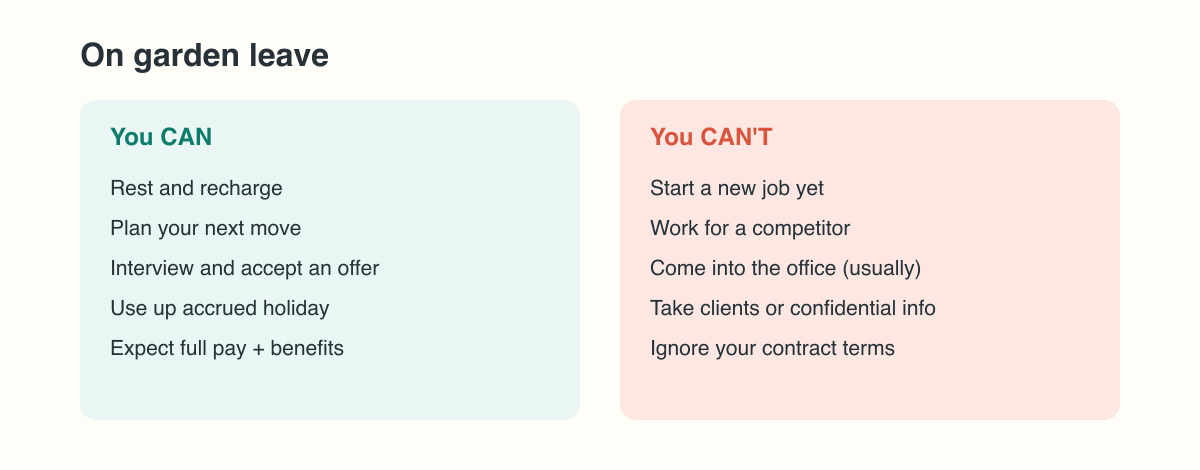
This is where people get caught out. Being at home on full pay feels like freedom. It isn't quite.
Because you're still employed, you're still bound by every obligation in your contract:
- You cannot start a new job, especially not with a competitor, until your employment officially ends.
- You cannot take clients, contacts or confidential information with you.
- You usually can't come into the office or contact colleagues and clients, unless asked.
- You generally must stay available, your employer can, in principle, ask you to return to work or do occasional tasks during the period.
What you can do: rest, plan, line up your next role (you just can't start it), and, yes, tend the garden.
Why do employers use garden leave?
It looks generous, paying someone to do nothing. It's actually strategic.
Garden leave protects the employer's interests during a vulnerable moment: the weeks when a departing employee is most tempted to take knowledge, relationships or clients to a competitor.
- It keeps you away from current, sensitive information as it goes stale, so what you know is less useful to a rival by the time you leave.
- It enforces confidentiality and non-compete obligations during the gap, and can strengthen post-employment restrictions.
- It removes a disengaged or departing person from live customer relationships.
In short: it's an insurance policy, paid for with your salary.
How long does garden leave last?
Garden leave lasts as long as your notice period, because that's exactly what it is: your notice, served at home instead of at your desk.
That means the length is set by your contract:
- A week or two for junior roles on short notice.
- A month for many mid-level roles.
- Three to six months for senior people, executives, or anyone with access to sensitive information or client relationships, which is precisely who employers most want to keep on ice.
The longer your notice, the more likely garden leave becomes, because that's when the risk of you walking straight to a competitor with fresh knowledge is highest. Some contracts also let an employer place you on garden leave for part of your notice and have you work the rest.
One nuance worth knowing: an employer generally can't extend your garden leave beyond your notice period to keep you out of the market indefinitely. Once your notice ends, your employment ends, and you're free.
Can your employer force you onto garden leave?
Usually only if your contract lets them.
To place you on garden leave, most employers need an express garden leave clause in your contract giving them the right to do so. With that clause, they can generally require it, you don't get to insist on coming in.
Without such a clause, it's murkier. Requiring an employee to stay away while refusing to let them work can, in some cases, breach the contract (particularly for roles where actually doing the work matters, think a surgeon or a trader who needs to stay current). In practice, most employers who use garden leave have the clause in place.
What you usually can't do is refuse garden leave and demand to keep working, if the clause exists. But you can, and should, make sure you're paid correctly throughout, and clarify how holiday, bonuses and benefits are handled.
Garden leave vs PILON vs severance
Work-Life Balance Jobs with Genuinely Reduced Hours
Save one to come back to it — it's free.



These three get muddled constantly, and the difference matters, because they leave you in very different positions.
| Term | Are you still employed? | Are you paid? | Can you start a new job? |
|---|---|---|---|
| Garden leave | Yes, until notice ends | Full pay + benefits | No, not until employment ends |
| PILON (pay in lieu of notice) | No, released immediately | Paid for the notice you'd have served | Usually yes, you've been let go |
| Severance / settlement | No | A separate agreed exit payment | Yes |
The big practical difference: on garden leave you're still tied to your employer and can't jump straight into a new role. With PILON, you're free, you've been paid off and released. If you're keen to start somewhere new quickly, PILON is often the better outcome to negotiate.
Is garden leave a UK thing?
Largely, yes. Garden leave is mainly a UK and Commonwealth concept.
In the United States, most employment is "at-will", employers can usually end the relationship immediately, so there's little need to park someone on paid leave to run down a notice period. Where US employers do want similar protection, they tend to lean on non-compete agreements and severance instead (and non-competes themselves are increasingly restricted in many states).
So if you're reading this from the US and an employer offers "garden leave", it's worth clarifying exactly what they mean.
What to do if you're put on garden leave
Treat it as a paid runway, not a punishment.
- Read your contract. Confirm your pay, benefits, holiday treatment, and exactly when your employment ends.
- Get the dates in writing. Your leave-end date is the date you're free, plan around it.
- Line up your next move, you can interview and accept an offer; you just can't start until your leave ends.
- Stay clean. Don't touch confidential data or poach contacts. Breaching your obligations during garden leave can cost you.
- Use the time. Rest, retrain, or simply reset. A paid gap between jobs is rarer than it should be, and a good moment to think about what you actually want next.
And if this whole episode has you wondering whether there's a saner way to work, one with more time and less brink-of-burnout churn, that's worth exploring too. Plenty of companies now offer four-day weeks and flexible, reduced-hours roles built around a life outside work, not just an exit from it.
Frequently asked questions
Do you get paid during garden leave? Yes, you receive your full normal pay and usually your benefits for the entire garden leave period, because you're still employed until your notice ends.
Can you get another job while on garden leave? You can look for, interview for and accept a new job, but you generally can't start it, especially with a competitor, until your current employment officially ends, because you're still bound by your contract.
How long does garden leave last? As long as your notice period, anything from a week to several months, depending on your contract and seniority.
What's the difference between garden leave and PILON? On garden leave you stay employed and paid until your notice ends (and can't start a new job yet). With pay in lieu of notice (PILON) you're released immediately, paid for the notice period, and usually free to move on.
Is garden leave the same as being suspended? No. Suspension usually happens during an investigation while you're still expected to return. Garden leave happens when you're leaving for good and serving notice away from work.
Rethinking the kind of job you go back to? Browse four-day-week and reduced-hours roles on 4dayweek.io →




Get 4-day week jobs in your inbox
Create a free account to receive curated opportunities weekly.
Sign up for freeFree forever. No spam, unsubscribe anytime.