
A human resource (HR) specialist is one of the most important roles a person can undertake in a business. They handle many critical tasks, like recruitment, training, payroll, compensation, and more. That's why a business will find it very difficult to run without their help.
So, if you're looking to become an HR specialist, the good news is that your service is in very high demand. Finding a job that pays well, has good benefits, and has good working time won't be difficult. Many companies will let you work four days a week, so long that you perform your duties well.
4 Day Week is here to help you find these job opportunities! But before we get there, let's discuss the job's specifics first. In this article, we'll tell you everything you need to know about the HR specialist job, from what you'll do to how much you will be paid and what sort of benefits you'll get!
What Is an HR Specialist?
An HR specialist is a person who is trained in all aspects of human resource management. They can recruit, train, and evaluate new employees for the company. Additionally, they will also have the necessary skills to handle payrolls, benefits, compensation, employee relations, and other tasks.
But they're called HR "specialists" for a reason.
Specialists are those that specialize in one specific area of human resources. They will have far higher technical skills and more in-depth knowledge in that area than others.
Here are a few areas that an HR person can focus on to become a specialist:
-
Risk management: Analyzes and handles the risks of having a workforce. In other words, they work to minimize the risks that employees pose to the business (e.g., dealing with violent or ineffective employees.)
-
Labor relations: Help maintain a line of communication between management and employees, facilitate labor disputes, and help employees with work rules and other legalities.
-
Recruitment and retention: Seeks, recruits, and retains talents for the company.
-
Training and development: Handles the training and onboarding of new employees.
-
Compensation and benefits: Calculates salaries, benefits, and bonuses for employees.
-
Workforce planning: Analyze the company's workforce and develop hiring plans to meet future staffing needs.
-
Workflow analysis: Break down the performance of employees to find out how they could be improved. Specialists in workflow analysis will also draw up training plans to address performance issues and optimize workflow.
What Does an HR Specialist Do in a Company?
The answer to this question will depend on the size of the company you work for.
In small companies, HR specialists generally spend most of their time being "HR generalists." They will take on many different roles, depending on the needs of the company at the time.
For example, say the company is in a recruitment drive. If you're the HR specialist, you will be expected to fill in as the one handling the recruitment and interview. And if a conflict pops up between two employees in the company the next day, your management may assign you to look into and mediate it.
These companies typically don't have a lot of resources or staffing. So, it's understandable that they would want to hire people who can juggle many different jobs.
In large companies, HR specialists will have more opportunities to shine.
These companies will usually have separate departments handling different tasks, like a recruitment department, a labor relations department, etc. Specialists will be assigned to the departments that suit their skillset. So, they will have to spend less time doing things they don't specialize in.
How Much Do HR Specialists Make in the US?
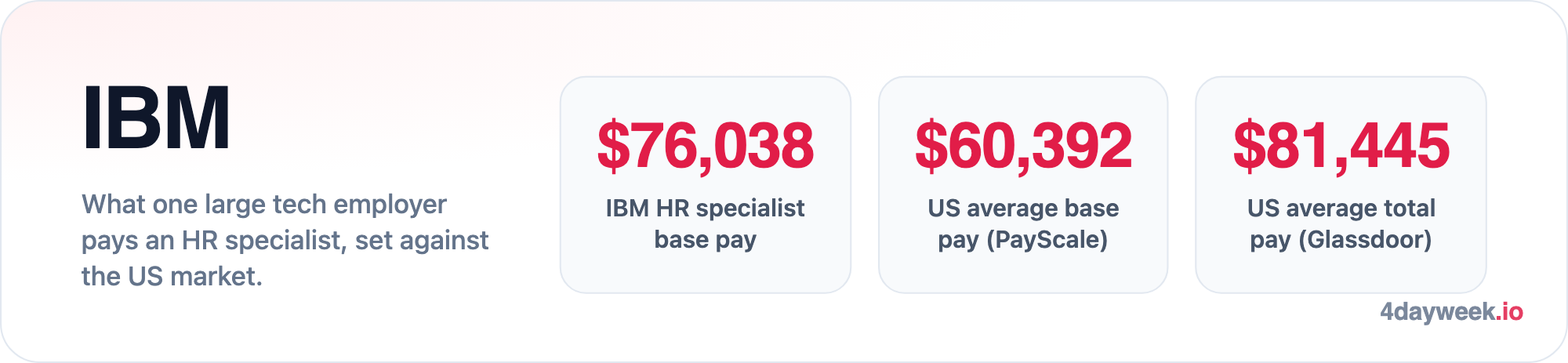
According to PayScale, the average HR Specialist in the US earns about $60,392 per year in base pay, with most salaries falling between $45,000 and $82,000. Glassdoor reports a higher average of $81,445 once total pay is factored in (including bonuses and profit-sharing), with the typical 25th–75th percentile range running from $64,871 to $103,512. Top earners cross $127,600.
Geographic differences are significant — HR specialists in coastal metro areas (SF Bay, NYC, DC) typically earn 20–30% above the national average, while Midwest roles tend to sit 5–15% below. Pay climbs with certifications (SHRM-CP, PHR) and with specializations like compensation, benefits, or employee relations.
HR specialists handle so many critical tasks in a company that most organizations would have difficulty running optimally without them. So, other than being highly sought-after, HR specialists more than deserve the good pay.
How Much Does an HR Specialist Make in Other Countries?
HR specialists can be found in just about every country. Here's how pay compares internationally in 2026:
-
United Kingdom: Indeed reports an average of £29,890 per year, while PayScale puts it at £36,851 and SalaryExpert at £37,897. London specifically averages £48,333, reflecting the city's premium.
-
Canada: Average pay lands between C$66,659 (SalaryExpert) and C$77,084 (Talent.com), with the typical 25th–75th percentile range running from C$59,524 to C$90,529.
-
Australia: HR specialists in Australia earn well — PayScale reports A$88,897 on average while Indeed puts it higher at A$97,805. Top earners cross A$130,000 in the 90th percentile.
Work-Life Balance Jobs with Genuinely Reduced Hours
Save one to come back to it — it's free.


If you're orienting your career toward becoming an HR specialist, the US and Australia continue to offer the strongest pay globally, while the UK and Canada sit in a steady middle band. Beyond base salary, a lot of international variation comes down to cost of living, benefits norms, and whether remote/hybrid schedules are on the table.
What Do Large Companies Pay Their HR Specialists?
Wondering what the top companies in the world pay their HR specialists? Generally speaking, you'll find postings from tech and professional-services firms that pay more than those from other industries.
The reason is pretty simple. These companies mostly employ highly-skilled workers, and recruiting, managing, and retaining them isn't simple. The pay is proportional to the level of work.
IBM
IBM (International Business Machines) is one of the premier companies in the tech world — on par with other large employers like Google and Microsoft.
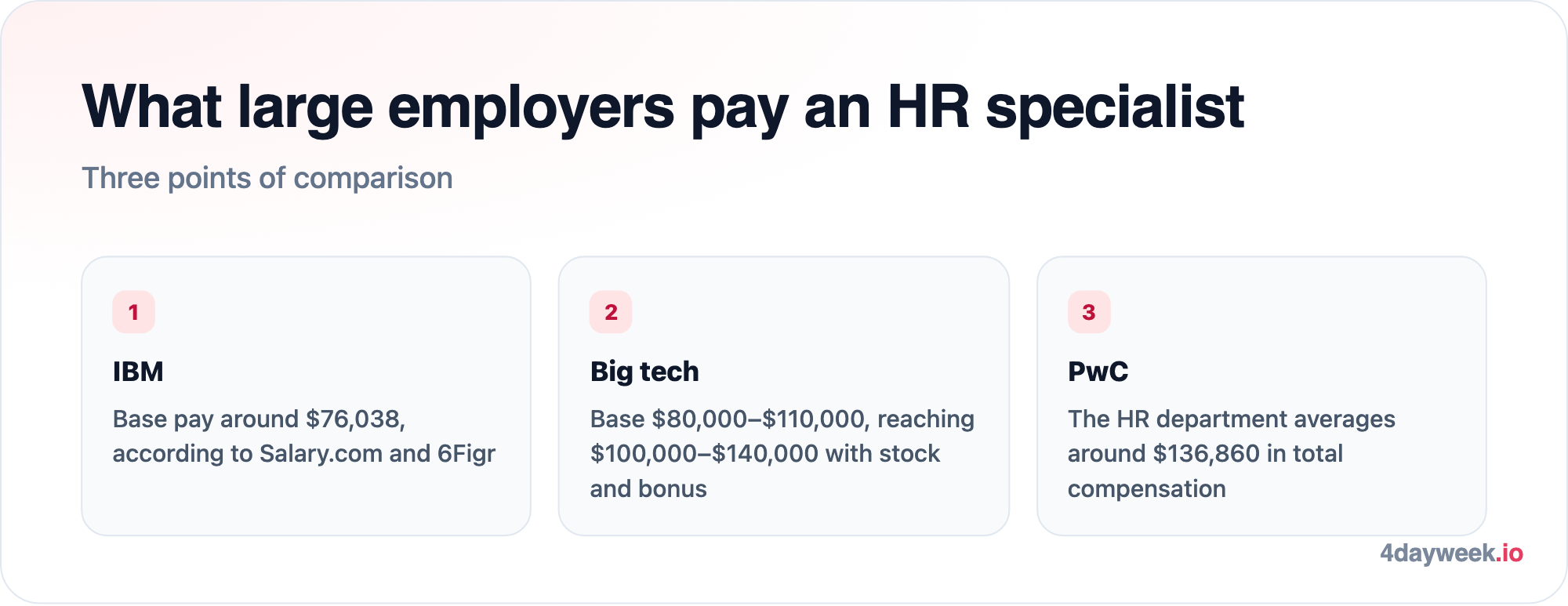
Working as an HR specialist at IBM is rewarding both in terms of working experience and finances. According to Salary.com and 6Figr, an IBM HR Specialist's base pay is around $76,038 annually. Like other big employers, IBM adds stock and bonuses on top of that, which lifts total compensation meaningfully.
Big Tech (Google, Apple, Meta)
Across the largest tech firms, HR specialist base pay typically falls in the $80,000–$110,000 range, with stock grants and bonuses often pushing total compensation toward $100,000–$140,000. These figures move quickly as tech compensation continues to evolve — check Glassdoor for the most current per-employer breakdown.
PwC
PwC is one of the big four accounting firms, partnering with thousands of companies worldwide on audit, tax, risk management, and advisory work.
According to Comparably, PwC's HR department averages around $136,860 in total compensation, reflecting a mix of strong base pay plus meaningful bonuses. Base salaries alone land in line with other large employers, but the overall package tends to be competitive relative to other professional-services firms.
Wrapping it up
Companies will still need skilled HR specialists for a long time — as the numbers above show, the pay is strong and rising, especially at large employers.
Ready to find an HR role that respects your time as well as your expertise? Browse our 4-day-week human resources jobs — every listing on 4dayweek.io offers a reduced-hours schedule, so you get competitive HR pay without the 5-day grind.
Prefer lighter hours? We also list part-time HR roles if you want to dial the commitment down further.




Get 4-day week jobs in your inbox
Create a free account to receive curated opportunities weekly.
Sign up for freeFree forever. No spam, unsubscribe anytime.