
An employee value proposition (EVP) template isn't just another HR document. Think of it as a blueprint for defining and communicating the value you offer your team in exchange for their skills and commitment. It works through the core promises — pay, benefits, career, environment, culture — that make your company somewhere top talent wants to work and stay.
This guide walks through what an EVP actually is, how to build one from genuine evidence rather than wishful thinking, and how to keep it honest once it's live.
What an Employee Value Proposition Really Is
Cutting through the jargon: an EVP is the promise you make to your people. It's the sum of everything they get in return for being part of your team — and your company's answer to the question every candidate is silently asking, "Why should I work for you instead of somewhere else?"
In a market where skilled professionals have options, a vague or non-existent EVP leaves you exposed. It's no longer just about a competitive salary; it's about the whole experience. A strong EVP works as a magnet for the right candidates and as the glue that keeps your best people from drifting out the door.
The Five Pillars of a Modern EVP
A solid EVP rests on five core pillars covering the full span of the employee experience. Together they help you organise what your company offers into a clear, compelling story.
The traditional version of these pillars is starting to feel dated, though. In a world of four-day weeks and flexible schedules, the emphasis has shifted.
| EVP Pillar | Traditional Focus | Modern, Flexibility-First Focus |
|---|---|---|
| Compensation | Base salary, annual bonuses, standard stock options. | Fair pay for outcomes, not hours — profit-sharing, productivity bonuses, and equity that reflects a real stake in the company. |
| Benefits | Health insurance, retirement plans, standard paid time off. | Benefits that give back time: a four-day week, flexible hours, generous parental leave, and wellness stipends for mental and physical health. |
| Career | A linear, predictable promotion ladder and annual training. | Dynamic growth — mentorship, cross-functional projects, modern skill development, and clear pathways in a non-traditional structure. |
| Work environment | The physical office, a desk, on-site perks. | Trust and autonomy — remote-friendly tools, home-office stipends, and a results-oriented culture that lets people work where they're most productive. |
| Culture | In-office events, top-down leadership, stated company values. | Intentional connection and purpose — psychological safety, transparent communication, and values that show up in actions, not posters. |
A modern EVP isn't just a list of perks. It reflects a fundamental shift in how we think about work itself.
A great EVP isn't only an HR document; it's a strategic business tool. Getting it right means building an environment where people don't just work — they belong and want to stay.
Why Your EVP Is a Business Imperative
A well-defined EVP has a direct, measurable impact on the bottom line. Gartner research has found that organisations which genuinely deliver on their EVP can reduce annual employee turnover by just under 70% and lift new-hire commitment by close to 30%. The same research notes that a strong EVP also reduces the compensation premium needed to attract candidates and reaches further into passive talent pools.




Hiring for a 4-day week?
List your roles on 4dayweek.io and reach candidates who want a better balance.
Get started freeIt doesn't stop at retention. Engaged employees are more productive, and Gallup's long-running meta-analysis shows business units with top-quartile engagement see roughly 23% higher profitability than those in the bottom quartile.
The message is simple: a promise you make and consistently keep reduces the substantial costs of hiring and training, while building a more committed, productive team.
How to Build Your EVP From the Inside Out
A genuinely powerful EVP isn't invented in a boardroom or lifted from a competitor. The best ones are discovered — found by looking inward and listening to the people who know your company best: your team.
Building from the inside out means creating a promise that reflects your reality, not just your aspirations. It's a process of digging into what your employees actually value, then translating those truths into a message you can deliver on.
Start by Listening to Your Current Team
Before you can build anything, you need to know where you stand. What do your employees really think? Anonymous surveys are a strong starting point because they create a safe space for honest feedback.
Your aim is to understand the "why" behind their day-to-day experience. Why do they stay? What frustrates them? What would they genuinely miss if they left tomorrow?
Use a mix of question types to get the full picture:
- Rating scales. Ask the team to rate things like pay fairness, career growth, and manager support on a 1-to-5 scale.
- Multiple choice. Offer options for what they value most — flexible hours, challenging projects, company culture.
- Open-ended questions. This is where the insight lives. Ask "Describe a time you felt genuinely valued at work," or "If you could change one thing about how we work, what would it be?"
This isn't about chasing perfect scores. It's about spotting patterns. If everyone praises the team but feels stuck in their careers, you've just found a critical piece of the puzzle.
Go Deeper With Focus Groups
Surveys give you the "what"; focus groups uncover the "why". These small, guided conversations are your chance to dig into the themes that surfaced in the survey data, adding context to the numbers.
If "company culture" scored highly, a focus group can tell you what that actually means. Is it the collaborative projects? The after-work socials? The psychological safety people feel with their managers?
To run a focus group well:
- Get a diverse mix of employees across departments, tenures, and roles.
- Keep groups small — six to eight people — so everyone gets to speak.
- Use a neutral facilitator who can guide the conversation without steering the answers.
- Create a safe space where people feel comfortable being candid.
The real value emerges in the organic conversation between team members, not just their direct answers. Your job is to listen.
Mine Your Exit and Stay Interviews
Your current employees are one source of truth. Another? The people who chose to leave — and the ones who consciously chose to stay.
Exit interviews offer unfiltered feedback. Departing employees have little to lose by being honest. Don't only ask why they're leaving; ask what they valued most. That highlights the strengths to lean into and the weaknesses you must address.
Stay interviews are proactive conversations with your top performers. Ask questions like:
- "What makes you choose to stay with us?"
- "What might tempt you to leave?"
- "What do you look forward to when you start work each day?"
These conversations reveal exactly what's keeping your best people engaged — the foundation for an EVP that retains the people you already have, not just attracts new ones.
Analyse the Competitive Landscape
Your EVP doesn't exist in a vacuum. You're competing for talent, so you need to understand what others offer. Look at the careers pages, job descriptions, and social feeds of your direct competitors and the companies you admire.
Don't just list their perks — decode the underlying promise they're making to candidates. Are they selling innovation, work-life balance, or rapid career progression?
While compensation gets people in the door, it's career growth and a supportive culture that make them stay. The goal isn't to copy competitors but to find where you can offer something uniquely valuable. You may not match a tech giant's salary, but you can offer a four-day workweek — a benefit with broad, genuine appeal.
The most powerful EVPs aren't about being the best at everything. They're about being verifiably the best at the things your ideal candidate values most.
Synthesise and Articulate Your Pillars
Now connect the dots. Lay out the data from your surveys, focus groups, interviews, and competitor research. Which themes keep recurring?
Group your findings into three to five core pillars that represent your unique promise. They might look like:
- Radical flexibility and trust — a four-day week, remote work, and real autonomy.
- Meaningful impact — the chance to work on substantial projects with a direct line to business outcomes.
- Supportive community — a collaborative culture where people feel genuinely seen.
With your pillars set, craft a concise EVP statement: a short, memorable summary of your promise that is authentic, clear, and easy for anyone to understand. Ground each pillar in real proof points rather than aspiration, and involve both leadership and a diverse group of employees in this final step so the result reflects your company's actual character.
How to Communicate Your Flexible-Work Advantage

A four-day week is a significant benefit — but it's only a true advantage if you know how to talk about it. Simply adding "we offer a four-day week" to your careers page is a missed opportunity.
To stand out, frame it as the solution to what modern professionals actually want: more life, less grind. That means moving past generic phrases like "good work-life balance" and painting a vivid picture of the freedom and focus you offer. This part of your EVP shouldn't just list a perk; it should describe a better way of working.
Frame the Narrative Around Autonomy and Trust
Candidates drawn to a four-day week aren't only after a long weekend. They want an employer who trusts them to deliver strong results without monitoring every minute. Your communication has to reflect that shift — from valuing presence to valuing output.
Your messaging should reinforce three themes:
- Trust. You hire capable people and get out of their way.
- Autonomy. Employees own their time and are measured by their contribution, not the clock.
- Focus. Your processes have been intentionally engineered to cut waste and make room for deep work.
Instead of "flexible schedule," try "own your Fridays." That small change turns a passive benefit into an active promise — a life where personal projects, family time, and rest are a guaranteed part of the week rather than something to squeeze in.
A four-day week isn't just a schedule; it's a statement. It says productivity comes from focused effort, not endless hours — a culture built on trust, efficiency, and respect for people's lives outside work.
Turn Generic Perks Into Compelling Promises
Here's the practical part: taking the bland language found in most job descriptions and giving it the power of your flexible-work advantage. The key is to connect every pillar of your EVP back to that core benefit.
| EVP Component | Standard Corporate Language | Compelling Flexible-Work Language |
|---|---|---|
| Compensation | Competitive salary. | Full-time pay for focused work. We invest in efficiency, so you're paid for five days but work four. |
| Work-life balance | We value work-life balance. | Reclaim 52 extra days a year. Your Fridays are yours — no meetings, no email, no guilt. |
| Career growth | Opportunities for advancement. | Build your skills in an output-driven culture. Grow your career on impact, not hours logged. |
| Team culture | Collaborative team environment. | A culture of intentional connection. We work hard Monday to Thursday so we can all properly disconnect. |
| Company mission | We are an innovative company. | We're pioneering a smarter way to work. Join a team that values your time as much as your talent. |
The difference is specificity. The compelling language quantifies the advantage — 52 extra days — and ties it directly to values like efficiency and results.
For teams still new to this model, our guide on how to implement a four-day week goes deeper on making the transition work.
Weave the Message Everywhere
This messaging can't live in a single document. It needs to be the consistent drumbeat of your recruitment marketing — consistency is what builds a memorable employer brand. Integrate the language into every candidate touchpoint:
- Job descriptions. Don't bury the lede. Open job posts with a clear statement about your four-day week.
- Careers page. Dedicate a "How We Work" section to the philosophy behind your schedule and what it means in practice.
- Social media. Share testimonials from current employees. A photo of a team member on a Friday hike says more than any bullet point.
- Interview process. Ask candidates what they'd do with their extra day. It opens a genuine conversation about values and surfaces alignment early.
Communicate your flexible-work advantage with specific, confident language and you transform a scheduling choice into the cornerstone of your whole EVP — attracting candidates looking not just for a job, but for a better way to live.
Living Your EVP Every Single Day
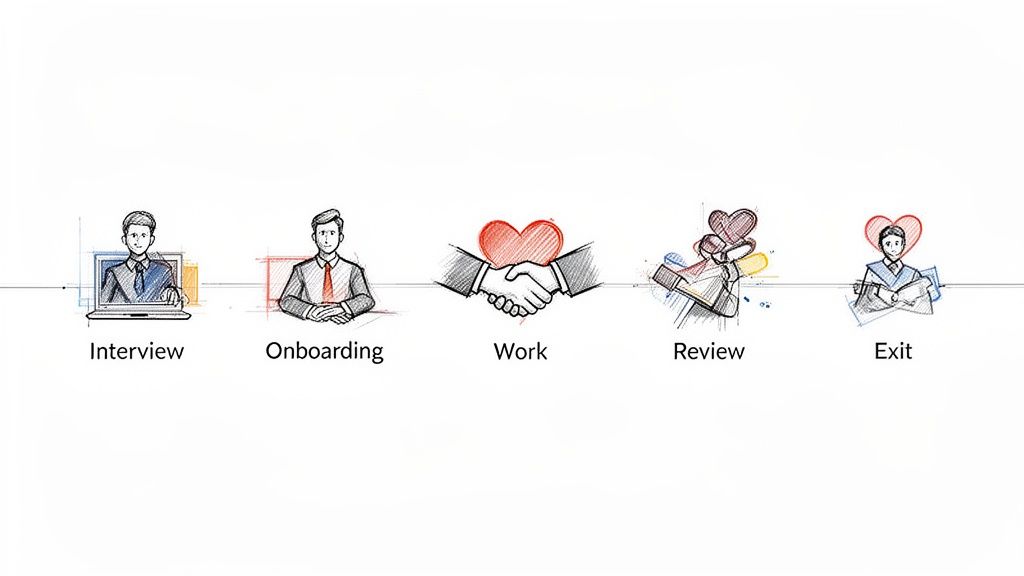
An EVP that just sits on your careers page is marketing fluff. A real EVP is lived within your culture every day. The genuine challenge — and the opportunity — is closing the gap between the promise you make to candidates and the experience you deliver to your team.
This is where your EVP template stops being a strategic doc and becomes an operational roadmap. The work is weaving your core promises into the entire employee lifecycle, from first interview to last day. That consistency builds trust and makes your EVP a tool for retention, not just attraction.
Infusing Your EVP Into the Hiring Process
Treat your EVP as a filter for every candidate. You're not only looking for the right skills; you're looking for someone who will thrive in your specific environment. That alignment starts long before day one.
Craft interview questions that get to the heart of your EVP pillars. If "radical autonomy" is a core value, don't just ask about project management — dig deeper:
- "Tell me about a time you had to make a significant decision without a clear playbook. What was your process, and how did it turn out?"
- "Describe your ideal work environment. How much structure versus freedom helps you do your best work?"
Questions like these move past technical skills to probe mindset and values, helping you see whether a candidate would feel empowered or overwhelmed by the level of trust you offer. Getting this right is your best defence against early turnover.
Onboarding as Your First Proof Point
A new hire's first few weeks are when your EVP gets tested. Strong onboarding isn't just about setting up laptops; it's about reinforcing the cultural promises you made during hiring.
If "supportive community" is a key pillar, your onboarding should make that obvious from day one:
- Assign a buddy from a different department to help the new hire navigate the social side.
- Schedule casual coffee chats with key team members, leadership included.
- Build a welcome packet with more than a laptop — perhaps handwritten notes from new teammates.
This is your moment to show, not tell. Demonstrating your values early validates the hire's decision to join and sets them up for long-term engagement.
An EVP is a promise. Onboarding is the first, and most critical, chance to prove you intend to keep it. Every interaction should echo the values you claim to hold.
Reinforcing Your EVP Through Daily Operations
The real work of an EVP happens in the daily grind — in how managers run meetings, deliver feedback, and celebrate wins.
Work-life balance has risen sharply up the list of what employees value. Gallup found that 59% of US workers call greater work-life balance and personal wellbeing "very important" when weighing a move to a new employer — and the cost of ignoring it is real. By Gallup's long-standing estimate, actively disengaged employees in the US cost employers somewhere between $450 billion and $550 billion a year in lost productivity. On the other side of the ledger, LinkedIn's Workplace Learning research has found 94% of employees would stay at a company longer if it invested in their development.
If "continuous learning" is one of your pillars, build it into performance reviews. Replace the backward-looking critique with a forward-looking growth plan: "What skill are you keen to develop this quarter, and how can we help you get there?"
And if "wellbeing" is central to your promise, it has to be more than a wellness stipend. That means training managers to spot burnout, actively encouraging people to take their leave, and creating space for open conversations about mental health. Steady, daily reinforcement is what turns an EVP from a poster on the wall into a lived reality.
Measuring the Real Impact of Your EVP
So you've done the work and crafted a compelling EVP. How do you prove it's more than a feel-good project? The answer is in the data. A strong EVP isn't an expense — it's a strategic investment you can, and should, measure.
To demonstrate its value, connect your EVP efforts to the KPIs leadership actually cares about. This isn't about tracking random metrics; it's about telling a clear before-and-after story.
Key Metrics to Track
First, get a baseline. Benchmark your performance before you roll out the new EVP — without that starting point, you can't show how far you've come. Once it's live, watch these core metrics:
- Offer acceptance rate. Are more of your top candidates saying yes? An uptick is one of the strongest signals your message is landing with the right people.
- Time-to-hire. A clear, attractive EVP shortens the hiring cycle because more aligned applicants come through the door.
- Quality of hire. Trickier to track, but performance reviews at the 90-day or six-month mark give you a read on whether new hires are thriving, not just filling seats.
- Employee turnover. The ultimate test. A meaningful drop in voluntary turnover, especially among high performers, is the clearest sign your EVP is delivering.
Your data tells a story. The goal is to show a direct line between launching your EVP and positive shifts in hiring speed, candidate quality, and employee loyalty.
The Financial Case for Your EVP
Connecting your EVP to the bottom line is how you get leadership to invest further in people-first initiatives. The cost of losing people makes the case on its own: replacing an employee typically costs between 50% and 200% of their annual salary, once you account for recruitment, lost productivity during the vacancy, and the time a new hire takes to reach full output.
By tracking turnover, you can put a real figure on the savings your EVP generates. Prevent a handful of key people from walking out the door, and the saving easily reaches six figures — a persuasive case in any budget conversation.
Creating a Continuous Feedback Loop
Your EVP can't be a "set it and forget it" project. The best ones evolve alongside your business and your people. Keeping it relevant means building a continuous feedback loop — and you don't need a complicated system:
- Pulse surveys. Short, frequent surveys — quarterly or monthly — track sentiment on specific parts of your EVP.
- Regular check-ins. Train managers to make conversations about career goals and satisfaction a normal part of one-on-ones.
- Stay interviews. Don't wait for exit interviews. Proactively ask top performers why they stay, and which parts of your EVP they value most.
This data-driven approach shifts HR from a cost centre to a strategic driver of growth, giving you the evidence to justify why investing in a great workplace is always worthwhile.
Common Questions About EVP Templates
Even with a solid template, you're bound to hit a few roadblocks. Here are the questions leaders ask most.
How often should we update our EVP?
Treat your EVP as a living document, not a stone tablet. A full, formal review every 12 to 18 months is a sensible rhythm, but the real value is in continuous listening. Any major business shift — a merger, a new strategy, adopting a four-day week — should trigger a review, because those moments reshape the employee experience and your promise has to reflect the new reality. Lean on pulse surveys, stay interviews, and exit data between formal reviews so you can make small, smart adjustments along the way.
Can a small business compete without big-company perks?
Absolutely — and this is where small businesses have an advantage. You won't win by outspending a corporate giant on salary or sprawling benefits. You win by being more human, more agile, and more authentic. Focus your EVP template on the things large corporations can't easily replicate:
- Direct impact. People can see their work shape the company's future.
- Mentorship. Access to senior leaders, and the founder, in a way that's impossible in a vast organisation.
- Culture. A tight-knit community where every person is genuinely seen.
- Real flexibility. A level of trust and autonomy that bureaucratic structures struggle to match.
Your story is your strongest card. Use it.
What's the biggest mistake to avoid when creating an EVP?
The most damaging mistake is creating an "aspirational" EVP — describing the company you wish you were rather than the one you actually are. That creates a painful gap between the promise you advertise and the reality your employees live. The disconnect breeds cynicism: when a new hire arrives expecting radical autonomy and meets micromanagement, their trust is gone almost immediately. Your EVP has to be honest, built on the real experience of your current team. It's fine to have aspirations — just frame them as a journey you're on together. Promise what you can deliver today, and be transparent about what you're building for tomorrow.
A strong EVP is never finished. It's a promise you keep refining as your company and your people change — and the companies that treat it that way, honestly and consistently, are the ones that stop competing for just anyone and start attracting people who genuinely want to build something with them.
Hiring for a 4-day week?
List your roles on 4dayweek.io and reach candidates who want a better balance.
Get started free