100 years and 4 days since the five-day weekRead the story
Philippines flag

4 Day Work Week in Philippines

President Marcos ordered a 4-day compressed work week for government agencies in March 2026 via Memorandum Circular 114

AsiaGovt Compressed Work WeekImplemented
41.2
Avg Hrs/Week
5
Vacation Days

Overview

Philippines 4-day Workweek

Companies in the Philippines don’t officially work a 4 day work week, but the idea of a shorter working week is being considered to provide relief to workers from the intense heat caused by the El Niño weather pattern.

El Niño, a periodic climate pattern, significantly raises temperatures in parts of the Pacific Ocean every two to seven years, causing severe weather conditions such as droughts and extreme heat in various regions, including the Philippines. This year's occurrence has been particularly severe in the Philippines, leading to a notable increase in heat-related illnesses.

From January 1 to April 29, the Department of Health reported 77 cases of heat-related illnesses and 7 potential fatalities due to the soaring temperatures.

Cavite

To mitigate the risks posed by the extreme heat, the provincial government of Cavite decided to implement a 4 day workweek starting Monday, April 29.

This decision, formalized by Executive Order No. 19 – Series of 2024, extends work hours from 7 AM to 6 PM, Monday through Thursday, ensuring that employees meet the 40-hour weekly requirement within four days. The schedule is set to continue until July 31.

However, certain essential services will continue their regular Monday to Friday schedules. These include:

  • Health office and its supervised hospitals

  • Provincial jail

  • Disaster Risk Reduction and Management Office

  • Public safety office

  • Social welfare office

  • Environment office

Binmaley

Cavite is not alone. Other local leaders have issued similar orders for city hall and government workers, although frontline workers like emergency responders, traffic enforcers, and health workers are excluded.

In Binmaley, Pangasinan, the local government adopted a four-day workweek from April 22 to June 30, 2024.

Employees work from 8 AM to 6 PM, Monday through Thursday, while specific offices like the Economic Enterprise and Slaughterhouse, MDRRMO, Utility Workers, Waste Management, and Traffic Management continue their regular schedules.

Imus

Similarly, the City Government of Imus has implemented a 4-day compressed workweek starting Monday, May 6, lasting until July 31, 2024.

According to Executive Order No. 027 s. 2024, city government offices will operate from Monday to Thursday, with extended hours from 8:00 AM to 7:00 PM.

This move aims to protect residents from the extreme heat while ensuring continuous service.

However, offices delivering essential services will maintain their regular Monday to Friday hours to provide uninterrupted support to the community.

The idea of a compressed 40-hour workweek is not new in the Philippines. Socioeconomic Planning Secretary Karl Chua also proposed this shift back in 2022 in response to fuel price spikes caused by the Ukraine war.
Work Culture in Philippines

Vacation Policy in Philippines

In the Philippines, employees are entitled to various types of leave, including 5 days of Service Incentive Leave (SIL) after 1 year of service. Employees who have served for more than 3 years are typically granted one additional vacation day per year, up to a maximum of 18 days per calendar year.

Female employees receive 105 days of paid maternity leave, with an additional 15 days for single mothers, and 7 days of paternity leave for fathers.

Additional leave includes 7 days for solo parents, 10 days for victims of violence against women and children, and discretionary bereavement leave typically ranging from 3 to 7 days.

Unused leave credits can often be converted to cash at the end of the year​.

There are 12 public holidays in the Philippines:

  1. New Year’s Day – January 1

  2. Maundy Thursday – Movable Date

  3. Good Friday – Movable Date

  4. Araw ng Kagitingan – April 9

  5. Labor Day – May 1

  6. Independence Day – June 12

  7. National Heroes Day – Last Monday of August

  8. Bonifacio Day – November 30

  9. Eid'l Fitr – Movable Date

  10. Eid'l Adha – Movable Date

  11. Christmas Day – December 25

  12. Rizal Day – December 30

Overtime in Philippines

Overtime work in the Philippines is governed by the Labor Code, which ensures that employees are compensated fairly for any work performed beyond the standard 8 hour workday.

Key points about overtime policies in the Philippines:

  • Regular workdays: Employees who work beyond 8 hours on a regular workday are entitled to an additional 25% of their regular hourly wage. This means their hourly rate is multiplied by 1.25.

  • Rest days and holidays: Overtime on rest days or special holidays is compensated at an additional 30%, making the rate 1.30 times the regular hourly wage. For regular holidays, employees receive double their daily wage for the first 8 hours, and overtime beyond this is calculated with a higher premium​

Part-time Working in Philippines

In the Philippines, part-time work is defined by its flexibility and typically involves working fewer hours than a standard full-time job. While there is no fixed definition of part-time work in the country, it generally encompasses jobs where employees work less than 30 hours per week.

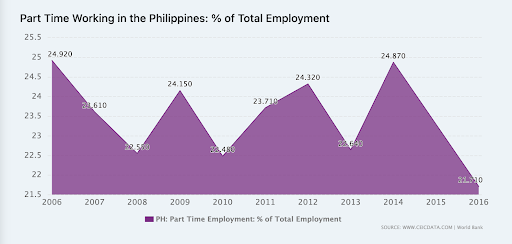
According to CEIC, around 22% of Philippinos work in part time jobs.

Philippinos part time jobs

Remote Working in Philippines

Remote working has seen significant growth in the Philippines, especially since the onset of the COVID-19 pandemic. According to a survey, 28% of Filipinos prefer remote work whereas 46% prefer a hybrid working model.

The Telecommuting Act of 2019 officially recognized remote work as an alternative work arrangement in the private sector. This law ensures that remote workers receive the same benefits and protection as on-site employees.

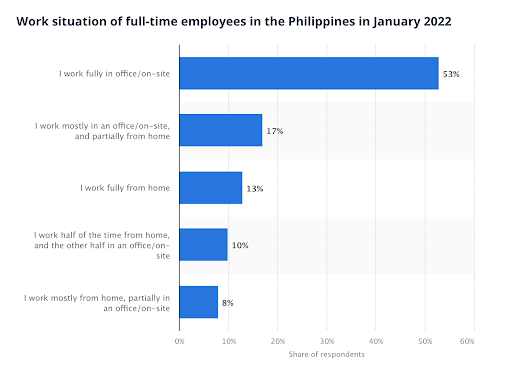
A Statista survey reported that in January 2022, 13 percent of Philippine workers were working fully from home.

Philippine workers stats