
Hiring your first employee in another country is mostly a paperwork problem. The work itself travels fine. The employment contract, the payroll filings, the statutory benefits, notice periods and termination rules do not.
An employer of record solves that by legally employing the person on your behalf. You still direct their day to day work. The provider owns the local contract, the payroll and the compliance risk.
This guide compares seven EOR providers on the two things most comparisons skip: what they actually charge, and how much of their coverage runs through entities they own rather than partners. Every figure came from the provider's own site on 21 August 2026. We also asked what nobody else in this category asks: whether any of them can put a person on a four day week.
What is an employer of record?
An employer of record is a third party company that legally employs your worker in a country where you have no entity of your own. You call the shots on the work. The provider handles the local contract, payroll, statutory deductions, required benefits and the compliance around them.
It is a shortcut around registering a subsidiary and building local HR infrastructure from scratch. Using one usually makes sense in two situations: you are testing a new market, or you need one or two people on the ground and an entity would be overkill.
Two distinctions matter before you read the table. An EOR is not a PEO: a PEO co-employs staff where you already have an entity, an EOR employs them where you do not. And a provider that covers 180 countries is not necessarily running 180 of its own. Most operate a mix of owned entities and local partners, and the ratio is worth asking about.
How we compared these EOR providers




Hiring for a 4-day week?
List your roles on 4dayweek.io and reach candidates who want a better balance.
Get started freeWe pulled every figure from each provider's own product and pricing pages on 21 August 2026, and screenshotted each so you can see the claim in context. Where a provider publishes a price, we quote it. Where it does not, we say so rather than estimating.
Three things we looked for:
- Published pricing. A provider that shows a number before the sales call is easier to budget against.
- Owned entities versus partners. An owned entity means one legal chain and one accountable party. A partner network can work well, but you should know which you are buying.
- Reduced hours support. Whether the provider says anything about part time or four day week contracts.
We have not run payroll through all seven. This is a documentation and pricing comparison rather than a hands on review, and we would rather say so plainly.
EOR providers compared at a glance
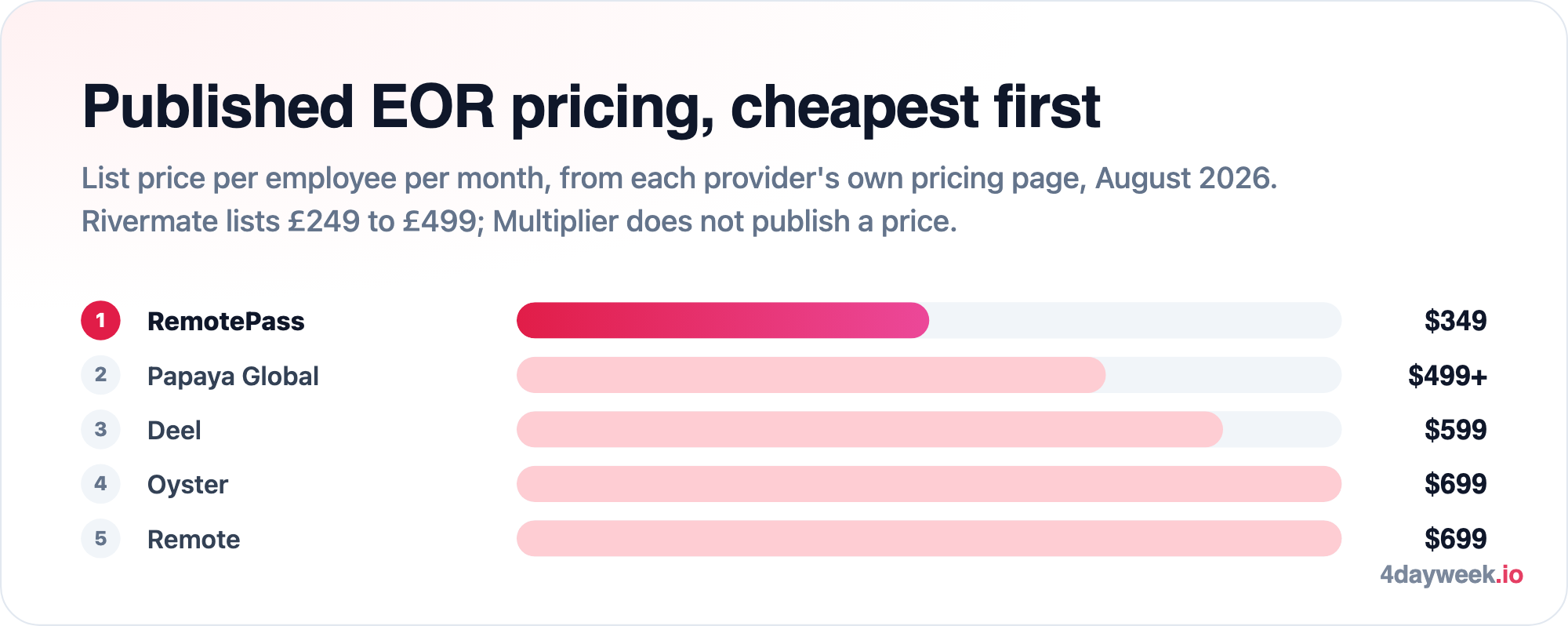 Prices below are each provider's own list price per employee per month. They sit on top of salary and statutory employer costs, usually the larger number.
| Provider | EOR countries | Owned entities | Published EOR price | Contractors too |
|---|---|---|---|---|
| Deel | 150+ | 130+ | $599 | Yes, from $49 |
| Remote | 90+ | 100% owned | $699 | Yes, from $29 |
| Papaya Global | 180+ | Not stated | From $499 | Yes, from $199 |
| RemotePass | 150+ | Not stated | $349 | Yes, from $39 |
| Oyster | 120+ | Not stated | $699 | Yes |
| Multiplier | 150+ | Owned, count not stated | Not published | Yes |
The spread is wide. RemotePass lists $349 and both Remote and Oyster list $699, so the same hire can cost twice as much in platform fees depending on who signs the contract.
1. Deel
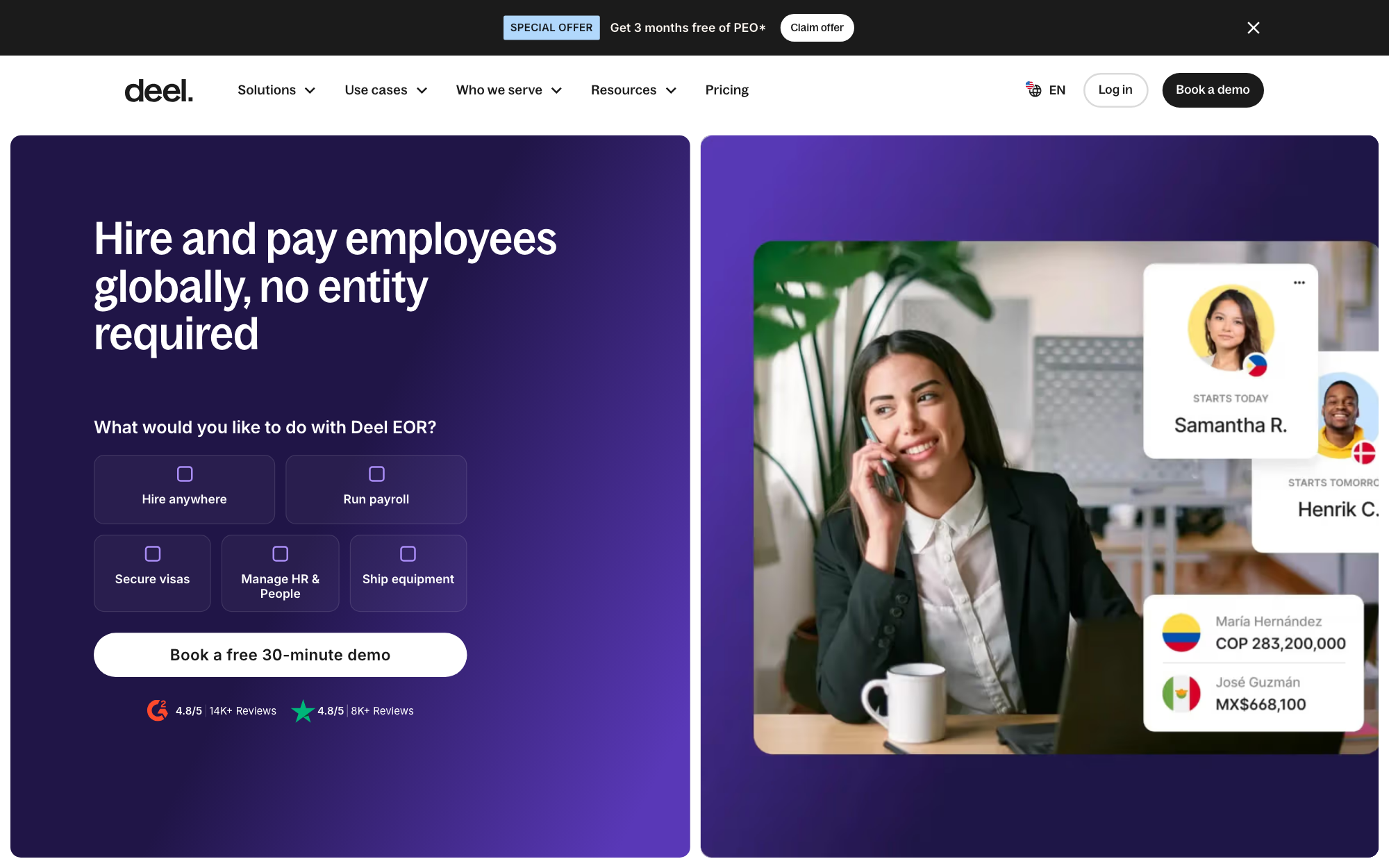 Deel pairs EOR with payroll, contractor management, onboarding and a wider set of HR tools. Its EOR page claims compliance coverage across 150 plus countries and says Deel owns entities and its payroll engine in 130 plus of them, the highest disclosed owned entity count here. Pricing is published at $599 per EOR employee per month, with contractor management from $49 and contractor of record at $325.
Deel also reports more than 40,000 customers and over $20 billion in payroll processed. If your footprint is likely to grow, breadth is the argument. Confirm what the quoted price includes, because benefits administration and country specific extras tend to surface later.
2. Remote
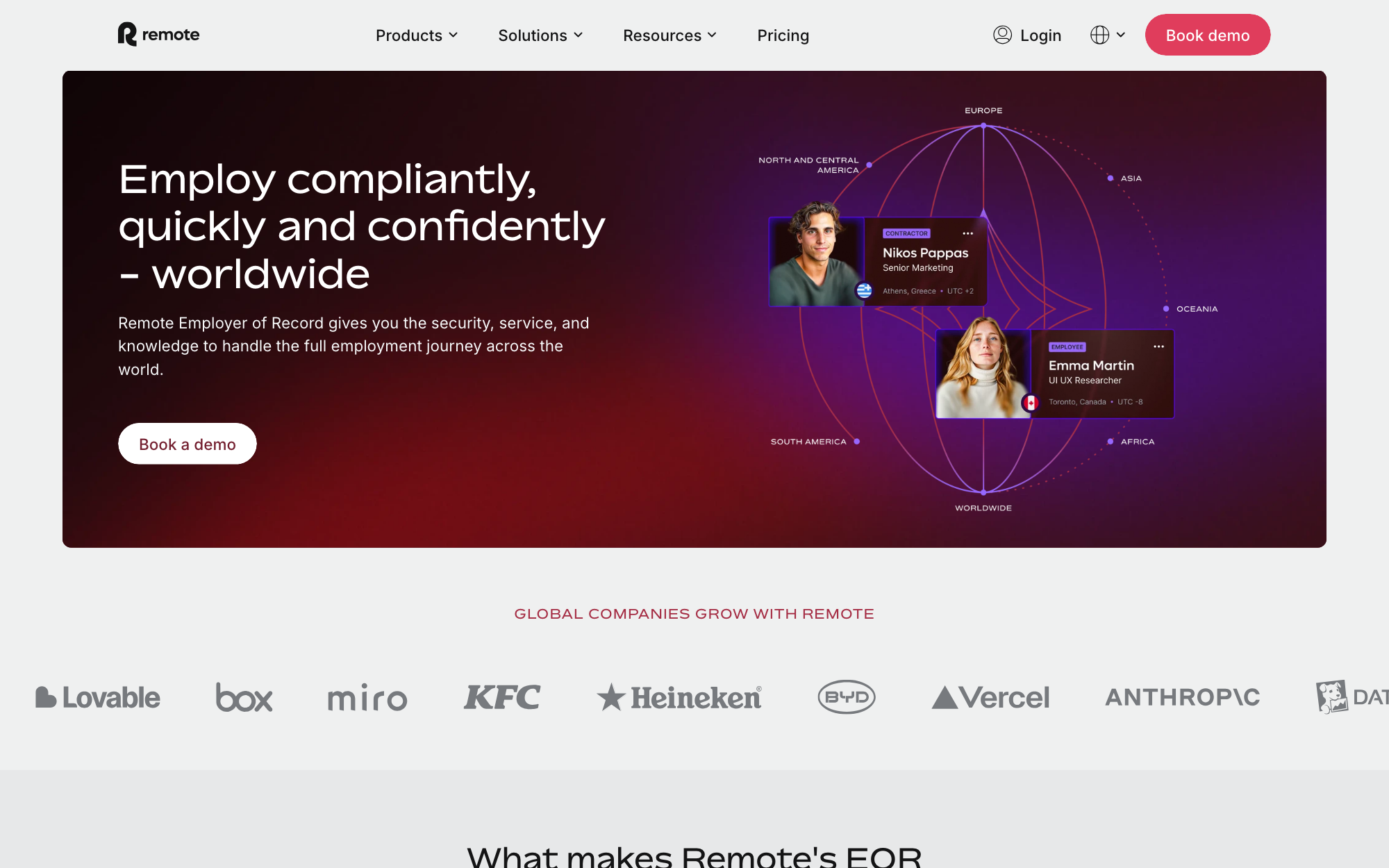 Remote covers 90 plus countries, the narrowest footprint here, and makes a deliberate feature of that: it says it owns and operates 100% of its entities with no handoffs to third parties. For a small number of target countries, that single accountable chain is worth more than a larger map.
Pricing is published at $699 per employee per month, with payroll and contractor management from $29. The service includes onboarding, local payroll, compliance support, benefits and dedicated help when things get complicated. Check country availability first: a country Remote does not cover is a hard stop, not a negotiation.
3. Papaya Global
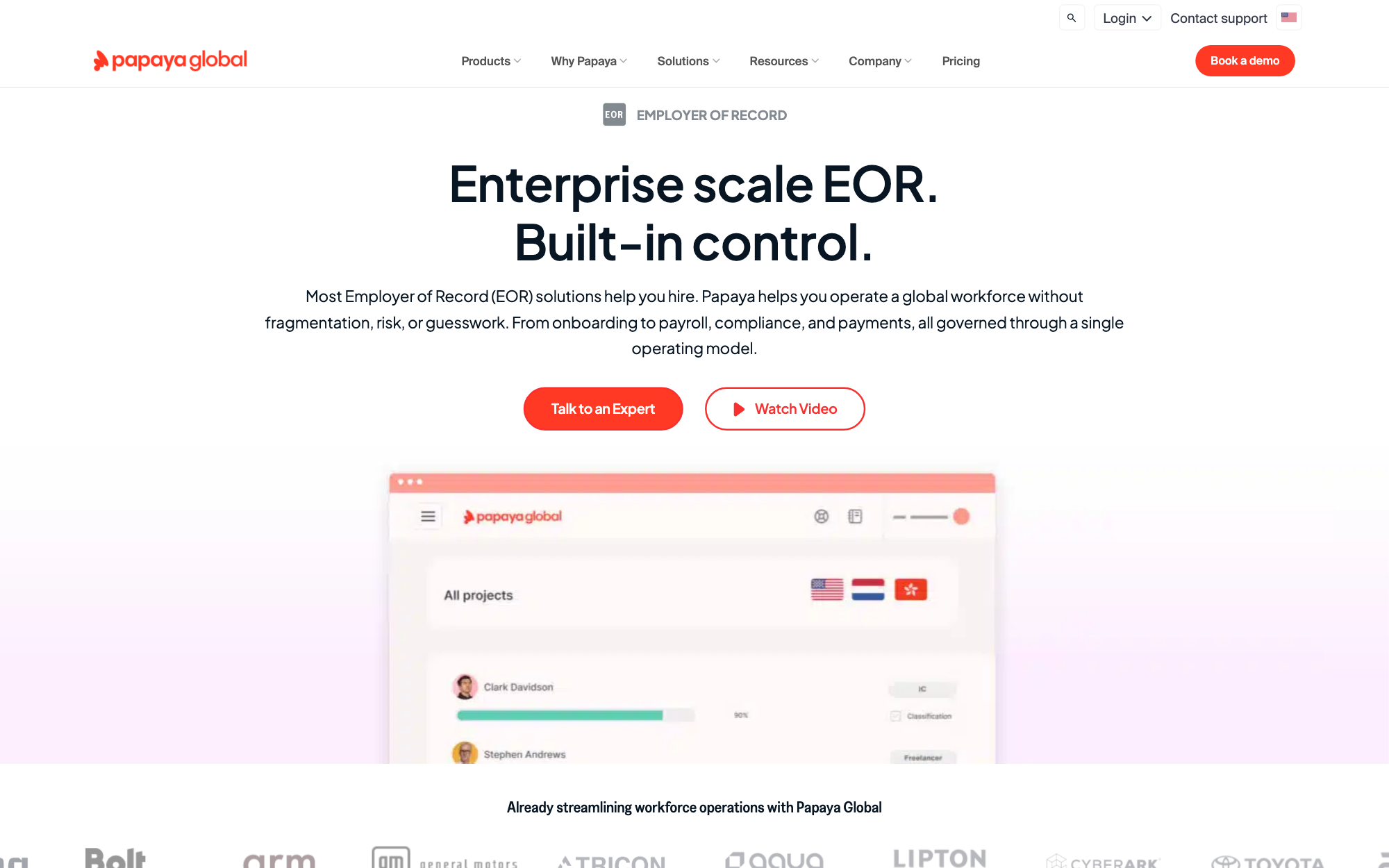 Papaya Global pairs EOR with global payroll and workforce management, which suits companies running people across many countries at once. Its EOR page claims 180 plus countries supported, 20 plus years of in country expertise and 24/6 human support. EOR pricing starts at $499 per employee per month, with contractor of record from $199.
The pitch is centralised financial visibility rather than raw country count, which matters most to finance teams tracking headcount and liabilities across several jurisdictions. Check reporting, implementation time and how it fits the systems you already run.
4. RemotePass
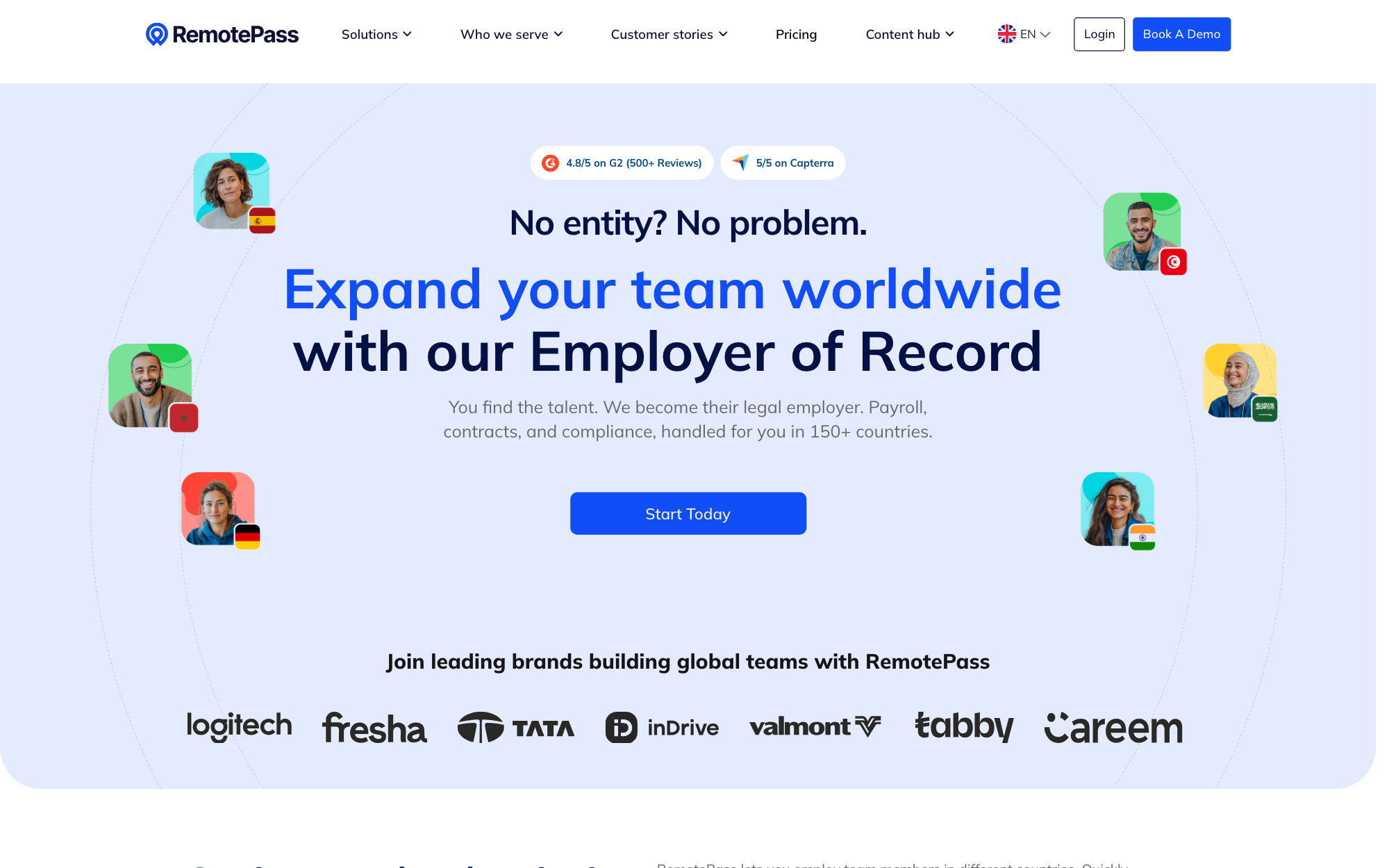 RemotePass offers EOR in more than 150 countries with no entity required on your side, and posts the cheapest published price here at $349 per employee per month. Its tools cover onboarding, locally compliant contracts, payroll, benefits, expenses and time off.
It also handles contractors at $39 per month, contractor of record at $299 and local payroll at $15, which helps if your workforce mixes employment types. That combination suits smaller teams needing employees and contractors under one roof without enterprise fees for both.
5. Oyster
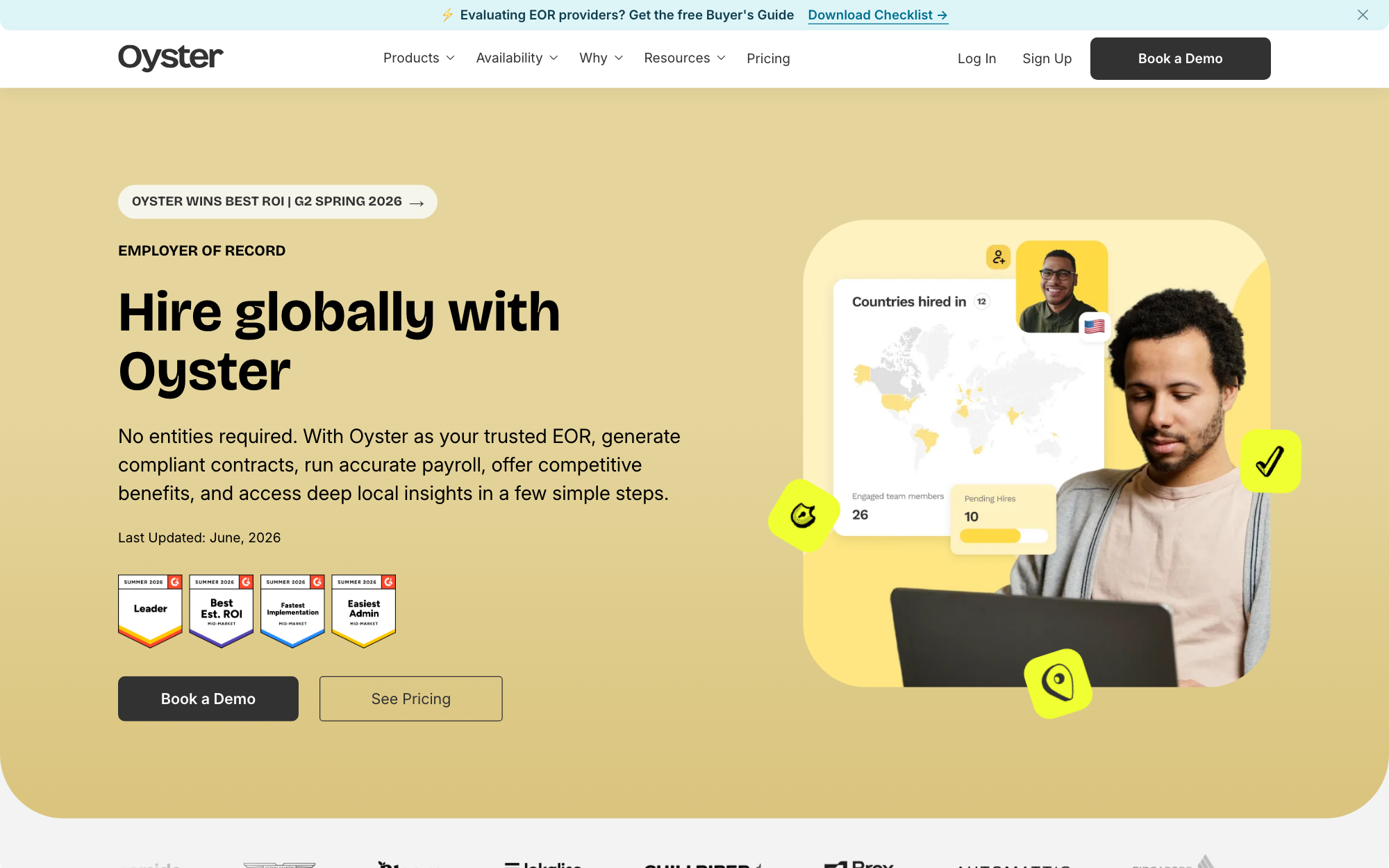 Oyster supports 120 plus countries and publishes $699 per employee per month directly on its pricing page. The service covers compliant contracts, payroll, benefits, onboarding and local guidance, and is a common pick for remote first teams. Oyster is a certified B Corp and cites liability cover exceeding $8 million.
Its pricing page makes the point that statutory costs and lifecycle charges deserve consideration alongside the base fee, which is a fair framing to carry into any vendor conversation.
6. Multiplier
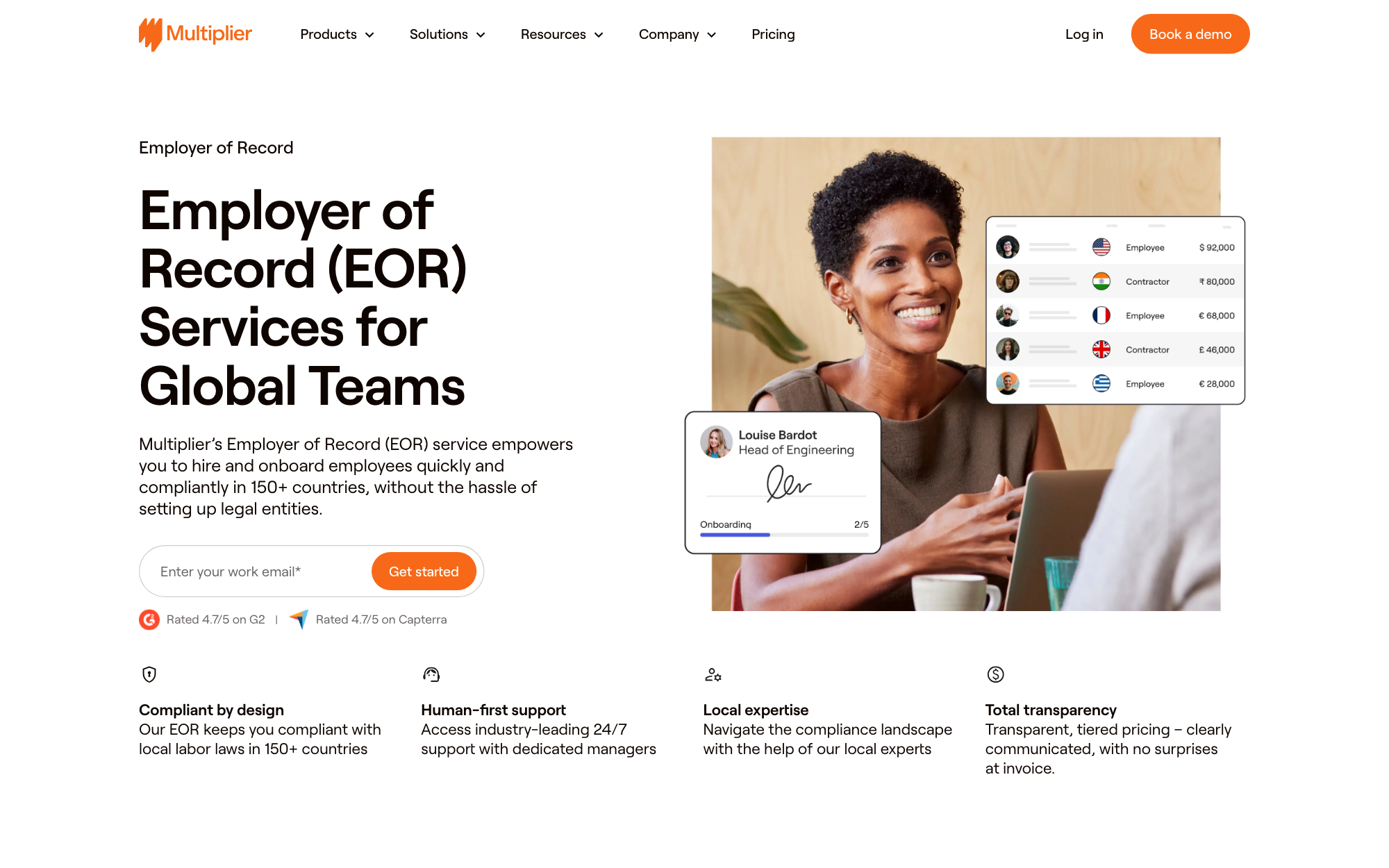 Multiplier delivers EOR across 150 plus countries and says it operates through owned legal entities with no third party partner dependency. Hiring, onboarding, payroll, benefits and local compliance are covered, with contractor management and global payroll alongside.
It is the one provider here that does not publish an EOR price, describing its model as transparent tiered pricing and routing you to a quote. Its own buying guide notes that mid market providers typically charge $300 to $600 per employee per month, and warns that some add onboarding, offboarding and benefits surcharges on top. That warning comes from inside the category and applies to every name on this list.
Can an EOR employ someone on a 4-day week?
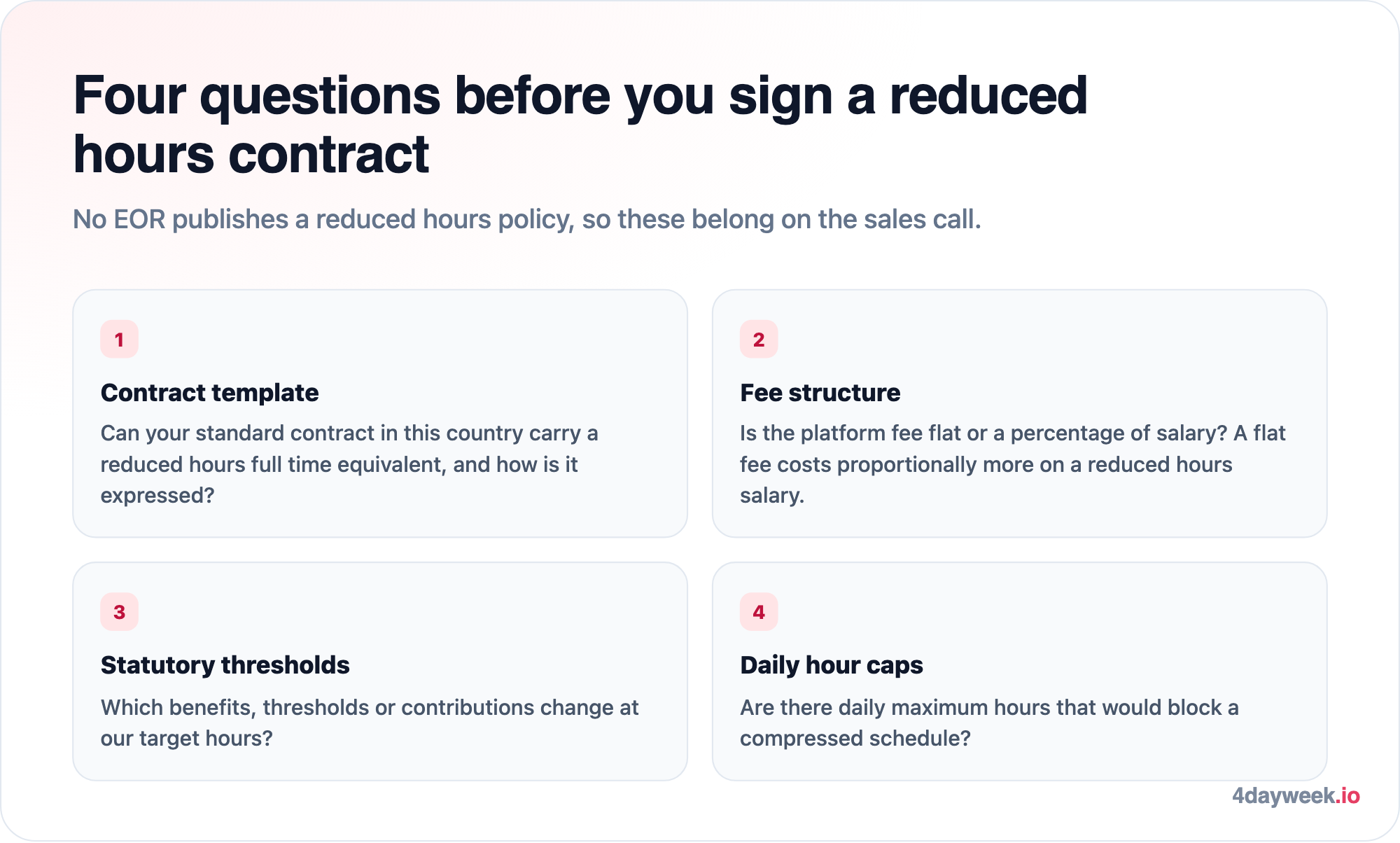 In most countries yes, but none of the seven publishes a policy on it, so you have to ask.
The question is harder than it sounds. A four day week at full pay is a reduced hours contract: the employee works roughly 32 to 36 hours and keeps their full salary. A compressed week is the same 40 hours pushed into four longer days. Those are different contracts. Reduced hours changes the contracted hours figure in the local agreement, which can touch statutory benefit thresholds, pension contributions and holiday accrual. Compressed hours usually changes only the pattern, though some countries cap daily hours in a way that makes a ten hour day unlawful.
An employer of record has to model whichever you choose in the local contract, and the answer varies by country rather than being a platform wide yes or no.
Four questions to put to any provider before you sign:
- Can your standard contract in this country carry a reduced hours full time equivalent, and how is it expressed?
- Is your platform fee flat or a percentage of salary? A flat fee is proportionally more expensive on a reduced hours salary.
- Which statutory benefits, thresholds or contributions change at our target hours?
- Are there daily maximum hours that would block a compressed schedule?
The Netherlands is the gentlest place to start. Eurostat put the Dutch part time rate at 38.6% of employed people in 2024 against an EU average of 17.1%, the highest in the union. Dutch law is built around that: the Flexible Working Act gives employees with at least 26 weeks of service the right to request a change to their hours, which an employer may refuse only on compelling business grounds. Local templates and payroll systems treat reduced hours as routine.
If a shorter week is already your policy at home, our 4 day work week guide covers the definitions, and managing distributed teams covers running one across time zones.
How to Choose the Right EOR Service?
The best EOR isn't the one with the biggest country count plastered across its homepage. It's the one that fits the hiring plan you actually have.
Start with coverage in the specific countries you're targeting. From there, look at compliance support for contracts, taxes, leave, and termination rules. Review payroll and benefits next, then stack up onboarding, pricing, and customer support against one another. It's also worth asking about entity ownership, integrations, data security, and what the exit process actually looks like if you ever need one.
When should a business consider an EOR?
An EOR earns its fee when you are hiring your first employee in a new country, testing a market, or building a distributed team without registering a foreign entity yet. It also lifts a lot of HR load around local payroll and employment rules.
It is not always the right call. If you expect steady, high volume hiring in one country for years, your own entity usually becomes cheaper per head, and the crossover arrives sooner than most people expect. Run that comparison before you scale. Retention economics belong in the same spreadsheet, and the true cost of replacing employees is a good place to start.
Frequently asked questions
How much does an employer of record cost?
Published list prices here run from $349 per employee per month at RemotePass to $699 at Remote and Oyster, as of August 2026. Multiplier does not publish a price. Those fees sit on top of salary and statutory employer costs, which are usually the larger figure.
What is the difference between an EOR and a PEO?
An EOR legally employs your worker in a country where you have no entity. A PEO co-employs staff where you already have one. If you have no local entity and do not want to register one, an EOR is the model you need.
Can an EOR hire someone part time or on a four day week?
In most countries yes, because reduced hours contracts are ordinary local employment. None of the seven publishes a reduced hours policy, so confirm country by country before signing, and check whether the platform fee is flat or salary linked.
An employer of record can put someone on your payroll almost anywhere. What their week actually looks like is still your decision.
Hiring for a 4-day week?
List your roles on 4dayweek.io and reach candidates who want a better balance.
Get started free