Vacation Policy in Lithuania
Lithuania offers a comprehensive vacation policy to ensure that employees have sufficient time to rest and recuperate. Below are the key details:
-
20 Days: Minimum paid vacation for regular full-time workers.
-
24 Days: For those working six days per week.
-
3 Extra Days: Awarded after 10 years of service with the same employer.
-
1 Extra Day: For every additional five years of service with the same employer.
Additional Vacation Entitlements
-
35 Days: Available for disabled workers, single parents with children under 14, and employees under 18 years of age.
-
41 Days: For workers under hazardous conditions or those facing significant mental and emotional stress.
Leave for Parents
Public Holidays
In addition to annual leave, Lithuania observes 16 public holidays each year. If a public holiday falls on a weekend, it is generally not carried over to the following weekday. The observed public holidays include:
-
New Year’s Holiday (January 1)
-
Day of Restoration of the State of Lithuania (February 16)
-
Day of Restoration of Independence of Lithuania (March 11)
-
Easter (March 31)
-
Easter Monday (April 1)
-
Labor Day (May 1)
-
Mother’s Day (First Sunday in May, May 5)
-
Father’s Day (First Sunday in June, June 2)
-
St. John’s Day (June 24)
-
Statehood Day (July 6)
-
Assumption Day (August 15)
-
All Saints’ Day (November 1)
-
All Souls’ Day (November 2)
-
Christmas (December 24, 25 & 26)
Overtime in Lithuania
In Lithuania, overtime work is regulated by the Labor Code and is subject to strict guidelines to protect employees' rights. The standard working week is 40 hours, spread over five days, with any work beyond these hours considered overtime.
Overtime Rules and Compensation
-
Maximum overtime: Employees are allowed to work up to 8 hours of overtime per week, with a maximum of 180 hours per year. However, with the employee's written consent, the weekly overtime can be extended up to 12 hours.
-
Overtime pay rate: Overtime is compensated at a rate of 1.5 times the employee's regular hourly wage. If the overtime occurs at night (between 10:00 pm and 6:00 am) or on public holidays, the rate increases to 2.5 times the regular pay.
-
Unauthorized overtime: Even if overtime work was not pre-approved, employers are typically still required to compensate for it if they were aware the work was being performed and did not take action to stop it.
Part-time Working in Lithuania
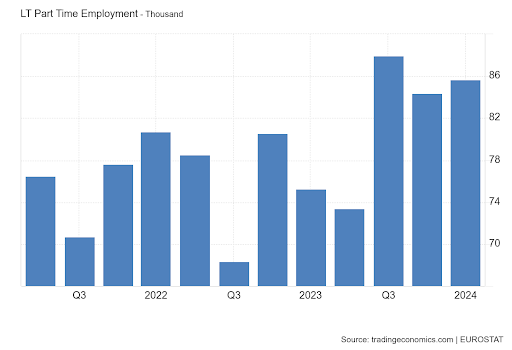
Part-time employment in Lithuania is more common among women, students, and older workers. Lithuanian labor laws ensure that part-time employees receive proportional benefits, including vacation, sick leave, and social security contributions, similar to their full-time counterparts.
As of the first quarter of 2024, part-time employment in Lithuania increased to 85.70 thousand from 84.40 thousand in the fourth quarter of 2023.
Remote Working in Lithuania
Lithuania has rapidly become one of the top destinations for remote work, ranking 8th globally in 2023, according to a study by NordLayer. This high ranking is attributed to the country's strong cybersecurity infrastructure, robust digital and physical infrastructure, and supportive economic and social conditions.
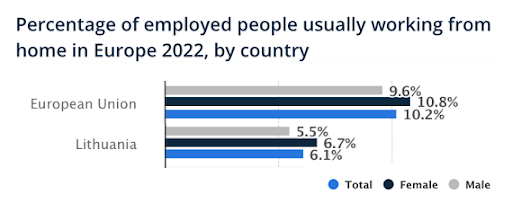
Despite the excellent infrastructure, fewer people work remotely when compared to the European average in Lithuania:
The Lithuanian capital, Vilnius, is particularly popular among digital nomads due to its modern amenities, affordable cost of living, and welcoming atmosphere for remote workers.
Key Highlights
-
Legal framework: The Lithuanian Labor Code defines remote work as any work conducted outside the traditional workplace using information technology. Employees have the right to request remote work, and employers can only refuse if it causes unreasonable expenses. Certain groups, such as pregnant employees or parents with young children, have the right to work remotely for at least 20% of their total working time.
-
Infrastructure and support: Lithuania excels in providing the necessary infrastructure for remote work. It ranks highly in cybersecurity (2nd globally) and internet access, ensuring that remote workers can operate securely and efficiently. The government also supports remote work by allowing flexible work arrangements and protecting workers' rights to request remote work.