Vacation Policy in Finland
In Finland, employees are entitled to 2.5 days of paid vacation per month after a full year of employment, totaling 5 full weeks of paid vacation annually (or 25 days).
This vacation is typically divided into 4 weeks of summer vacation and 1 week of winter vacation.
Here are some more details about Finland's leave policies:
-
Sick leave: Employees in Finland can take up to 9 working days of paid sick leave per year. After these 9 days, the government covers the sick leave pay, with a total coverage of up to 300 days.
-
Pregnancy leave: The duration of pregnancy leave is 40 working days, usually starting 30 weekdays before the estimated delivery date.
-
Parental leave: Parents are entitled to a total of 320 working days of parental leave, which is roughly 14 months. This leave is divided equally, with each parent eligible for 160 working days (around 7 months).
-
Childcare Sick Leave: Employees who are parents are entitled to up to 4 days of childcare sick leave per year.
Public Holidays in Finland
There are 15 national public holidays in Finland.
-
New Year’s Day (January 1)
-
Epiphany (January 6)
-
Good Friday (March 29)
-
Easter Sunday (March 31)
-
Easter Monday (April 1)
-
Labor Day (May 1)
-
Ascension Day (May 9)
-
Whit Sunday (May 19)
-
Midsummer Eve (June 21)
-
Midsummer Day (June 22)
-
All Saints’ Day (November 2)
-
Independence Day (December 6)
-
Christmas Eve (December 24)
-
Christmas Day (December 25)
-
St. Stephen’s Day (December 26)
Overtime in Finland
Overtime work in Finland is strictly regulated to ensure fair compensation and to protect workers' rights and it can only be performed with the explicit consent of the employee.
The total working hours, including overtime, must not exceed an average of 48 hours per week over a four-month period. This regulation is designed to prevent employee burnout and ensure a healthy work-life balance.
Compensation for Overtime
-
Increased pay: Overtime work is compensated at a higher rate than regular hours. The first two hours of daily overtime are paid at a 50% increase over the regular wage, while any additional hours are compensated at double the regular pay (100% increase). For weekly overtime, a 50% increase is applied.
-
Alternative compensation: Instead of higher pay, employers and employees may agree to compensate overtime with time off, but this must comply with regulations set out in the Working Hours Act.
Part-time Working in Finland
In Finland, part-time work is generally defined as working fewer hours than the standard full-time schedule, which is typically 8 hours a day or 40 hours a week.
Finnish labor laws ensure that part-time workers are entitled to the same rights and benefits as full-time employees on a pro-rata basis. This includes entitlements such as holiday pay, sick leave, and access to training and career development opportunities.
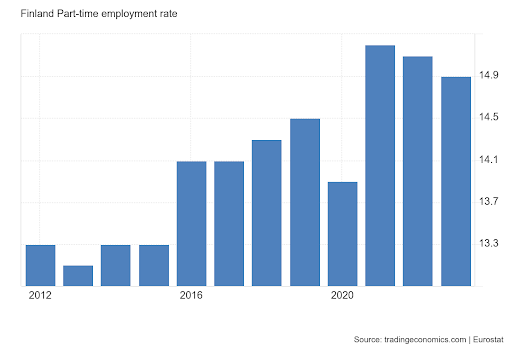
According to EUROSTAT data, Finland's part-time employment rate stood at 14.90% as of December 2023.
Remote Working in Finland
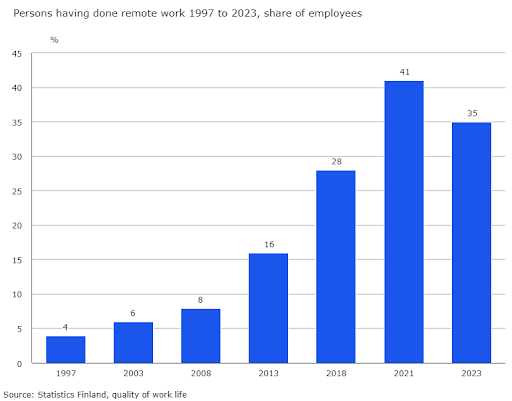
Remote working in Finland has seen significant adoption, especially following the COVID-19 pandemic, but it was already well-established even before then. In 2022, Finland ranked fifth in Europe for the proportion of workers engaging in remote work.
Finnish employment law does not specifically define remote work, but standard employment regulations apply to it. Remote work arrangements are based on mutual agreement between employer and employee, with no inherent right for employees to demand it, nor can employers enforce it without exceptional circumstances.
In 2023, remote work continued to be widespread, with 35% of wage and salary earners in Finland working remotely, according to Statistics Finland's Quality of Work Life Survey. This high rate of remote work reflects the country’s strong integration of flexible working arrangements into its labor market.