
No, you do not need a degree to become a software engineer. Today’s tech industry increasingly values practical skills, hands-on experience, and real-world project work over traditional academic credentials.
The Apple CEO said:
"I don't think a four-year degree is necessary to be proficient at coding"
While a degree in software engineering can certainly open doors and offer structured learning, many successful software engineers, like the co-founder of GitHub, have built their careers through boot camps, online courses, and self-taught methods.
Nowadays, employers are hiring based on job-ready skills, relevant experience, and technical proficiency, not just degrees.
Can You Become a Software Engineer Without a Degree?
Yes, a career in software engineering is now accessible through multiple routes, including non-traditional education paths. While some roles still list a college degree as a preference or requirement, many others evaluate applicants based on their technical skills, soft skills, and ability to solve real-world problems.
A Hired report found that 45% of software engineers have a CS degree, 24% are self-taught, and 10% come from bootcamps.
“Candidates are becoming more focused on obtaining the skills they need to do their jobs rather than pursuing the traditional credentials such as certain degrees,” the Hired report said.
The shift in the job market has opened doors for candidates who can demonstrate practical, hands-on experience without a degree.
How Much Does a Software Engineer Earn Without a Degree?
According to a survey of 3,043 bootcamp graduates, the average starting salary was $70,000, placing it close to the $84,180 average for entry-level software engineers.
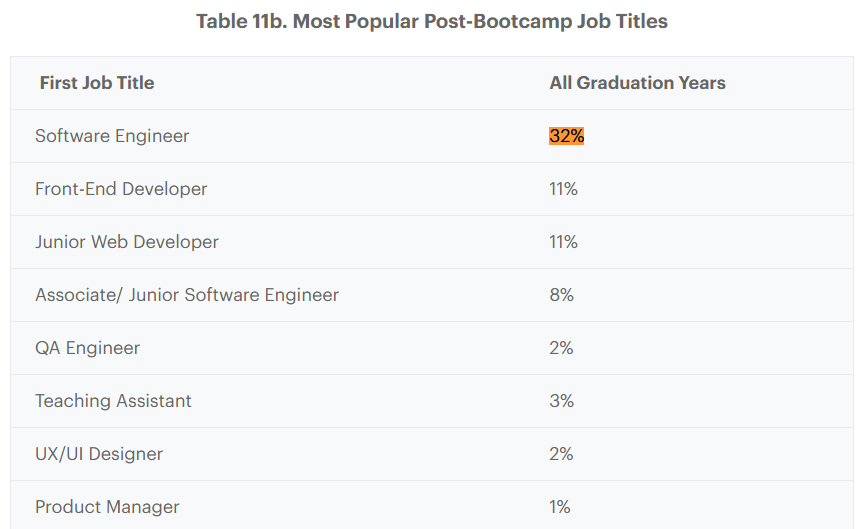
Notably, the most common job title among bootcamp graduates is Software Engineer, with 32% of respondents listing it as their first role after graduation.
P.S. If you want to land your first job, check out these flexible software engineering roles, they’re perfect for bootcamp grads and self-taught coders.
Key Benefits of Becoming a Software Engineer Without a Degree
A 2021 Switchup study shows coding bootcamp grads are hired at the Big Five companies at nearly the same rate as traditional CS graduates. At Code Fellows, 11.15% of alumni are employed by these top firms, with Hackbright Academy and Hack Reactor also showing strong placement rates.
Best of all, bootcamps cost just about 10% of what a college degree does, with only a 0.57% difference in employment outcomes.
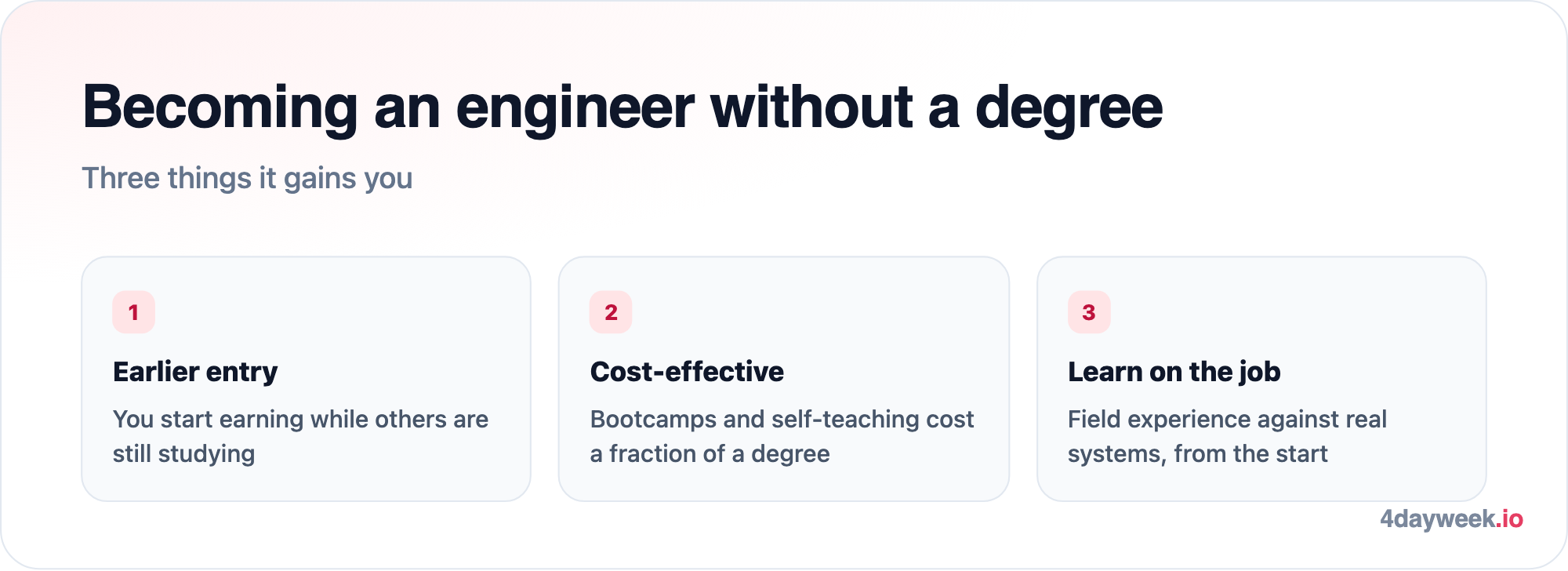
1. Earlier Entry Into the Workforce
While a bachelor’s degree takes around 4 years (or 208 weeks), most coding bootcamps only take about 15.1 weeks on average. That means you can start working and earning, a full three years earlier than someone following the college route.
Many bootcamp grads land jobs within 3 to 6 months of finishing their course, often earning starting salaries of around $75,000.
2. Cost-Effective Options
A four-year college degree in computer science can cost at least $35,000, while software engineering bootcamps or certificate programs typically range between $10,000 and $20,000, sometimes even less.
Some individual courses start at just $795. Bootcamps and online learning platforms, both free and paid, offer a more affordable path, helping you build your skills without incurring massive student debt.
3. Ability to Learn Through Field Experience
One of the most significant advantages of boot camps or self-taught paths is the hands-on learning experience. In fact, around 80% of bootcamp graduates report that their jobs directly require the technical skills they acquired during their bootcamp experience.
Instead of sitting through lectures, you build real apps, contribute to open-source projects, or create final capstone projects that show off your skills. Employers love this kind of experience; it demonstrates your ability to solve problems and accomplish tasks.
Top Jobs for Software Engineers Without a Degree
Some typical software engineering roles that value practical experience over formal education are:
-
Web Developer (Front-End or Back-End)
-
Full-Stack Developer
-
Mobile App Developer
-
DevOps Engineer
-
QA Analyst / Tester
-
UI/UX Designer
-
Technical Support Specialist
-
Data Analyst
-
Product Manager
These roles require a strong foundation in programming skills, a solid grasp of the Software Development Life Cycle, and often knowledge of tools such as Git, Docker, and cloud services like AWS.
How to Become a Software Engineer Without a Degree?
Want to become a software engineer without a degree? With coding boot camps and self-learning, many individuals land full-time roles quickly.
According to Course Report, 79% of coding bootcamp graduates secure full-time jobs, usually within 1 to 6 months after completing the program.
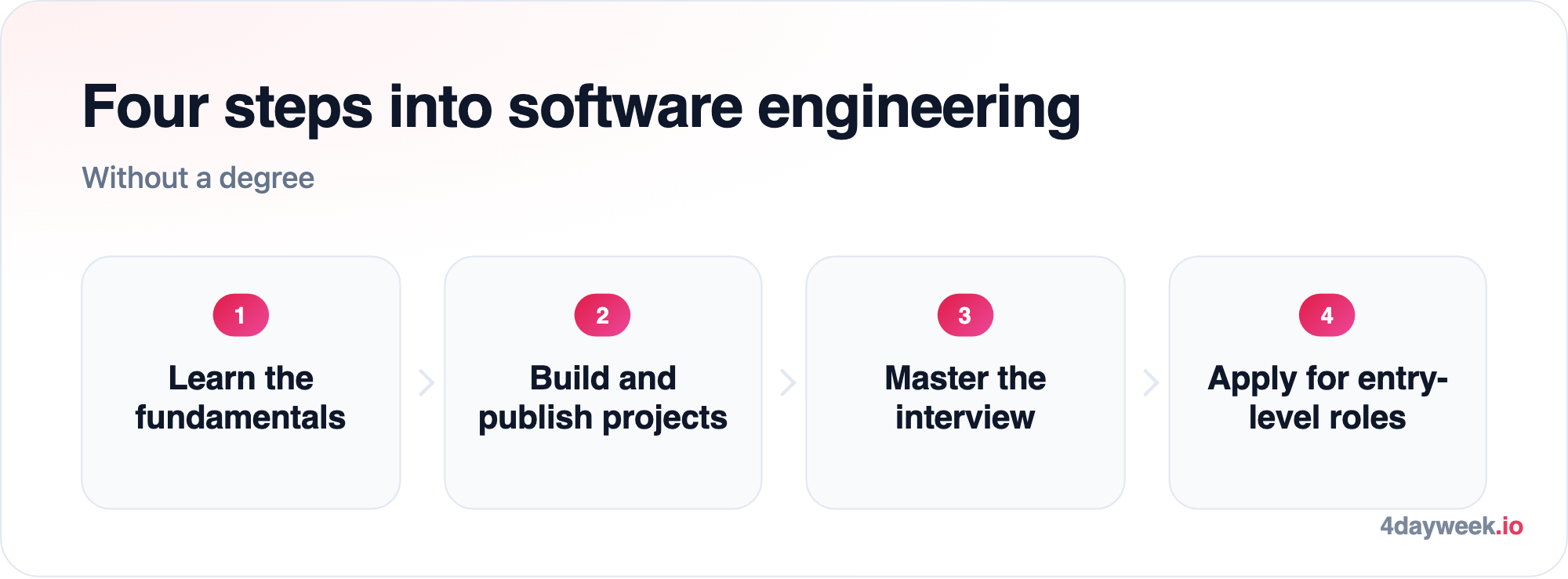
Step 1: Learn Core Programming and Software Engineering Fundamentals
Begin by focusing on the essential technical skills that every software engineer must possess, regardless of their background. Instead of going for a computer science degree, you can take online courses, join a bootcamp, or even self-study.
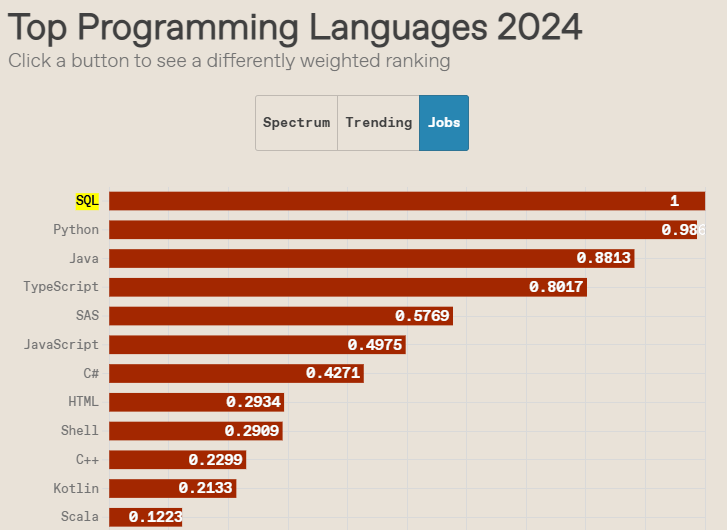
Based on the IEEE ranking, SQL holds the #1 position with a perfect score of 1.0. This makes it the most in-demand language for software engineering job opportunities.
You should begin with:
-
Basic Programming languages: Start with Python (great for beginners), JavaScript (key for front-end and full-stack roles), and later add SQL, Java or C++ (used in backend systems and enterprise applications).
-
Core software engineering principles: Object-Oriented Programming, test-driven development (TDD), and Agile methodology.
Tools of the trade:
-
Git & GitHub (for version control)
-
VSCode (industry-favourite code editor)
-
Docker (to containerize apps)
-
Linux CLI (to navigate server environments)
-
Postman (for API testing)
-
Computer science concepts: data structures, algorithms, system design, and databases (SQL and NoSQL)
Start with Harvard’s CS50 (free on edX) or The Odin Project to get a taste of real-world software engineering concepts like client-server architecture and REST APIs.
Step 2: Build Software Projects and Upload to GitHub
One of the best ways to demonstrate your skills to employers is through a GitHub portfolio featuring hands-on projects.
Recruiters increasingly trust GitHub activity over coding interviews. In a survey of 500 tech hiring managers conducted in Q1 2025, 78% said GitHub contribution analysis was more predictive of job performance than traditional algorithm-based interviews.
Focus on building:
-
End-to-end web applications using Node.js or Django
-
API-based services that solve real problems (e.g., a job aggregator or budget tracker)
4-Day Week Engineering Jobs
Save one to come back to it — it's free.



-
Tools for developers, like a custom CLI app, linter, or productivity extension
-
Contributions to open-source projects, this shows collaboration and real-world experience
Include README files, proper commit messages, and precise documentation. Employers look at GitHub not only for code quality, but also for engineering habits such as testing and version control.
Step 3: Master the Software Engineering Interview Process
Software engineer interviews are about engineering thinking, collaboration, and system knowledge.
You’ll need to prepare for:
-
Data structures & algorithms (arrays, trees, hash maps)
-
System design questions (e.g., how would you design Instagram?)
-
Technical assessments (platforms like CodeSignal or HackerRank)
-
Behavioural interviews (expect questions on teamwork, deadlines, and debugging under pressure)
Use these platforms:
-
LeetCode: especially good for FAANG-style interviews
-
Exercism or InterviewCake for concept-based learning
-
Tech mock interview platforms like Pramp or Interviewing.io
Step 4: Apply for Entry-Level Software Engineering Jobs
Don’t wait to be “perfect.” Apply once you’ve got 1–2 solid projects, a functional GitHub, and some basic interview prep under your belt.
Focus on roles like:
-
Junior Software Engineer
-
Backend Developer Intern
-
QA Automation Engineer
-
Technical Support Engineer with coding tasks
Target startups or mid-sized companies where practical skills matter more than credentials. Use niche job boards like:
P.S. Struggling to write a cover letter for your 1st software engineering job? Try https://4dayweek.jobcopilot.com/login?r=/cover-letter-builder our free cover letter builder to craft one that highlights your top skills.
Final Thoughts
To sum up, a career in software engineering is one of the most rewarding career choices today, and it’s no longer limited to college graduates with a science degree.
By focusing on basic knowledge, building practical experience, and showcasing your abilities through a strong portfolio, you can impress any potential employer and land high-quality software engineering jobs without a degree.
Want to work from the comfort of your home? Check out our job board for remote software engineering jobs that welcome skills over credentials.
FAQ’s
Should I get a degree to be a software engineer?
**A degree can help, but it isn’t always necessary. If you prefer a structured learning experience and want access to internships, attending college may be a good path. But if you’re motivated, bootcamps and self-study can get you job-ready faster and for less money, especially in today’s skills-first job market.
What is required to become a software engineer?
To become a software engineer, you need strong programming skills, a solid understanding of software development principles, and hands-on project experience. Tools such as Git, databases, and cloud platforms are essential. A portfolio of real projects on GitHub helps prove your readiness to employers.
How long does it take to become a software engineer without a degree?
It typically takes 3 to 12 months to become job-ready through coding bootcamps or focused self-learning. Most full-time boot camps last around 15 weeks, while self-taught learners may take longer, depending on their pace and prior experience. With consistent effort, many secure jobs within 6 months of completing their training.
Is a coding bootcamp enough to get a job in software engineering?
Yes, a coding bootcamp can be enough, especially when paired with real-world projects and a strong GitHub portfolio. According to Course Report, 79% of boot camp graduates land full-time roles. Employers seek practical skills, not just credentials, so hands-on experience and project-based learning are essential to success.




Get 4-day week jobs in your inbox
Create a free account to receive curated opportunities weekly.
Sign up for freeFree forever. No spam, unsubscribe anytime.