
Overview
4 Day Work Week in Japan
Japan does not officially have a 4 day work week, but a 2021 government report encouraged companies to consider offering a shorter workweek. This recommendation is part of a broader initiative to tackle labor shortages, declining birthrate and improve the well-being of workers.
Background
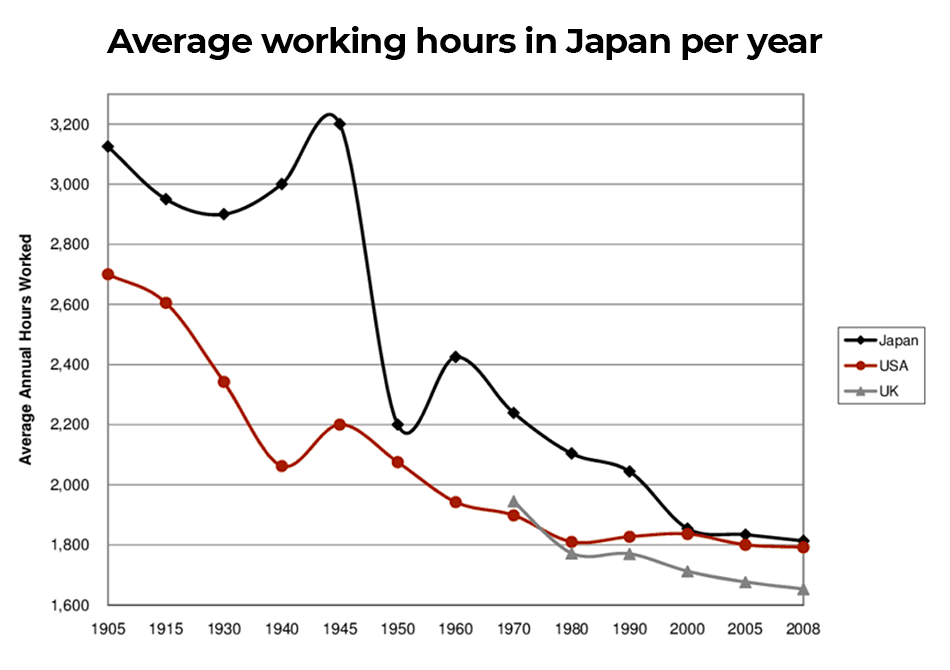
Historically, Japan has been known for its intense work culture, where long hours and the expectation to sacrifice for one's company are deeply embedded in society. This culture has also led to significant issues, such as "karoshi" — death from overwork. The country reports an average of 54 such fatalities a year, including heart attacks.
Another key factor driving Japan toward adopting a four-day workweek is its declining birth rate. Japan faces a shrinking working-age population, making it crucial to retain existing workers.
The birth rate has dropped to 1.26 births per woman in 2022, well below the replacement rate of 2.1 needed to sustain the population. As a result, the working-age population is projected to shrink by 40% by 2065, decreasing from 74 million to around 45 million.
In response, the Japanese government has been advocating for reforms to encourage a healthier approach to work.
The Government's Role
In 2021, Japan officially endorsed the idea of a four-day workweek as part of its economic policy to improve worker well-being. The Ministry of Health, Labor, and Welfare introduced the "hatarakikata kaikaku" or “innovating how we work” campaign, which seeks to:
- Encourage small and medium-sized companies to reduce working hours.
- Limit overtime.
- Offer flexible working arrangements.
- Guarantee paid annual leave.
Additionally, the Ministry of Health, Labor, and Welfare has started offering free consulting, grants, and a growing library of success stories to motivate businesses. Despite these efforts, only around 8% of companies have adopted a three-day-off policy per week.
Companies Leading the Way
Some major companies have already started experimenting with the four-day workweek, although adoption remains limited:
-
Fast Retailing Co.: Recently introduced a four-day workweek for some employees.
-
Panasonic: Despite offering the 4-day workweek option to 63,000 employees, only a small fraction (150 employees) have opted in.
-
Spelldata: A small Tokyo-based technology company offering a flexible schedule.
-
Shionogi & Co.: A pharmaceutical company implementing flexible work options.
-
Ricoh Co. and Hitachi: Electronics companies that have introduced a four-day workweek.
-
SMBC Nikko Securities Inc.: A brokerage firm allowing four-day workweeks since 2020.
-
Mizuho Financial Group: Offers a three-day schedule option for its employees.
Challenges to Adoption
Despite the potential benefits, there are several obstacles to the widespread implementation of a four-day workweek in Japan:
-
Cultural barriers: Many workers fear that a shorter week may be seen as a lack of commitment to their company or result in lower pay.
-
Workload concerns: Some employees worry that they will be expected to do the same amount of work in fewer days, leading to increased pressure.
-
Corporate mindset: Japan’s work culture has long prioritized long hours as a measure of dedication, making it difficult to shift to a new mindset.
For Japan to fully embrace the four-day workweek, a major cultural shift is necessary. The COVID-19 pandemic has already opened doors to flexible work arrangements.
However, deeply rooted traditions such as service overtime (unpaid work) and the pressure to conform to corporate norms remain significant hurdles.